




When speaking about the European Green Deal, one must think of two things: the fairy-tale part (greenery, joy, delight, drumming and dancing in natural meadows) and the practical part (how much this will cost me, a resident of Europe, and what I will or will not be able to afford). About the second – the practical, financial, everyday one – little is said, or it is spoken of only by those for whom it is important. How much and whether Latvian politicians are discussing this...
Since the 2018 Saeima elections, representatives of the political alliance “Attīstībai/Par!” have given the impression of being distinctly detached from practical life, blurring this with catchphrases and vague statements. Your previous work was with the Latvian Wood Construction Cluster, so you were close to wood, timber, and practice; does this use of empty phrases not bother you?
Well, that is quite a question... It is clear that politicians learn certain phrases. That is our job – at any moment one can be asked anything, and one must be able to answer. The first reaction tends to be phrased. As for the practical side, it varies among MPs. I cannot agree that we are detached from practical life, from business, but, of course, there is room for improvement.
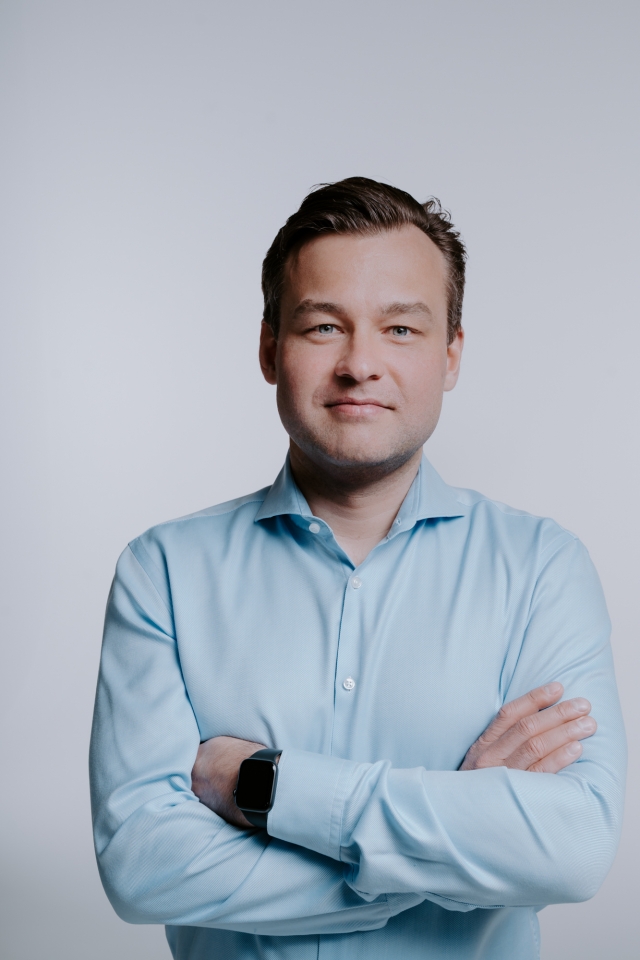
Continuing with the practical side: always and everywhere where it has been possible when meeting with entrepreneurs, I have repeated – we must talk, talk, and talk. An entrepreneur must come with their own opinion and vision, and what is more, “bring along” not only criticism but also a potential solution. As you correctly pointed out in the question, my work and life experience are very much related to the construction of wooden buildings. In 2011, the Latvian Wood Construction Cluster (in fact, an association) was established; before that, there was no such organization. The industry is well-known, uses local material – wood, and exports high value-added products, yet industry representatives did not have a unified opinion to defend their interests.
Continuing about the “detachment” of MPs from practical life, sometimes I see it, but I cannot agree that MPs would not listen to someone or not take an opinion into account. That is definitely not the case! Working in the Saeima, at every committee meeting, we listen to and, for the most part, take into account the proposals of the LDDK, the LTRK, and others.
When I was representing entrepreneurs while working at the cluster, I saw and felt very well that we are quick to criticize. A board meeting of the Latvian Wood Construction Cluster was unthinkable without criticizing the government, because it is a convenient and easy subject. To form a working group to solve a problem... That is already more complicated. For example, it is clear that we build too few wooden houses in Latvia; the volume should be increased. What to do? How to encourage it? How to achieve growth? A 10-point plan for further action is needed. You see, for such a plan to be created, a lot of effort had to be put in, much more than for critical talking! This is a joint learning process of democracy, and I think the situation is getting better every year.
“The entrepreneur must go and talk to the MP”. Shouldn't it be the other way around?
It can be the other way around; that also happens. From my own experience, I know that business organizations are always listened to. For example, I do not remember us in the Saeima Economic, Agricultural, Environmental and Regional Policy Committee deciding against any LTRK recommendation. Surely, it has happened sometimes... Of course, one can argue about who should take the first step – the entrepreneur or the MP, but for the sake of a sensible goal, it does not matter who was first or who was last.
Why did VARAM begin the administrative-territorial reform (ATR) “from the top”, not allowing the “bottom” to reach an agreement within a certain time?
So that the reform could happen at all! I, personally, do not see any other way to accomplish it. The idea of the ability of municipalities to agree and merge on their own is an illusion. It is a story told for 30 years by the ZZS: “You need reform, come, propose it, we will think about it!” Reform is a difficult and arduous political process; it is not perfect, but it is good. Its best achievement is: it has happened at all. It would never have been perfect. The Constitutional Court shows the errors of the reform, which are correctable. Waiting for the initiative to come from below is not possible. That is how it was, it was waited for, but it did not happen with a carrot, a stick, or any other method. It had to be done because another tactic would still leave us living in 119 municipalities.
I actually meant the question differently: give the municipalities, for example, eight months to agree, then the Saeima and VARAM come and start. I would like to turn to the conflict that has been current this spring: VARAM acted as if it did not notice (it cannot be that they did not know!) that there has been no serious research in Latvia on pesticides and their use (1), calmly watching as all farmers were lumped together. Is this the right policy direction – to pretend not to notice?
Why do we do something if there is no evidence? I will answer: “Fine, let's research it, but during the research period, we will not use pesticides at all until we gain clarity on what is happening.” Looking at it in a broader context, the justification “this pesticide has not been studied, we need 3-5 years, during which time we will use them and then we will see” – one will always be able to say that. VARAM adheres to the European view.
The Green Deal is what it is, we will not escape it anywhere. What we have committed to, will be demanded of us, namely, a greener, cleaner, “more sorted” (in terms of waste) Latvia – that is the necessary direction. There will likely not be major changes to the already established Green Deal. What is important? In the process of change (Changes will happen, and serious ones!), we must not go to extremes – we must talk to entrepreneurs and society, and understand what is happening in the forest or in the field.
Speaking of forestry, there is a good example: to reach Latvia's commitments regarding the Green Deal, logging would have to be stopped. Yes, that would be enough!
...
Yes, I know, such fantasies can arise in the heads of bureaucrats! VARAM's political task is to prevent such and similar situations, to act in a balanced way, namely, to clearly know and maintain those industries in Latvia that bring money into the budget. Politically, green ideas are big and will become even bigger; this will truly be a serious challenge in the literal sense of the word. The Green Deal must be maintained; it should not be avoided, but it must always be remembered that people will need work, people will need to eat, people need to earn for themselves and their families, and pay taxes.
You mentioned the heads of bureaucrats in a harsh context... Can 100% organic farming feed all the inhabitants of Latvia, leaving enough for export as well?
Organic farming can feed Latvia. This is perfectly proven by organic farmers in Lithuania, who within 20 years obtain the same yields as conventional farmers. That is the reality right next door.
Will that happen here? Will it happen soon? I think the transition will be slow and depend on demand: whether a person in a store or at a market will want to purchase this organic product.
Will all agriculture become organic in our lifetime? I think not! There is still a grey area between organic and conventional farming, where, most likely, we will be and operate in the coming decades, not giving up chemicals entirely, but using them more precisely, less, more digitally, and more intelligently.
The commitment you mentioned. Latvia has committed to something significant, although, I will add, it was committed to by a few people without consulting the wider public beforehand. What will other EU countries do, how will they act? Will we not lose something if others are not as committed?
I do not see a basis or a possible scenario for pessimistic thoughts. The fact that not everyone will become greener at the same speed and with the same criteria is clear. The family of European Union countries is too large. I look much more at our opportunities. Of course, one can trail behind, watching others, fearing, being careful about losing competitiveness. Changes give opportunities to entrepreneurs. Yes, there are opportunities to be the first, to whom, by the way, EU fund money is and will be available! Being ahead, being brave, in my opinion, is wiser than doing the minimum. By doing nothing, we will lose.
Would it not be time to talk about what the Green Deal will cost every resident of Latvia? Reducing consumption is one of the so-called “tools” of the Green Deal. Recently, the TV show “Nekā personīga!” talked about Latvia's relatively old vehicle fleet... I allow that Latvian residents will not need to be prodded to use some household appliance longer, but – how many are financially ready or will be ready to change cars... or anything else?
True, that is true! Is it possible to estimate how much the changes will cost? I think not! Today, walking into a supermarket, you can buy a T-shirt for €5. Soon, we will not be able to buy a T-shirt sewn in Thailand or Malaysia for such a price in Riga. That will not happen anymore! Undoubtedly, serious changes in consumption are expected in consumption. The most tectonic shift in our consumption habits can be explained simply: we spend less, use higher-quality things and use them much longer, we repair them, refurbish them, do not throw them away, we recycle them. Habits of how we consume things are changing. Such changes also have risks, they are known.
If you need, for example, a washing machine and a professional has recommended one manufactured in Europe. In stores you see: China, Malaysia, South Korea... Do they already know in those countries that a washing machine for the European market must now be manufactured to be used, say, for 17 years?
The plan is: it will be solved with the help of money, which is a very effective instrument. In the near future, it will be very expensive to import cheap things into Europe. I assume they do not know it in Asian countries yet, and will not know until the rules are clearly written and approved. There will no longer be situations where you see a Chinese product on the shelf for €8 and a product manufactured in the European Union for €55. I will repeat: that will not happen!
When such a mechanism will start working in practice is unknown, but import duties and even import bans will come, we will not be able to do without them.
One of the current issues of the Green Deal and already a market object is GHG emissions. Has VARAM done anything so that Latvia has coefficients (numbers) appropriate to our climatic conditions, not those of Germany or France (2)?
I cannot answer. The numbers sound incredible, but not impossible. I will definitely ask the VARAM climate department about this.
In Latvia, the word “to protect” is often confused with “to prohibit”. For years, the number and volume of prohibitions have been growing, with compensation remaining laughably small, so the issue is effectively not being resolved. Does VARAM have a clear plan for further action?
It would be time to resolve this issue. It would... The process, however, will continue to be complicated. The habitat mapping and research process is currently in the finishing stretch; the decisions that will follow from all this will be tough, and their formation will be long enough for all parties. Compensation is necessary, but: how will it happen and where to get the funding... As I said, there will be long conversations with the forest industry and forest owners both about habitats and protection. Compensation must eventually appear; how and when that will happen, I currently have no idea, but I know that the negotiation process on this will most likely continue at the end of this year.
1. About pesticides and their use, you can read in the interview of September 28, 2021, with Prof. Ainis Lagzdiņš https://www.zemeunvalsts.lv/zinojumos-ietvertie-un-izmantotie-koeficienti-latvijas-apstaklos-nav-zinatniski-pamatoti-intervija-ar-profesoru-dr-sc-ing-aini-lagzdinu-llu-meza-un-udens-resursu-zinatniskas-laboratorijas-vaditaju
2. About GHG emissions and their compliance with Latvia's climatic conditions, you can read in the 2019 interview with Ainārs Lupiķis https://www.zemeunvalsts.lv/inventarizacija-inventarizacijai and in the interview with Prof. A. Lagzdiņš mentioned in reference 1