
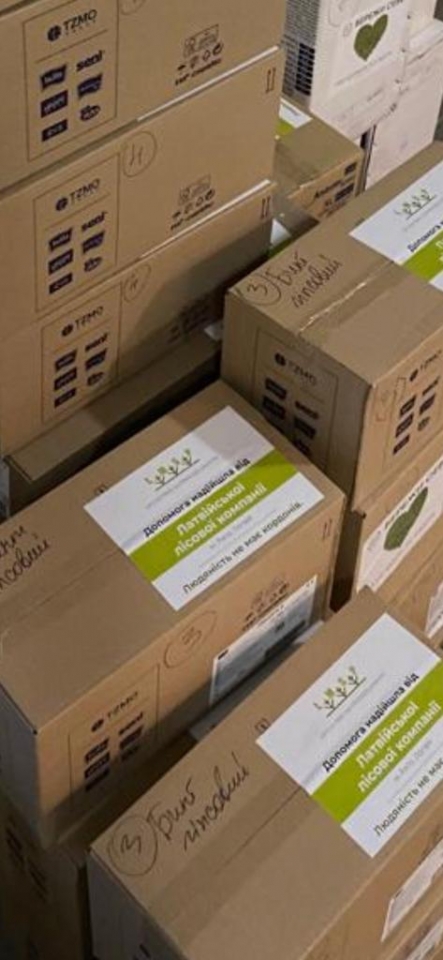
Speaking very relatively, for many in Latvia, war for 77 years was associated with stories, memories, books, or films. (Yes, there was the resistance movement, the year 1979 and Afghanistan, and more, but still...) Now it has drawn closer. In the very first days after 24 February, people in the Latvian forestry sector made contact with their Ukrainian colleagues and began organising aid in various ways, including travelling to Ukraine. In March, Inese and Māris Liopa also set off for the Volyn region with a cargo of aid.
Today, as we speak, marks the 47th day of the Russian invasion of Ukraine. We in Latvia know that a war is taking place relatively nearby; there is news, stories, reports, and eyewitnesses. Heading towards Volyn, there certainly comes a moment when you start to feel quite tangibly that the combat zone is approaching.
Inese Liopa: I felt this sensation in Poland, at the last petrol station before crossing the Ukrainian border, while talking to a petrol station attendant, a young Polish lad. We wanted to cheer ourselves up a little with coffee, we chatted, and during the conversation I realised (sensed) – we are indeed approaching...

Māris Liopa: An “Orlen” petrol station, a young person around 25 years old speaking English quite fluently. In the conversation, he mentioned that he is afraid, that he sleeps poorly at night or does not sleep at all, because the proximity of the war is palpable. It is important – our interlocutor was young, of reserve soldier age; in the event of any aggression, he “can be snatched” into war. The Poles have no illusions in this regard; they approach the issue quite pragmatically and do not cherish overly positive thoughts about the respective neighbouring countries. From such a conversation, effectively being in the frontline zone, you understand that you are approaching a real war, not one of news or features or stories. On the way, we saw very long queues of freight transport; I should add that we were driving on secondary roads (not motorways) that lead along the Polish-Belarusian and further on the Polish-Ukrainian border.
IL: We were stopped twice by Polish police performing regular checks, the so-called block-post. The second time, the breath of the nearby war literally sighed against the back of our necks, because you are stopped by a police patrol with submachine guns, made to open the boot, and asked: “Who are you? What are you carrying? Where are you going?” If the policeman’s face is also covered, the respective feelings become even stronger.
ML: There are many such checks in Polish territory. We saw few army vehicles or people; it is specifically the police that are actively working.
We were driving quite briskly, and despite the feelings of the war’s proximity we mentioned, there was both confidence and a good mood, because we are doing necessary work and are taking things to the Ukrainians that are very much needed – means of communication are essential for them, as are medical supplies for treating wounds. The cargo we carried was the second one organised by the Latvian forestry sector; now (at the time of writing at Easter) five have been prepared and sent. A very significant contribution to supporting Ukraine was made by colleagues from “Latvijas valsts meži” and the management of “Latvijas Finieris”, and special thanks for operational support right from the beginning go to Uldis Ameriks, the head of the peat company “Laflora”, as well as to the LLU Faculty of Forest and many of our like-minded people in the Latvian forestry sector.
Did you both decide immediately that you would go together?
IL: Māris was supposed to have another travel companion, who cancelled. I thought: “What could be the best travel companion for my husband?” Years ago, Ainārs Baštiks heard our marriage vows, in which we promised to be together in joy and sorrow. I am a graduate of Rīga Stradiņš University, a physiotherapist, I have a certain clarity about what is happening, and, as a representative of the medical field, I do not fear things or situations that people not directly connected with medicine might perhaps fear. That is how it very quickly became clear who my life partner’s travel companion would be. Women have their own intuition; I had no doubt that after the trip we would meet our 11-year-old son and everything would be fine.
More than one person in the sector in Latvia has had to communicate with people in the Volyn region’s forestry sector. How did it begin?
ML: It all started with a visit by “Latvijas valsts meži” (LVM) colleagues – Edvīns Zakovics and Guntis Grandāns – to Volyn (it must be said now – shortly before the war), talking about Latvia’s excellent experience with tree nurseries, forest regeneration, and planting. The LVM representatives returned home, and a few weeks later the Russian invasion began. Latvian and Ukrainian colleagues connected, found out what the Ukrainians needed and what exactly to help with. “Latvijas valsts meži” is a member of the Forest Certification Council of Latvia (LMSP), which is why colleagues also turned to me. That is how it started. I contacted the people of Volyn, and we found out what was needed. The most important and very, very necessary “object” to provide was satellite phones, which turned out to be a difficult and time-consuming problem to solve even for us. Both Telia got involved – here a huge thank you must be expressed to Svetlana Nazarkeviča personally – and ziedot.lv; eventually, the phones ended up in the boot of our car and successfully reached Ukraine.
It must definitely be emphasised how much Russia’s despicable attack has united the Ukrainian nation. It is a power, one feels it undoubtedly!
Unfortunately, the war has been going on for almost two months now, and again – unfortunately, we do not know when it will end, which is why I want to emphasise that we must learn as much as possible from this situation and understand what is needed in Latvia and how. While organising aid, I concluded (and I am not the only one) that there are many unclear and unprepared issues with us, for example, bureaucratic “fussing”, explaining that “we have never encountered anything like this before” or “this has never happened before” (truly a surprise!), or a mandatory desire to certify that the phones will not be used for war purposes... No, no, of course... To prevent a humanitarian catastrophe, which is effectively one and the same.
It is the right time to evaluate many things and situations differently. As we can see, a certain, albeit very, very slow movement in this regard is observable in the European Union, but the Ukrainians need specific things and help immediately – preferably the day before yesterday! I agree with what Ukrainian President Volodymyr Zelenskyy said: “How many Ukrainians must die for the help to be more effective and sharper?”
When receiving lists of necessary items from colleagues in Ukraine, it is very important that everything is stated clearly and concretely in the request for help.
IL: As I am a physiotherapist, I must say that the lists you mentioned with the necessary medical accessories were a surprise to me as well. Out of everything included in the long list, I knew only a couple of things; my excellent colleagues came to the rescue, for example, from the Latvian Association of Surgeons; thanks also to Guntis Belēvičs, Ieva Palma, Ruta Dziļuma, Aiva Mičule, and Anna Angena for their advice and suggestions. Together we sorted it out and understood what was needed. Personal acquaintances are very important in this situation.
ML: Exactly! For example, I did not know that a “tourniquet” is a specific type of arterial clamp. I will say – I have experienced similar situations with names or terminology in conversations about the forestry or peat sector – a good and qualified translator is involved who knows nothing and understands nothing of the specifics of the respective sector. By getting lost in translation, wonderful things can happen.
As in war – not everything runs beautifully and at the same pace. It happened that we communicated with companies in Latvia whose representatives did not want to cooperate – “Let’s not look, better not to, we are not interested!” Look at that!
IL: During this time, we have met and supported a woman from Mykolaiv. She arrived in Latvia with three children; now all three are studying in a Latvian school. We recommended the Latvian school so that problems would not arise accidentally.
ML: I will repeat, this is the time (the right time) when tolerance and long-winded speculation must be cast aside, because from the Russian-speaking part of society we hear various speeches; it is not unified either against aggression, at the Russian embassy, or elsewhere. Keeping silent is to some extent resignation or even agreement. The widely known stories about slashing tyres and smashing windows of cars with Ukrainian number plates – I feel great shame and anger about that.
Talking with like-minded people about this issue, we concluded that the police must deal with such groups of activists swiftly and sharply... Period! The leadership of the Ministry of the Interior, unfortunately, under the influence of various theories, has become overly obsessed with combating self-imagined hate speech and other language issues, without noticing that in the situations I mentioned and those reflected in the media, unfortunately, real hatred is visible in real action, which is simultaneously an opportunity for the police to show their professionalism. A brutal attack on Ukrainians because they are Ukrainians cannot be cheaply labelled as petty hooliganism, pandering to some part of society... That is “completely wrong”!
IL: It is also sad to hear a story like this – people from Ukraine want to rent an apartment, and moreover, rent it for money. The landlord, upon learning that the potential tenants are Ukrainian refugees, refuses the rental possibility. That is unacceptable!
ML: I will add, often they do not simply refuse, but in a sufficiently rude way abuse them, literally regurgitating the aggressive speech style of Putin’s information space, and... It is pathetic that since 2014 and the occupation of Crimea (or even earlier – since the 2008 conflict with Georgia), the propaganda of the neighbouring country was not banned. It has nothing to do with freedom of speech; it is the dripping of war and aggression, word by word, day by day. For example, is it clearly known to us what is happening in the minds of many Latvian residents both in Riga and in the eastern part of Latvia, where people do not really know where they live, where they are, what Latvia is, and who the President of Latvia is. That is a very serious state error in the long term.
It must be said that our governments have long sat comfortably in a puddle, thinking it to be a beach...
IL: Of course, there are very many good things and events, for example, the woman from Mykolaiv I mentioned did manage to get accommodation, and receive unsolicited support from the owners, get a job, etc. In the majority of cases, there is support and good thoughts and deeds...

I fully agree about the majority, because it happens, in connection with the Song Festival, someone will also be found who will know how to spend money better...
ML: The majority is certainly understanding of the situation and supportive of the people; in my opinion, there is a lack of sharp and clear (and fast) reaction from the interior structures regarding aggressive actions. The state must clearly show – who is the master here and what the reaction will be.
The master in Latvia...
ML: Watching Ukrainian TV reports, reading the information that industry colleagues send us, it is visible that the occupiers in Ukraine act extremely destructively – if they cannot take something with them or if it is not useful to them, it is smashed, broken, or burned. In Ukraine, people have lived in relatively good conditions; it is not clear from where the soldiers were drafted into the occupying army, but they leave ruins behind them.
IL: Crossing the Polish-Ukrainian border and seeing a line of buses with women and children, as a mother, my heart truly tightened: where are they going, where will they end up, how will they fare, will they ever return home and will there be anything to return to. I caught the eye of a 13-year-old boy, I thought, where is he and what is his morning like. Returning home and crossing the Polish border from the Ukrainian side, a sense of discomfort takes over that I am heading to a land where there is peace, but in Ukraine, people remain who have to leave, who knows where... In Ukraine, we met a representative of local foresters, Ruslan Voytsekhovsky, who introduced us to a young man who had brought four women of his family to the border, said goodbye, and headed back.
ML: The refugee situation can never be considered good, because there are always mean-spirited people nearby who want to exploit the situation. No matter how much one tries to combat and limit it, such people are and will remain. As we were told, the Ukrainians are dealing with looting quite successfully, even with sufficiently harsh methods.
People are being subjected to the ultra-chauvinistic politics of the current Russian leadership and also the society, which have decided that Ukraine is not a country, Ukrainians are not a nation, and they must be where the specific dictator V. Putin and his court have decided. That is not understandable.
IL: We crossed the border at the Yahodyn border point; we saw that the young border guards already had tired faces and eyes, having effectively aged in a short time. Because they had not imagined or experienced anything like this. Older people are more composed. But there a hellish vortex reigns; the feelings are oppressive and terrible.
On zemeunvalsts.lv we started covering the events, recalling our meeting last year with Gundars Kalvis (1). At the start of the war, it was said that five Latvians were fighting in Ukraine...
ML: More than 10. Communicating with Gundars, he said that there is a Latvian unit of their own, where commands sound in Latvian, the soldiers are brave. Gundars has conviction, a clear sense of justice, which he has proven through deeds here, in Latvia, too. The month-long training is over; the Latvians are part of the foreign legion. In the conversation, Gundars emphasised everyone’s great determination to fight – no one needs to explain anything, no one needs to be convinced, everything is clear.
I very much hope that we will not have such situations, but I think one cannot fully rely on some treaty articles either. A lot is in our own hands. An important fact, which is not mentioned much, is that, however slowly and slightly, Ukraine is receiving help and support because it is fighting and resisting. The nation is united!
IL: Men are heading to war, women were well described to us by Ruslan – we offered to bring someone to Riga, to support, to help. The answer was: “You do not know Ukrainian women, for whom family is in first place and who will stay here until the last. Unless she is persuaded to leave by her husband or she herself understands that it is time, a Ukrainian woman will stay.”
ML: In Kurzeme, we have a Ukrainian friend who has lived here for several generations. He has an 18-year-old cousin who cannot leave Ukraine; the cousin’s mother could leave, she is even invited, but she will stay with her son... There are many such cases...
IL: Also, the partner of the Ukrainian woman from Mykolaiv could go to the family, there are no obstacles, but he wants to provide his support there as an ambulance driver.

ML: In this situation, I think about the slick and vapid approach of many Westerners to the situation... Does understanding truly come only if a foreign tank pulls up to your fence or balcony? When it is already too late... At the moment, it looks like understanding is coming very slowly and with difficulty...
Not so long ago, in 1991, when the Baltic states were waiting for nothing but the recognition of their independence (by the way, also from countries that had never recognised the loss of independence), owners of slippery tongues were waiting for the occupier himself to say his word...
Are all levels in Latvia currently grasping and understanding that combat action is not far away? Of course, there is news and an information flow, but the road roller continues its motion by inertia... The war is “over there”, and we will continue to grind and thresh empty straw here, as before...
ML: You have atypically included the answer in the question, but many in Latvia also live in a very illusory world. The aggressor is right here, across the border; the Pskov Division may have been driven into the swamps of Chernihiv, but... does that create a feeling of relief?
We are close to the aggressor! That must be known and understood by everyone. Recently, in an interview, a member of the National Guard from Balvi was asked: “How do you feel?” “20 km to the Russian border, we will stand, we will fight when and if needed.” Do we have many such people? A brochure about 72 hours is one thing, how well people know how to act is another. If a siren starts sounding during our conversation, what to do? Where to go? What to take, what not to take, what definitely not to do? Inese and I have discussed this issue, but if we think about what happened in Kharkiv, which the occupying army began shelling in the first days? Many people still cannot leave the combat zone, green corridors are being shelled, an information war is continuously going on, telling how great the occupiers are as liberators.
Returning to NATO’s Article 5, for example, if some country disagrees, which is possible in the 21st century – how long does the bickering go on?
IL: My work is very much connected with people; mostly, my clients are women. In conversations, I have asked whether the question of what to do at the X-hour has been discussed in the family. For me and Māris, it has been clear since 2014 – where we go, where we drive, where we pick up our son, etc. 99% of my clients have not even thought about this. There is horror about what would be if it were, but there is no practical idea of action. We have no training or explanation regarding civil defence and action in such a situation. When clients ask me what I will do, I tell them about our 2014 plan. Of course, I can only judge those people I have personally spoken to.
ML: Looking at the Ukrainian experience, a number of things come to mind that are very ordinary in everyday life. For example, after a rocket strike, electricity disappears... So, the petrol station does not work, you cannot pay with a card, etc. Where to drive, how to drive...? We do not need panic to create a traffic jam, which happens if there is an emergency and there are many cars on the streets and anxiety reigns? In terms of occupational safety, there is a great deal.
In my opinion, another serious issue of internal security is the attitude towards Ukrainian refugees, which I have already mentioned. The impermissibility and combating of Russian imperialistic propaganda is a very important issue in this aspect. That is not just a Ukrainian and Russian issue.
It has happened that I have watched a few Russian state TV broadcasts. How can a reasonable person watch something like that seriously?
ML: We have a different perception, different experience, different upbringing, and rebelliousness.
The so-called Soviet or occupation times were in the entire then-vast country, but for more than one person, household members quite quickly taught what information was intended for home, and what – for society. Such were definitely not all, but enough will remember such stories.
ML: You see, that is how understanding and the ability to analyse are formed. I think Latvians did not need to be convinced in 1988 or 1991. We know too little about what Latvia’s Russians were thinking in those times – who participated, who watched, waiting, who was very aggressive in Interfront. I remember well the speeches about deportations, Siberia, shooting, the Pskov Division, and those were the 80s-90s; as can be seen, the speech style in a certain part of Russian society and the part of the Russian information space in Latvia has remained.
How has it remained 30 years? People live in Latvia, do not live badly, work, earn, raise children, but yearn for the old, good system when all of this was not there?
IL: Putin’s supporters who still live in Latvia are welcome to buy tickets and leave. Every opportunity! Live where it is better for you, do not live here and do not bring your wishes to us. We do not need them!
ML: Russia has a repatriation programme, the admission of compatriots.
That, of course, sounds good, but more active at the moment looks the programme of compatriots running away, because Russia is being left even by some Putin supporter...
ML: We already know that not even those who slander Latvia with the final words want to go to live in Russia. It is more comfortable to sit in a democracy and slander your breadwinner than to head there, where you can be locked up for such freedom. By the way, in vast Russia there are huge opportunities that are not being used. It is easier to be in comfort and slander. I often think about what those who keep silent do... What is silence – waiting or support, or...
IL: In this regard, school and education have a very great significance – our son studies in a prestigious school in the Riga Centre district. It is very essential to teach young people a correct and clear attitude, for example, to talk about what is happening, about the war, about patriotism in history or social studies classes. For young people, it is important. At the moment, this is the truly appropriate and right moment.
Very serious and rapid changes would be necessary in the education system. School youth must know and clearly understand what the war in Ukraine means, how one should relate to it. In every normal Latvian school, the day could be started with a minute of silence to understand what this time is and what is happening just nearby.
ML: Speaking with my Russian-speaking acquaintances in Latvia, I hear that the 30-year-long mucking about with language and other issues also obviously looks mistaken and unacceptable to them now. The transition to the Latvian language in schools should have happened in the early 90s. That would have solved many things that have dragged on inexcusably.
During the last century “with a tail”, the territory and state of Latvia and our ancestors have experienced rarely nasty and tragic events, starting with 1905 and the Black Hundreds (Great Russian chauvinist punitive expeditions), WWI, the occupation, WWII, and the post-war years...
We have survived, but... with what hatred the Russian regime is now turning against a democratic neighbouring country. One of the roots of the problem in Russia is definitely Ukraine’s clear stance: “We can do without Russia, we can do it much better and more willingly alone!”
From war to politics... The latest political party ratings show a trend – the rating of the Latvian Russian Union (LKS) has risen, if only slightly... Does that mean masks falling, or positioning before October?
ML: One must definitely be reasonably sceptical about polls and ratings, but, I agree, the trend is there. I will also agree that LKS supporters have lost or removed their masks; this force supports Russian aggression, I have no illusions what they will do if something happens... They are defenders of the bloody Putin regime, the more aggressive part of whom is becoming visible. That forces us to unite. At the moment, in Latvia, stormy bickering is taking place about very many things, both minor and serious: drivers against cyclists, Rigans against country-dwellers, patients against doctors, green activists against foresters and farmers, etc., etc.
IL: I would gladly continue the topic of the new generation – parents (of course, not only now, but at all times) must pay more attention to their children. More! Often a mundane situation – the child has a phone or tablet, the child himself – somewhere, the parents have more important work to do... Phones must be put away, one must head into nature and talk – tell them about what is happening! That is important at the moment! In conversations, a clear and real view will definitely form for the new generation, and their detachment from reality will decrease or disappear. The same applies to adults.
ML: I fully agree! Recently I read in an article about clip-thinking – piles upon piles of images remain in the head, a colourful mosaic, but... if someone does not help to structure it and explain what is to be placed or positioned where, the result can be both sad and dangerous. Russian army soldiers, sufficiently young people, as we see, live in an inexplicable reality and act worse than the Mongol-Tatar hordes. This is happening in the 21st century...
1. https://www.zemeunvalsts.lv/vakar-uz-lauka-sodien-paliga-ukrainiem-saruna-ar-lauksaimnieku-gundaru-kalvi
Photographs from the trip to the Volyn region have been used