
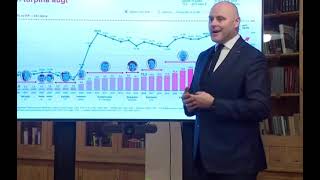
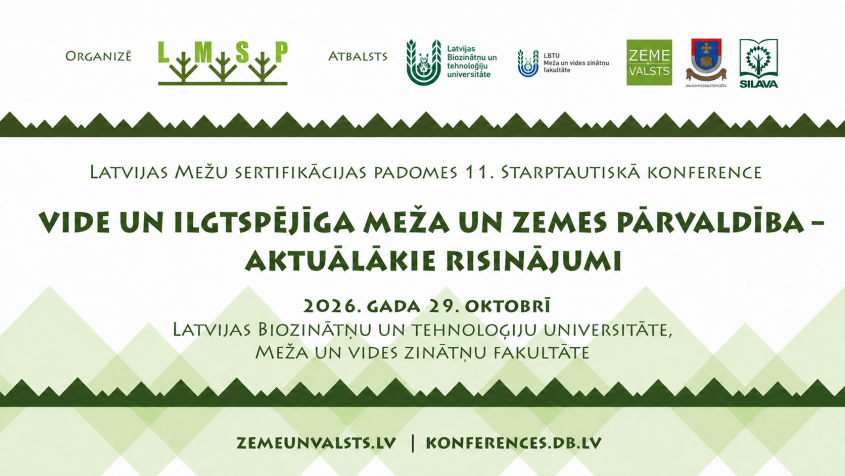
The use of land capital is absolutely vital for Latvia’s economic security and future, which is why land stratification at a national level is necessary. These conclusions were voiced at the 11th international conference of the Forest Certification Council of Latvia, titled “Environment and sustainable forest and land management – current solutions”.
 We must come up with a different perspective
Uldis Biķis, Chairman of the Supervisory Board of AS Latvijas Finieris and a member of the Council of the Employers' Confederation of Latvia, acknowledged that the conflict between environmentalists and the economic sector is not harmless, as it is equivalent to the shutdown of nuclear power plants in Germany and the subsequent dependence of that country on Russian natural gas. U. Biķis pointed out that 80% of all fertile land on the European continent is concentrated in two countries, Russia and Belarus, which are located to the east of Latvia, while the combined size of all countries in the European economic zone is only slightly larger than 20%. Therefore, any reduction in bioresources within this 20% creates huge opportunities for another country to sell its products in this market.
“It is unlikely that bioproducts, as simple food and wood products, will see massive intercontinental trade, because the largest framework is the continental market, which is also determined by supply chains, and so Europeans may end up being dependent on the one country that started the war in Ukraine,” concluded U. Biķis. It should be taken into account that land use, or the bioeconomy, generates every fifth euro of the total added value of the national economy, and the export of bioproduct solutions accounts for approximately 40% of total goods exports.
The puzzle of sustainability dilemmas
“Sustainability is the ability to work in the long term and make a profit, which is the basis for development, yet over the last six years, almost every sixth farm (a 17% decrease compared to 2020) has disappeared,” concluded Guntis Gūtmanis, Chairman of the Cooperation Council of Agricultural Organisations of Latvia. He admits that while other farms have replaced those that have disappeared, at the same time, the existing ones have had to grow in size to exist and survive.
“A competitive farm is one that existed yesterday, exists today, and will exist tomorrow, passing its assets on to children and grandchildren; stable production does not mean making a lot of money in one year, but working in the long term while earning and developing,” explains G. Gūtmanis. He acknowledges that the basis of agriculture and forestry is soil, water, and energy, where the conditions in which one works are of great importance.
“There are huge areas that have suffered from flooding,” emphasised G. Gūtmanis. Specifically, if in 2020 such areas covered 12,200 ha, then by 2021 it was 27,600 ha, in 2023 even more – 43,100 ha, in 2024 – 38,700 ha, and in 2025, 92,975 ha of crops were affected. G. Gūtmanis acknowledged that buyers in shops see price increases, but behind the scenes remain the production costs (fuel, fertilisers, spare parts, etc.), which have increased by 43% compared to 2019-2021, reducing the amount of money left at the farmer's disposal for development. Meanwhile, in forestry, due to various factors (storms, floods, pests), 7,949 ha of sanitary logging were carried out in 2025. Furthermore, in mid-2026, farmers were given a major surprise by the Bank of Latvia, which apparently knows better how to manage land.
“Bad farming is when you sow grasses on arable land, even though you can get a higher yield that way; cattle must be turned out to pasture, but the area per animal must be no less than one hectare, which means that if a farm has 5,000 cattle, it needs 5,000 ha of pasture. Likewise, restoring a shrub-overgrown field to agricultural use is labelled bad farming, as is taking more than 10m³ of water per day, but what is one to do if the animals need to drink in hot weather? Should they just go without water?” G. Gūtmanis cites shocking examples from the guidelines to farmers. He points out that, in those same guidelines, forest regeneration with spruce is labelled bad forestry, meaning that one should plant other species of trees instead of spruce and mechanically process forest soils, even though drainage in forests is intended to make trees grow better.
“The guidelines today only affect agriculture and forestry, not the public, but this could only be the first step. That is, we could end up with a definition of what an eco-friendly family is. Can it be one if they don't sort waste? No! Can it be one if they don't drive an electric car? No! And what if the children get grades of 5-7 instead of 8-9? No! Can such a family, if it is not sustainable, be granted a loan?” G. Gūtmanis explained his position. In his view, society is too permissive towards such crazy ideas that are being put forward.
Natural resources – the untapped capital
Uldis Ameriks, Chairman of the Board of SIA Laflora and a member of the Council of the Employers' Confederation of Latvia, pointed out that the land resource is not only what grows on the land, but also what is under it, and this is natural capital.
“Karl Marx once wrote the work Capital, the basic postulate of which is that capital creates value and also surplus value, which is not created by the capitalist himself, but by the working people, and that must be redistributed in some way,” explains U. Ameriks. He reminds us that the concept of natural capital appeared not so long ago, but the idea is exactly the same – those who work with resources create profit, and therefore a mechanism must be found to balance what has been taken from nature with what is given back.
“A mechanism has been created where many people from the financial sphere have become involved,” says U. Ameriks. He points out that every year the world's peat resources increase by 270 million tonnes, and this means it is one of the rare resources that increases natural capital even though it is being used.
“In Latvia, the identified peat resources are 11 billion m³, and about 1 million tonnes are extracted annually, which is a very small amount, and from the perspective of natural capital, we can increase the use of this resource,” explains U. Ameriks. He reminds us that peat used to be an energy resource, but today it is an essential part of the horticulture and forestry segments, where demand is growing every year.
“Laflora has twice as many orders as the company can fulfil,” says U. Ameriks. He mentioned land use as a significant factor — a 108 MW wind farm has been built in the Kaigu bog owned by the company, with 16 turbines occupying a total area of 24 ha, alongside which there is highbush blueberry and cranberry cultivation.
“The goal of Laflora was not to enter the electricity market, but to generate our own accessible electricity, even though there is the exact opposite opinion in society – build anywhere else, just not in my backyard or near it, which is essentially a story about energy security and independence,” says U. Ameriks. He admits that geospatial planning has not been carried out in Latvia to understand where things will be located, and as a result, everything happens chaotically and people get upset about plans.
“Every municipality has its own spatial development plan, which is a kind of basic law within which an agreement is reached on where something can be built and developed, and the entrepreneur who actually wants to do that does not have to deal with a long bureaucratic process and all kinds of consultations,” suggested U. Ameriks. In his opinion, if a specific activity is provided for in the territorial development plan of a particular municipality, then that should be accepted and no new discussions should be opened.
“A significant factor is the availability and predictability of resources so that companies can plan their strategic development; for example, Laflora plans its development until 2050,” says U. Ameriks. He points out that Latvia has a new government and the fundamental question is how we can earn more – and with what.
“With peat, we can generate an additional 100 million euros or so for the state budget by 2030 by releasing peat extraction areas, as the export market demand for peat substrates is huge,” notes U. Ameriks. He does emphasise, however, that horticulture must also be developed in Latvia. At the same time, work is underway to create a green industrial zone, where one of the possible development directions is data centres, which are large consumers of electricity, but also have residual heat that can be used by other sectors.
The formula for economic security
U. Biķis reminds us that several years ago, scientists from the University of Latvia, commissioned by the Ministry of Defence, prepared material on Latvia’s values, national ideas, and ideology.
“It contains conclusions about trust, respect, and about the fact that if you carry out daily work that is viewed negatively, trust and the will to defend the country fall apart, and that cannot be allowed. One must know how to fight back, and the industry knows how to do so,” emphasised U. Biķis. He points out that one of the scientists' suggestions was to return to land policy issues, which should be clarified in Latvian legislation.
“AS Latvijas Finieris has participated in the development of various research papers that compared economic benefit against nature conservation issues, and came to the conclusion of land policy stratification – targeted land use policy (what is done on a specific hectare of land), which is defined by legislation,” says U. Biķis. He points out that in the very next study, lawyers researched its incorporation into the regulatory system.
“The idea is not new, but one must know how to consolidate it within the existing legal environment,” stressed U. Biķis. In his view, one must be able to justify the needs of nature very broadly, but without causing harm to the national economy.
“This dilemma regarding climate, biodiversity, and the economy has been raised by University of Latvia researchers led by Rector Gundars Bērziņš, projecting Latvia for 2050,” emphasises U. Biķis. He reminds us that the Constitution of Latvia contains articles not only about the language and the continuity of the state, but also about prosperity, and this is why the forest sector must stand tall and be able to hold its ground.
“Without an economy there is no country; without the use of natural resources a country does not exist; creating natural territories where there is no economy means abandoning it,” emphasised U. Biķis. He pointed out that over 30 years, Latvia has significantly increased the volume of decaying wood in forests by nearly 40 million m³, which is equivalent to three years of economic activity, while the value of three years of economic activity is 9 billion euros.
“Of course, that is not how it should be counted, but it shows the scale,” stressed U. Biķis. In his view, it must be possible to explain to the public that when you give something up, you have to pay for it.
“Economic security is also a form of security that must be achieved; unfortunately, in the field of prosperity and the economy, Latvia is one of the weakest in the entire EU, so the priority must be the economy,” emphasises U. Biķis. In his view, when talking about national economic security, there should be neither foresters nor environmental activists at the table, but smart people who understand that the system needs a backbone – elements that do not allow for the destruction of natural resource use, the assets accumulated in factories, logistics, and other human-created processes.
“It cannot be that the Bank of Latvia starts dealing with market changes, which is what certification systems should be doing, so as not to sacrifice the economy but to let the best and highest quality win,” emphasises U. Biķis. He reminds us that the 2050 future scenarios are outlined on three levels, one of which is precisely the downward spiral in which the forest sector already finds itself – if a territory is removed from economic circulation, then activity is narrowed.
“The sector is putting up a good fight and is capable of increasing added value, but forestry lacks a mandate for productivity because of restrictions in the regulatory environment, especially for LVM, and it is difficult to work on young stands and maturing stands if there is a risk that a part of the work result will simply rot,” says U. Biķis. In his view, this is precisely why there must be a simplified understanding – where there is a mandate for productivity, there is a green light for work, and where the priority is nature conservation or recreation, there are other rules and principles, where the economy is not the priority.
“The Forest Law must be built on a new concept: not for carrying out multifunctional tasks on every single hectare, but by separating priorities to create economic territories, and then we will achieve a stronger economy,” suggested U. Biķis. In his view, it is crucial not to empty rural territories and not to become a one-city state, because if there is one city and the countryside is empty, without people, then we will have left this territory without a fight, to be used by no one.
A different recipe for conversation must be used
G. Gūtmanis concludes that land managers and environmental activists do not understand each other because nature lovers dictate how they think one should work in the field and forest. “The landowner – the manager lives on the edge of the field or forest and is essentially there every day, but where do environmental activists live? Do they live in the same place as the land managers, or in a city apartment?” G. Gūtmanis points out the paradoxical situation. In his view, this is exactly why one must speak to environmental activists differently so that they might understand.
“Environmental activists probably travel by bicycle, but you cannot take it into the stairwell because you don't like tyre marks, and since the newest model tyres contain gas and it can leak, it spoils the climate. Where should you keep the bicycle now? Where you want? And furthermore, you can only go into the bedroom in the flat every other day, and there is a spider and a cockroach living in the kitchen, so you are not allowed to enter the kitchen at all. That is how biodiversity must be maintained, because everyone needs to preserve it,” G. Gūtmanis demonstrates a form of conversation that environmental activists might understand. He does not understand why an owner cannot decide what to do with their own forest, field, or property, but someone else determines it.
The forest sector – a stepping stone
“If we restrict our forest usage possibilities again, the biggest threat is that we stop using our production capacity. The factories we have built, furniture manufacturing, veneer, and simpler processing – all these investments and all staff training only work if there is raw material. If we remove the production base, then the sector falls apart, and our Polish colleagues have just told us exactly that. Removing raw materials is shooting oneself in the foot,” emphasised Rolands Feldmanis, Chairman of the Board of the Latvian Agricultural Cooperatives Association. He emphasises that added value arises from three factors: from people, from capital, that is, equipment, and from land.
“If we do not use the land, destroy capital, and our population number is not growing, then we are already one of the poorest countries in Europe, and by killing off a sector like the forest sector, we will have no stepping stone, because there is no other industry that could pull the country along more rapidly,” says R. Feldmanis.
Asymmetric shock
When the Nature Restoration Regulation is adopted at the European level, according to R. Feldmanis, everyone goes to Brussels, and we receive what in economics is called an asymmetric shock. “Rules that are good for a forest in Spain, if there is a forest there at all and if it is comparable in quality to Latvia's or deciduous forests in Italy, France, and Germany, are applied to our spruce, pine, and mixed forests in a completely different region,” says R. Feldmanis. He justifies his statement by saying that there are several differences in forest structure, and therefore Latvia cannot have the same rules and requirements that Europe introduces.
“This is also confirmed by Polish colleagues and the Austrian example. In Austria, forest coverage is much lower, and the forest is in the mountains, where no one can get anyway. It is much easier there to separate a territory that is not touched, just as in Spain or the Alps. We do not have such territories. We simply have forest that must be separated from economic circulation, that is, from itself,” says R. Feldmanis. He reminds us that the asymmetric shock has been studied since the early 2000s.
“Economist Mortens Hansens specifically emphasises that regulations coming from Europe cannot be adopted automatically by a small country, because Southern Europe lacks water and forest, it has completely different problems, and those are large countries with large voting rights, but Latvia alone cannot decide anything, nor can the Baltics,” notes R. Feldmanis. He concludes that the Scandinavians say they go their own way, and Poland has the Visegrád Group and its own policy.
“We are pushed to the side, to the Russian border, to the final periphery, and the same conditions are applied to us. Members of the European Parliament from Latvia can explain this, but there are only a few of them, compared to, for example, the German representatives who are actually making policy,” explains R. Feldmanis. He cites as another example the global solution – the Deforestation Regulation (EUDR) – to stop the disappearance of primeval forests in the world, but in Latvia, forest area has increased.
“It is justifiably objected that while there are more hectares of forest, the quality of the forest is falling. Why is it falling? Because we no longer want to invest. Why invest if you cannot get a return? If I grow a new forest, an eagle appears, then there will be a micro-reserve, a habitat, and something else, and what then? The forest owner is not protected, and thus the sector cannot develop,” says R. Feldmanis.
Burdens – open your wallet
“If a restriction on economic activity is imposed, it should be followed by the expropriation of the property for the benefit of the state for public needs with full payment received by the owner; if the state lacks money, then we do not impose such restrictions,” G. Gūtmanis sees such an algorithm for setting restrictions and prohibitions. In his view, there cannot be a situation where restrictions or prohibitions are set for some owners for the benefit of a segment of society, but only one specific owner suffers losses.
“That is not right, and it must be changed,” says G. Gūtmanis. He also points to the bureaucratic burden, because there are many data points and databases, and we continue to increase their number.
“The regulations state: submit data once, and the authorities that need it exchange it among themselves, instead of making someone provide the same data to the first, second, and seventh institution, because we have the Rural Support Service, the State Plant Protection Service, the Forest Register, and entrepreneurs should not be asked for data that has already been submitted once,” emphasises G. Gūtmanis. In his view, support should be provided not based on what is written on paper, but by looking at the size of the farm, and each group – large, medium, small – has its own instruments that provide the best return. “We must support those activities that provide results the fastest,” suggested G. Gūtmanis.
Loss of value
R. Feldmanis reminds us that the state makes the forest protection promises, but the forest owner pays. “Compensation, which is 50 to 190 euros per ha per year, does not cover the losses, and this is a question that should be asked by everyone who owns a forest: what should I do with it?” concludes R. Feldmanis. He has calculated that the compensation generates a return of about one and a half percent on the frozen capital per year.
“That is less than a bank deposit. The European Central Bank's inflation target is 2%, so if my forest with the compensation generates less income than inflation takes away, I am losing capital every year. The return on forestry, depending on productivity, is higher, and the discount rate of Latvijas valsts meži, which, it seems, has not been recalculated in a long time, is 4.58%. That is also low if compared to a situation where I sell the forest and invest the money in a stock market index,” analyses R. Feldmanis. He reminds us that a stock index is a diversified portfolio of the world's largest companies, and if one is doing worse, another replaces it.
“Over a longer period, over 50 years, it gives 6 to 8% per year, including all crises and drops, and at any moment this asset can be converted into money. A forest, on the other hand, is not diversified: it has every disease, taxes must be paid on it regularly, and you cannot sell it in a single day. A small owner with 9 ha with all these restrictions loses the opportunity that they would theoretically have if the forest could be managed. It is not fair. And most other regulations work the same way: officials sign the commitments, but we pay,” says R. Feldmanis.
The European vector
Āris Jansons, Director of the Forest Department of the Ministry of Agriculture, acknowledged that Latvia works within a common EU regulatory environment, and this has a significant impact on the sector. There are directives, regulations, strategies, guidelines, and other types of documents that are issued by Brussels.
“Between 2004 and 2014, there were an average of 5-6 per year, but between 2018 and 2024 – an average of 90 per year,” Ā. Jansons shows the rate of increase in the number of legal acts. He admits that these figures show what officials are doing to find a solution for the least possible negative impact on the national economy.
“There are also positive things, for example, the EU Bioeconomy Strategy, which provides for several additional resource extraction opportunities – knowledge transfer from laboratory to production, allocating EU funding for it, and the second is the energy wood market, which, although very overregulated, is favourable for Latvia because it allows for export income from a resource that otherwise currently has no other use,” explains Ā. Jansons. He reminds us that for Europe as a whole, the forest sector is not a significant sphere because it generates less than 1% of total added value.
“Latvia must look for allies, and they exist, as a result of which it was possible to hold the interpretation of the Birds Directive so that economic activity does not have to be stopped for a certain period,” explains Ā. Jansons. He admits that it has been possible to achieve a much more understanding position from the European Commission in the Habitats Directive regarding economic activity than currently exists in Latvia's national legislation.
“Latvia has actively participated in the conference on forest protection in Europe, where criteria and indicators for sustainable forest management are defined, which countries use to describe their situation,” explains Ā. Jansons. He points out that Latvia is interested in having such information widely available and being used as a basis for characterising forest management in our country. There are also documents where national states have room for manoeuvre in adopting norms, and one of them is the EU Biodiversity Strategy, which provides that by 2030, 30% of the land territory must have the primary goal of biodiversity.
“That has been a hot object of discussion, and currently a peculiar consensus has been reached between the Ministry of Agriculture and the Ministry of Smart Administration and Regional Development, which we hope to consolidate in legislation so that we can work at the spatial planning level,” explains Ā. Jansons. He points out that currently, together with territories that are already protected, this proportion nearly reaches 29%, but when adding swamps to that, it exceeds the 30% target.
“So the total proportion of territory for biodiversity preservation in Latvia already exceeds the EU target, especially since there are EU member states that do not even plan to reach this 30% threshold,” says Ā. Jansons. He admits that in the development of the nature restoration plan, a turning point has been reached – a socio-economic impact assessment must be carried out.