



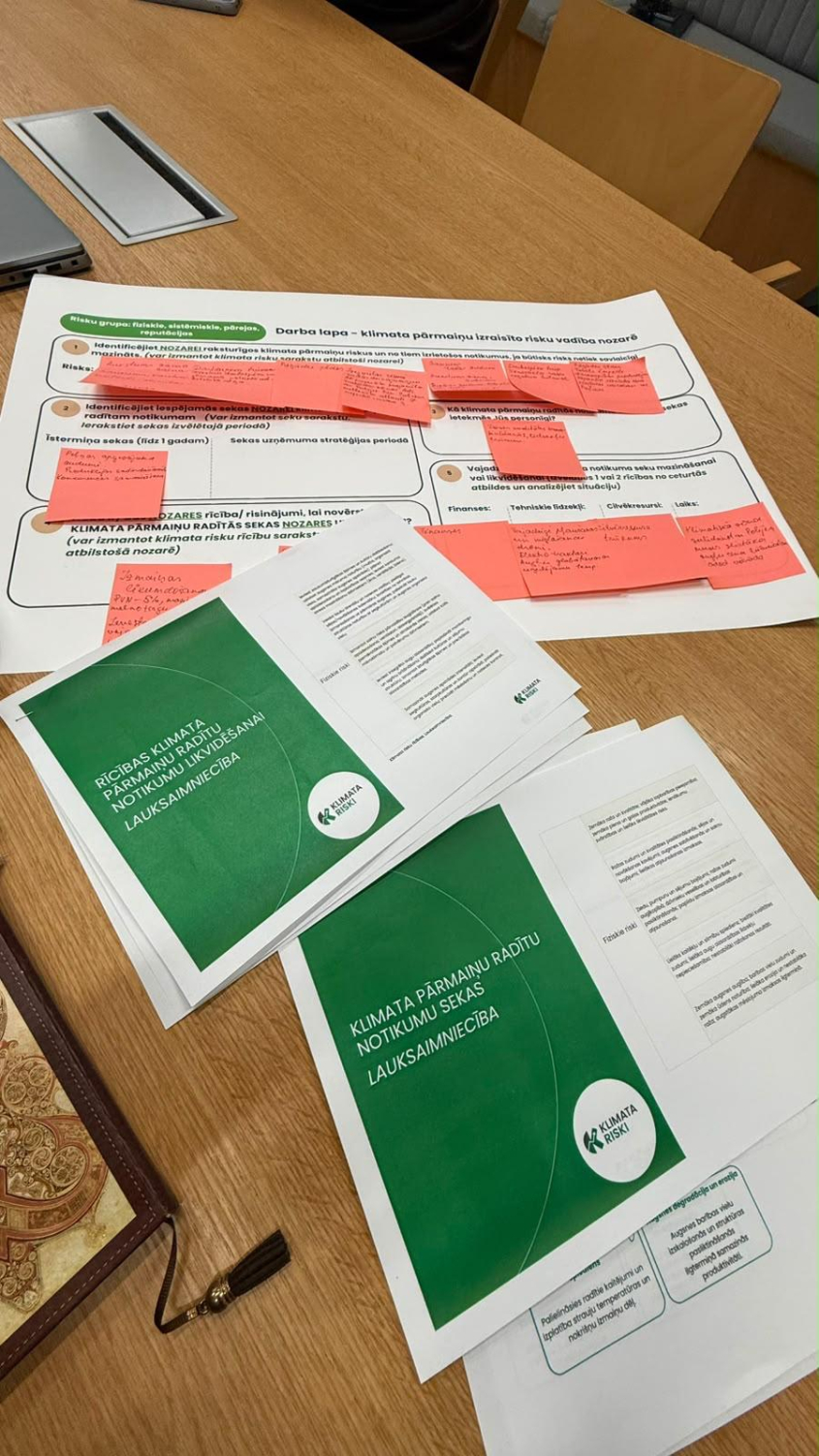
A series of industry dialogues organised by the association CSR Latvia in cooperation with the association Green Liberty (Zaļā brīvība) has concluded, involving 25 companies and nine organisations and associations. Their goal was to move from general discussions about climate change to the assessment of specific risks and the search for collective solutions. Using a unified methodology, participants analysed the potential impact of climate change on company operations, assessed the vulnerability of their sectors and discussed issues that require cooperation beyond the boundaries of an individual company to resolve.
Companies often assess climate risks individually, focusing primarily on their own infrastructure, operational processes and specific threats. However, company operations are interconnected, as they use shared infrastructure and depend on suppliers, transport services, energy supplies and other external factors. Therefore, a portion of the risks caused by climate change affects the entire sector, and individual company decisions are insufficient for managing them.
This is precisely why the industry dialogues were organised as practical working sessions where company representatives could jointly evaluate climate risks, compare experiences and discuss possible solutions.
The industry dialogues revealed how varied the impact of climate change on business can be: ranging from infrastructure damage and service interruptions in the transport, energy and industrial sectors, to construction delays, worker safety, crop losses and increasing costs in the construction and agricultural sectors. Representatives of the agricultural sector specifically highlighted the risks of crop losses, animal welfare, the financial stability of farms, as well as aspects of employee well-being.
In the discussions, participants focused not only on potential consequences but also on how to prepare for climate events in good time and mitigate risks. The need to strengthen cooperation between companies was particularly emphasised, including pooling resources to conduct joint research and involving industry associations in coordinating these processes.
“Companies are increasingly being asked to assess climate risks, but it is important to understand what to do with this information next. The industry dialogues brought companies to the table that compete on a daily basis but at the same time face similar challenges. No company can solve transport infrastructure problems, prevent supply chain disruptions or address energy supply failures on its own. That is why we wanted to not only jointly evaluate the risks but also understand which issues require cooperation across the entire sector,” emphasises Agnese Alksne-Bensone, Chairperson of the Board of CSR Latvia.
Participants of the industry dialogues particularly appreciated the opportunity to focus in-depth on issues that are not always examined systematically in daily work processes. The exchange of experience helped broaden their perspective on risks and evaluate how different companies might encounter similar problems.
“The event was very valuable because it provided an opportunity to focus in-depth on the risks caused by climate change in the manufacturing sector and to jointly evaluate both the most significant challenges and potential actions. The exchange of experience between company representatives was valuable, as it allowed us to look at climate risks from different perspectives. Over the course of the discussions, valuable insights and concrete proposals crystallised, which can serve as a basis for future cooperation and practical action. It is essential that these ideas are developed and moved forward, providing a real contribution to strengthening the sector's climate resilience,” notes Līga Rubene, Sustainability and Environmental Management Specialist at SIA Dinex.
The industry dialogues showed that climate risk management is not limited to readiness to react to extreme weather conditions. It is essential to evaluate the potential impact of risks on company operations in good time, plan necessary investments, develop or revise a company's climate transition plan and strengthen operational continuity. Although some measures are the responsibility of each individual company, the mitigation of shared risks also requires the involvement of industry organisations and the public sector. The insights gained and proposals developed in the dialogues are a foundation for future cooperation, ensuring that risk assessment is followed by concrete action.
The cycle of dialogues organised by CSR Latvia and the association Green Liberty offers an approach that can also be used in future industry cooperation. It involves not only identifying risks within each company separately but also collectively evaluating which solutions would be more effective if implemented by several companies or the entire sector.