In 2018, the European Union announced that it would become the world's first "climate champion" by committing to achieve climate neutrality by 2050. To achieve sufficient emission reductions to make "climate neutrality" 100% feasible, rules and regulations are necessary. A great deal has been achieved so far, and much more is planned. Political and strategic aspects continue to influence the extent to which legislative goals can be implemented.
Background information
The European Union's goal is to achieve "climate neutrality" by 2050. This goal is enshrined in the Climate Law. This means that by the middle of the century, greenhouse gas emissions will have to be reduced to zero by cutting them and absorbing them.
The purpose of the European policies, rules and legislative package contained in the European Green Deal is to align the EU with a climate-neutral trajectory by reducing and eliminating emissions across all polluting sectors, while simultaneously maintaining economic growth and social cohesion.
By 2030, emissions must be reduced by 55% compared to 1990 levels. To achieve this, new rules regulating clean energy, energy efficiency and transport have been introduced. If successfully implemented, the current set of policy measures would allow emissions to be reduced by approximately 57%.
Climate regulation is a shared competence between the European Union and its member states – this means that binding targets are set in Brussels in areas where progress must be made to meet common goals. National governments may set their own legally binding targets in areas where the EU has not chosen to exercise its powers. At the EU level, the legislative process begins with proposals from the European Commission, which are then amended and debated by the European Parliament and representatives of member states in the European Council.
Surveys conducted in the European Union show that the majority of EU citizens support climate policy, viewing climate change as a serious threat and are convinced that relevant efforts must be accelerated rather than scaled back.
On the global stage, the EU is a significant intermediary in climate diplomacy and finance. Both the European Commission and the European Investment Bank have committed more than 2.5 billion euros per year to climate change finance in developing countries. The EU is also a major promoter of climate change finance and action, strengthening and aggregating the individual efforts of its member states and partner countries.
Major events regarding the transition phase
The European Union is already nearing the completion of the laws and rules that will set the agenda for climate and energy policy until 2030, the so-called Fit for 55 package. Ahead lies a crucial implementation period when the governments of the 27-nation bloc will have to start meeting the targets set out in the new rules, as well as adapting a series of standards and regulations to the specific socio-economic situation of each country.
European Parliament elections will take place in mid-2024. Although these elections are often dominated by national issues, they will also serve as a litmus test for Brussels policy, showing the political result that will determine whether even more ambitious rules can be implemented in the next legislative cycle (from 2024 to 2029).
Policymakers will have to decide how to bridge the gap between the 2030 targets and the 2050 net-zero criterion already enshrined in law. How the late 2030s and early 2040s will be regulated will be a key issue in the coming months and years. Bloomberg agency reported that the EC is preparing to approve a plan for a 90% net reduction in greenhouse gases by 2040 in its proposal on 6 February 2024.
How European regions transition to a green economy will be of crucial importance, as significant regional disparities remain. Several programmes, such as the Just Transition Fund, as well as financial assistance in the form of cohesion funding, will help to bridge this gap. How regions spend these funds will be decisive.
Europe's place in the global energy transition will also be tested. As the EU has set goals to become a leader and international player in green technologies, climate standards and investment criteria, it will be difficult for it to stand against, for example, China and the US. It will be important to follow whether Brussels will be able to rely on regulatory influence to combat the financial power of its competitors.
Sectoral overview
Energy
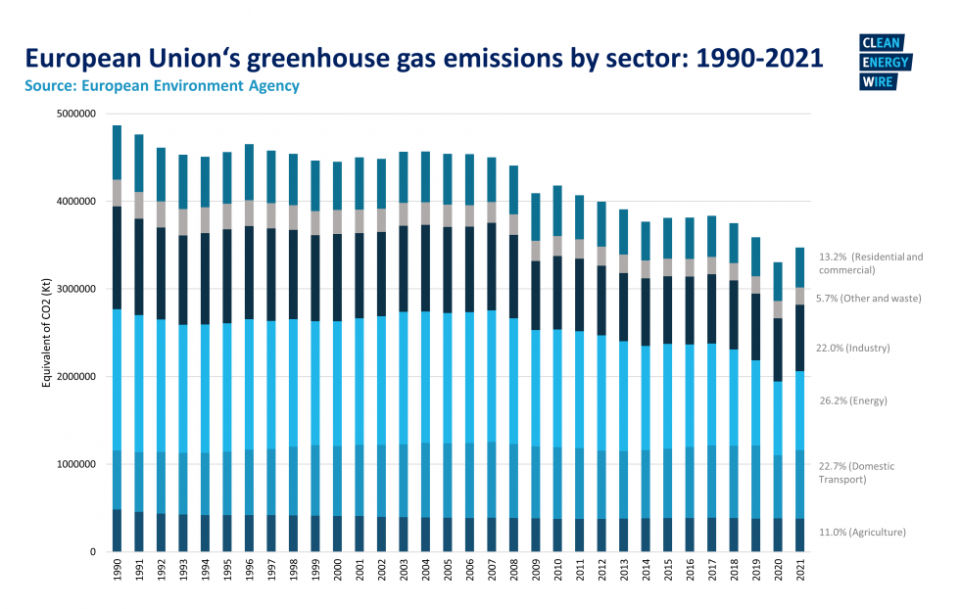
The energy sector generates approximately 25% of the EU's greenhouse gas emissions; it is the part of the bloc's economy that causes the most pollution. Since 1990, emissions have decreased by more than 40%.
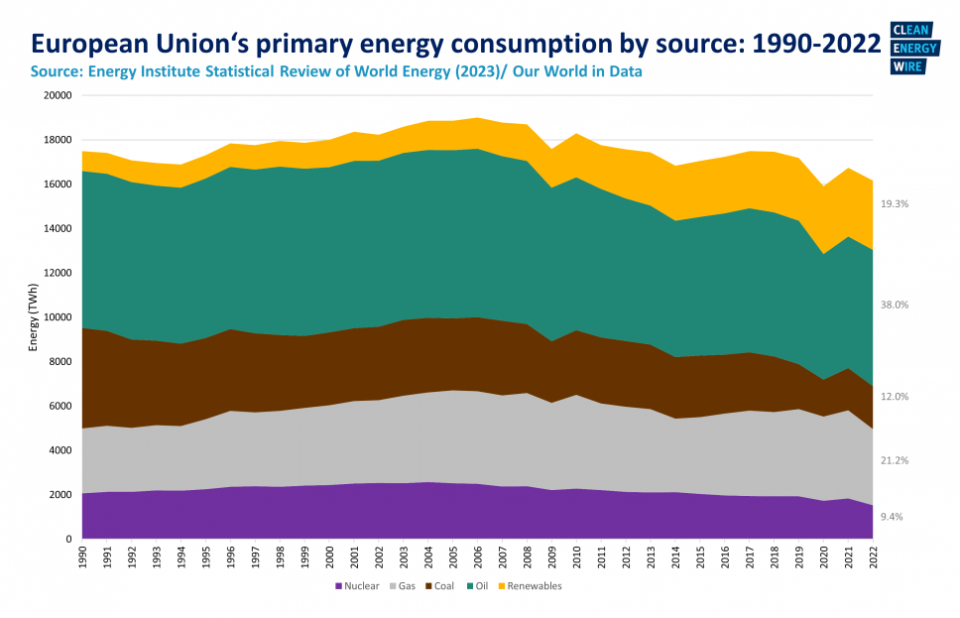
In 2022, almost 40% of generated energy was provided by renewable energy sources – wind, solar, hydropower and biomass – just slightly ahead of fossil fuels, which provided just under 39%. Nuclear energy provided almost 22% of generated energy, respectively.
In 2022, wind and solar energy together reached a record high in production volume, for the first time overtaking fossil gas as the primary source of electricity generation in the EU.
The EU's new renewable energy target for 2030 provides for a 42.5% share of renewables in gross final energy consumption. The original criterion enshrined in law in 2018 was only 32%, while a 2021 proposal planned to increase it to 40%. As part of an industry-wide strategy to reduce the EU's dependence on Russian energy imports, a 45% target was proposed in 2022. Governments and Members of the European Parliament finally reached a compromise of 42.5% in March 2023.
In 2021, 22% of energy in the EU was obtained from renewable sources, reaching the 2020 target of 20%. Oil and petroleum products still held the top spot in the final energy consumption ranking.
EU countries differ significantly when assessing how much of their energy they obtain from renewable sources: Sweden and Finland are leaders, while Malta and Luxembourg lag far, far behind.
Progress in this sector, especially in electricity generation, will depend on the development of electricity grids across the European Union, as the lack of modern infrastructure will limit the amount of clean energy that can be delivered. Renewable energy associations in August called on member state governments and the EU to address the risk of curtailment – when clean energy production is switched off due to a lack of grid capacity – by improving grid flexibility, developing 100% renewable energy scenarios, and accelerating permitting and construction.
Following the Russian invasion of Ukraine in 2022, EU energy policy has shifted to reduce dependence on Russian hydrocarbons. This means that existing policy must be refined as part of the REPowerEU strategy and other measures must be taken, such as joint gas procurement and mandatory gas storage targets. As a result, energy imports from countries outside the EU had decreased by almost 10% by early 2023 compared to 2021-2022.
Industry
The total renewable energy share target is 42.5%, which means that all 27 member states must make a sufficiently large contribution in this area. Each government must submit updated National Energy and Climate Plans (NECPs) to describe in detail exactly how it will achieve the 2030 targets, including the use of renewable energy sources. These plans are still being developed; the European Commission will work with member state governments in the coming months to improve their plans, which are scheduled for completion in June 2024. This is a part of EU policy-making that often goes unnoticed at the national level.
Industry generates approximately 20% of the EU's total emissions; this share is gradually decreasing as manufacturers introduce pollution-reduction measures – electrification and the transition to hydrogen feedstocks, which can provide zero emissions if clean energy is used in production.
The EU Emissions Trading System (ETS) has been updated to include more industrial sectors and maintain a high carbon price. Air pollution permits have been traded close to the 100 euro mark this year, and it is expected that the new reforms will gradually increase this price. Free permits previously granted to industrial sectors subject to carbon pricing will be phased out between 2026 and 2034.
To help industry and prevent carbon leakage – a phenomenon where companies move outside the regulatory zone to avoid costs – the EU will set a type of carbon border tax, known as the Carbon Border Adjustment Mechanism (CBAM). Starting a transition phase in October 2023, CBAM imposes taxes on certain imports that do not meet sustainability criteria. The initial list includes imports of aluminium, cement, fertilisers, hydrogen, iron, steel, and electricity.
The Net-Zero Industry Act was published in 2023 as a response to the US Inflation Reduction Act – a federal law offering tax credits and other financial benefits for clean energy production in various sectors. Its purpose is to support the industrial transition to a greener economy. The final version of the proposal has not yet been set, but it includes a list of priority technologies that regulators should prioritise. Self-sufficiency targets are also included, meaning the EU should cover 40% of its own needs related to energy use by 2030.
Under EU law, countries must increase the share of renewable energy by 1.6% per year, ensuring that at least 42% of hydrogen used in industrial processes, such as steel smelting, is obtained using clean energy. By 2035, this figure must be increased to 60%.
Carbon Capture, Utilisation and Storage (CCUS) is highlighted as a solution for industrial sectors where it is difficult to decarbonise, such as the cement production sector. The European Commission was required to submit an industrial carbon management plan in the last quarter of 2023, after inviting stakeholders to provide feedback during an open consultation period.
Essential:
EU industrial competitiveness has recently become a major topic, and it is likely to remain important in the future. The European Union is competing with large markets like the US and China in clean technology manufacturing. The Net-Zero Industry Act is seen as a response to US efforts to provide green subsidies, but there are still concerns that the EU may lag behind in the clean technology race.
Buildings
40% of the EU's energy demand originates in the building sector. Approximately 13% of emissions are caused by this sector, mainly due to heating, cooling, and lighting.
Poor building insulation is the main reason for the sector's huge impact on energy and climate, yet annual renovation rates in the EU only slightly exceed 1%. The EU's flagship "Renovation Wave" strategy aims to at least double these rates by 2030.
The EU building sector is governed by two main pieces of legislation: the Energy Performance of Buildings Directive and the Energy Efficiency Directive (EED). Both these directives have been revised in line with the Green Deal.
Under the new EED, a total combined energy saving of 11.7% must be achieved by 2030. Unlike previous versions, this target is mandatory, not voluntary. EU countries must achieve a saving of at least 1.5% each year.
According to the REPowerEU plan, an additional 10 million heat pumps are to be installed by 2027 to reduce energy consumption from building heating and cooling. The European Commission believes that by phasing out "stand-alone" boilers without hybrid elements by 2029, this number could reach 30 million.
Buildings will also be subject to emissions trading for the first time in a separate carbon market – ETS II. A new instrument, the Social Climate Fund, was created to help households ease the additional financial burden caused by carbon pricing. The fund is expected to provide more than 60 billion euros between 2026 and 2032.
Essential:
The EU Council agreed on a new general approach (negotiating position) to set Minimum Energy Performance Standards (MEPS) for residential buildings. The agreement provides for adopting national standards to meet the conditions set out in the member states' own building renovation guidelines. A final agreement on this article has not yet been reached, with the percentage of primary energy savings being the main issue still under discussion.
Mobility
Transport (excluding international aviation and shipping) accounts for 23% of EU greenhouse gas emissions; unlike other sectors, the emission trend is not downward, which is important to note.
Domestic transport emissions are expected to fall below 1990 levels by 2029 only if current policies are fully implemented. This increase is largely driven by growth in passenger and domestic freight transport volumes.
EU legislation regulating engine standards, CO₂ reduction targets, the implementation of charging infrastructure, and the use of carbon-free fuels is aimed at drastically reducing the sector's carbon dioxide emissions.
Road transport accounts for the lion's share of transport emissions (77%), with passenger cars and motorcycles generating the most emissions within this segment (64%). Since 1990, the number of light commercial vehicles has increased the most.
The amount of renewable energy in transport increased from less than 2% in 2005 to more than 10% in 2021. EU countries will have to choose: either reach 29% by 2030 or reduce greenhouse gas intensity in this sector by at least 14.5%.
Shipping will be included in the bloc's Emissions Trading System (ETS) for the first time. A separate legislative act on promoting the use of low-carbon fuels will apply only to the maritime sector.
A separate carbon market for road transport and buildings will be created in 2027 to set pollution costs in these sectors. If energy prices are high in the year leading up to the deadline, EU governments will have the option to delay it until 2028. Emission monitoring is planned to start free of charge in 2025. It is expected that all road vehicles will be included, though there are still a number of details regarding exemptions that will need to be clarified in the coming years.
Essential:
Engine standards mean that no new cars with internal combustion engines will be allowed to be sold after 2035. The European Commission is still considering Germany's efforts to obtain exemptions for synthetic e-fuels and to allow the continued sale of new cars with internal combustion engines after that date.
Agriculture and land use
This sector accounts for approximately 11% of the EU's total greenhouse gases. It is based on methane and nitrogen. CO₂ and other polluting gases make up a relatively small portion of the total.
The sector's emissions have remained relatively stable in recent years and, according to current policies, only a 2% reduction compared to 2005 levels is projected by 2030. If government plans were implemented, this figure could be increased to 6% across the EU.
Agricultural sector emissions are regulated by the Effort Sharing Regulation (ESR), which aims to reduce emissions in relevant sectors by 30% by 2030 compared to 2005. Given that not much progress is expected in agriculture, larger reductions will have to be achieved in other sectors, such as waste, buildings, and road transport.
Agriculture is also subject to the Land Use, Land-Use Change and Forestry (LULUCF) regulation, which defines how EU land use contributes to achieving climate goals. By 2030, net CO₂ removal from land using carbon sinks should reach 310 million tonnes. This is 15% more than at present. This means that governments will have to develop rules on the impact of agriculture in the planning of the Common Agricultural Policy (CAP).
When the ETS was recently revised, policymakers decided not to include this sector in the carbon market. CO₂ emissions from agricultural machinery – mainly diesel – are not subject to pollution pricing.
Essential:
The interests of farmers across Europe already threatened the approval of the Nature Restoration Law. Negotiations are currently underway on regulating industrial installations and their emissions, including large livestock farms. The European Commission is still required to submit a legislative act on sustainable food systems by the end of 2024. This will play a major role in the agricultural sector's impact on the climate.
Primary energy consumption in the European Union by source: