The European Union has announced sanctions against Moscow that are expected to have "serious consequences", but so far has not imposed an embargo on Russian oil or gas. Although talks on the former have intensified, Russia could beat European countries to the punch regarding the latter. On Monday evening, Russian Deputy Prime Minister Alexander Novak said in a statement that Russia could stop the construction of the Nord Stream 1 gas pipeline, in retaliation for Germany withdrawing support for the nearly completed Nord Stream 2 pipeline. Novak also said he expects it to take Europe more than a year to replace the oil it currently buys from Russia, and that it would come at a much higher price – 300 US dollars per barrel or more.
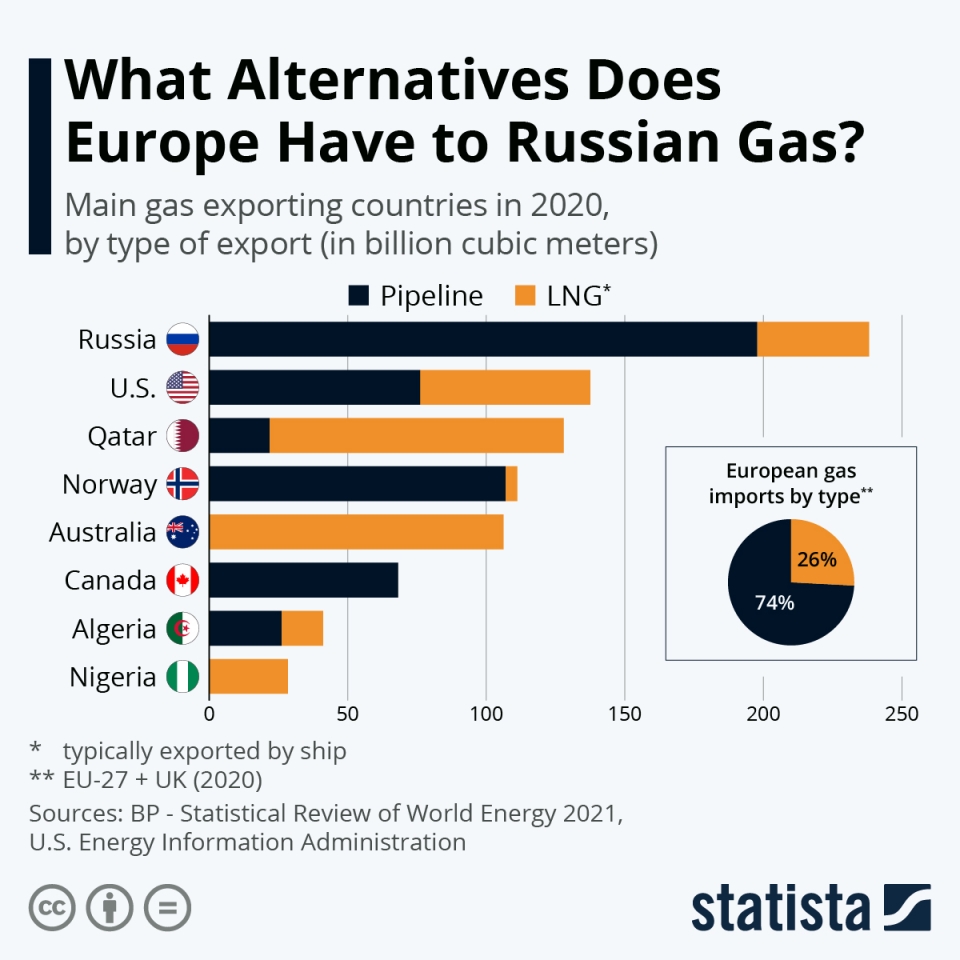
Russia currently supplies 40% of the natural gas imported by the EU, so what alternatives could European countries turn to if Russia were to turn off the gas tap? The continent would have to look for suppliers of liquefied natural gas (LNG), which is usually transported by ship. According to BP data, the world's main exporters of LNG in 2020 were Australia, Qatar and the United States. Although Qatar is geographically closest to Europe, the Qatari government has been rather reluctant to take on the role of gas supplier to the EU. The country stated that it does not wish to break its long-term contracts in response to a potential European gas crisis, leaving only about 10% of Qatari gas uncommitted. Qatar might be interested in signing new long-term contracts with European countries, but the EU has temporarily put a stop to this, citing concerns over anti-monopoly regulations. Human rights violations are another area that could cause headaches for EU buyers when dealing with Qatar.
With supplies still uncertain but negotiations underway, Germany has already announced the construction of two LNG terminals on the country's northern coast, which would be the first such terminals in the country. Other countries, particularly in Southern Europe, are already using this method. In 2020, the last year for which data is available, Portugal imported 56% of its gas from Nigeria and 17% from the US, while Spain purchased more than 35% of its gas as LNG. Italy and Greece also sourced some of their gas from the US and Qatar in 2020. The LNG terminal in Klaipėda, Lithuania, has taken on the task of creating some energy independence for the Baltics, Finland and soon Poland as well.
According to the US Energy Information Administration, almost 75% of supplies to the EU (EU-27 and the UK) currently arrive on the continent via pipelines. In addition to Russia, Norway and Algeria also supply large volumes to Europe via pipelines, but they effectively lack the additional production capacity to avoid a shortfall should Russia cut off supply. According to calculations by the Kiel Institute for the World Economy, a complete cessation of natural gas sales to the West would actually be a painful event for the Russian economy, shaving off nearly 3% of the country's GDP.