4 September 2025, Munich
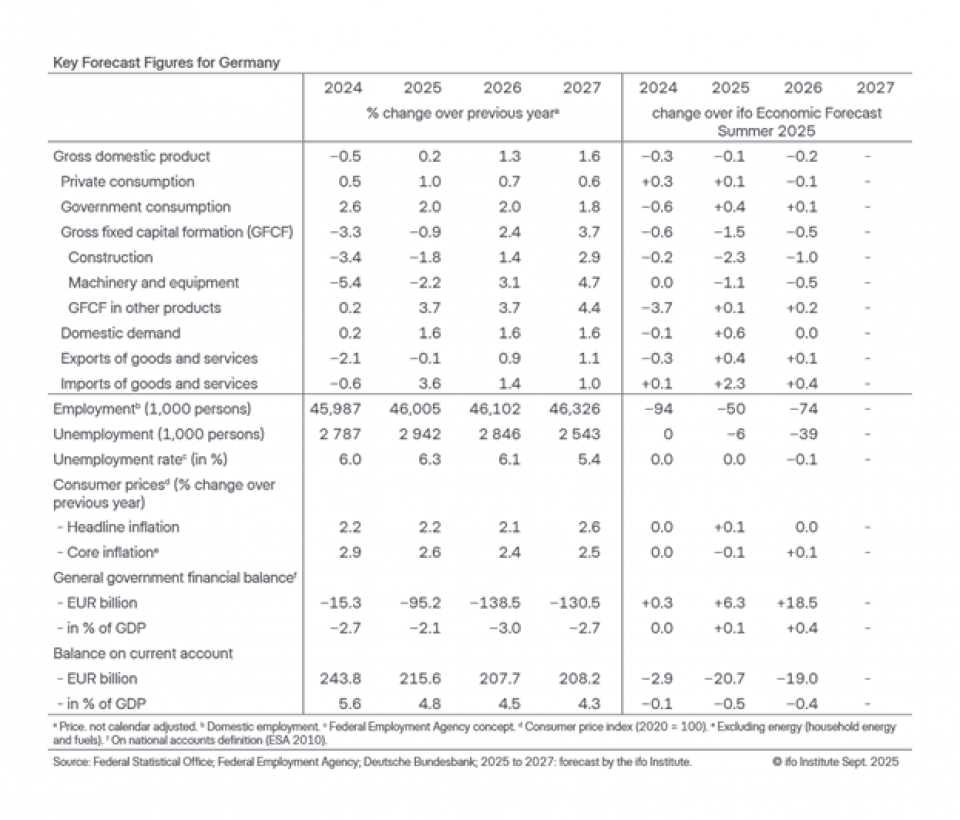
The Ifo institute has lowered its growth forecast for Germany. According to the forecast, the German economy will grow by just 0.2% this year and by 1.3% in 2026. Compared with the assessment made in the summer, researchers at the Ifo institute have trimmed the forecast slightly, by 0.1 and 0.2 percentage points respectively. The growth forecast for 2027 is 1.6%.
“US tariffs are still having a considerable negative effect on the German economy,” emphasises Professor Timo Vollmershauzers, head of the Ifo forecasting department. “The agreement in the tariff dispute between the US and the European Union is unlikely to have any direct impact on the forecast, since the tariffs now in force are almost the same as they were in the summer. It is only the uncertainty associated with the earlier tariff dispute that is likely to ease gradually, which will benefit the economy.”
Compared with the previous forecast, the economists expect the German government's economic policy measures to have a smaller impact than previously assumed. These measures are projected to amount to 9 billion euros this year, rising to 38 billion and 19 billion euros in 2026 and 2027 respectively.
“The German government's economic policy measures are likely to start taking effect from next year. If they are implemented firmly and convincingly and the current uncertainty subsides, fiscal policy ‘can pull' the German economy out of the crisis,” notes T. Vollmershauzers. “If economic policy remains unchanged, Germany runs the risk that the paralysis of the economy will continue for several more years and that business activity will be put in jeopardy.” Alongside increased spending on infrastructure and defence, the measures include accelerated depreciation options, a VAT cap for the hospitality sector and an electricity tax cap for the manufacturing sector, lower network charges and an increase in benefits.
According to the Ifo forecast, unemployment will rise by 155,000 people this year, taking the unemployment rate to 6.3%. It is not expected to come down until 2026 and 2027, when it will reach 6.1% and 5.4% respectively. Inflation is likely to fall slightly in 2026 – to 2%, from an average of 2.2% in 2024. Energy prices may well continue to fall, as network charges will be reduced at the start of 2026 and the gas storage surcharge will be abolished. In 2027, however, energy prices will rise again on the back of a sharp increase in the price of CO₂, so the rate of inflation is expected to climb to 2.6%.