



The Minister for Agriculture is interviewed by Māris Liopa, director of the forestry and related industries portal zemeunvalsts.lv, and Pauls Rēvelis, editor of zemeunvalsts.lv
Over the past year, in assessing various events in Latvia, the word “courage” has returned to everyday speech. Speaking of the 5 March protests by forestry sector representatives outside the Cabinet of Ministers – should the Prime Minister and ministers going out to talk with the protesters really be judged as “courageous”, or is it simply a minister's job?
I won't judge others, I'll speak about myself: since I have worked in the non-governmental sector myself, I know what is hard – namely, that fairly often you are not listened to. Both on 5 March outside the Cabinet of Ministers and at the meeting held before that, communication went sufficiently constructively – both sides listened and spoke, both the protesters and the ministry representatives.
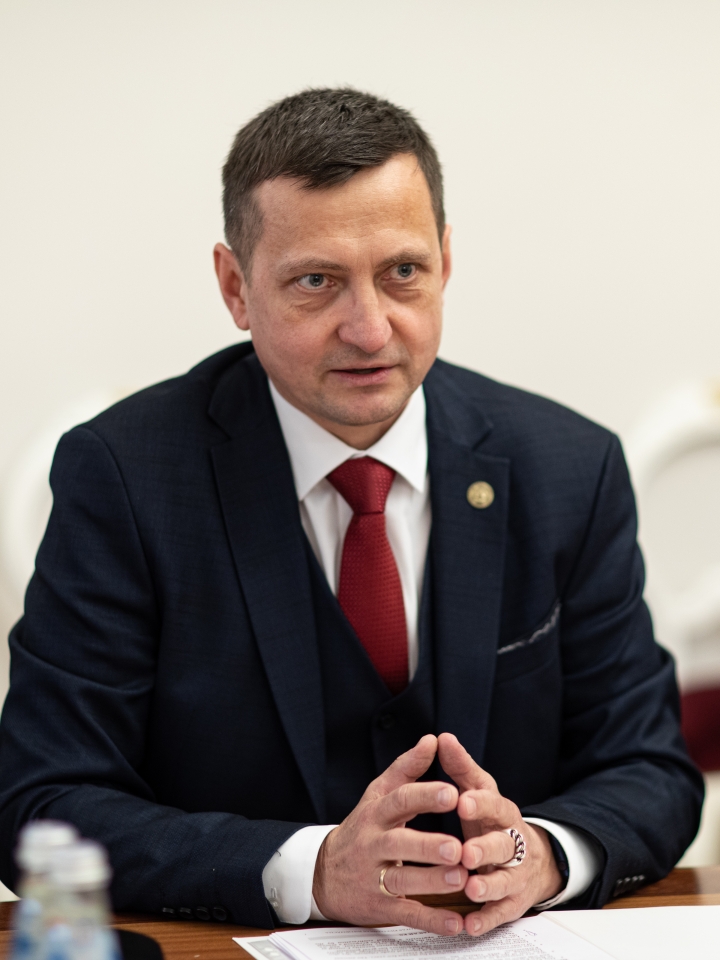
In my view, at moments when protesters meet politicians or officials, dialogue is what matters. There must not arise a situation where one side essentially does not hear what the other says, while the other side shouts and does not hear either; in neither case will there be a result.
A certain courage is needed to meet the protesters, to hear one another out and to reach the best possible agreement. Speaking of protests and various demands, one thing is clear – everything can never be fulfilled, if only because the things demanded by representatives of one particular sector are not acceptable to wider society. For the end result to match the interests of the greater part of society, balance or compromise is needed.
Take, for example, the question raised during the protests about habitats, their mapping and what happens next. Nobody objects to nature protection, but you cannot rob people while using that as an excuse and pointing to it alone. If we want to protect something, then let's say the forestry sector would come forward with a proposal that it “agrees to this and that”, but that it must be paid for at what it actually costs. I think that is a normal balance. Incidentally, without this balance, situations could arise where one side does not agree and acts on its own property as it pleases. The other side, in turn, demands – you must not show your face with any tools anywhere near your own forest or field. That is neither balance nor reasonable dialogue.
Speaking of the situation in Latvia, in my view a line can be drawn very clearly and precisely – what percentage and what areas in Latvia are set aside for nature protection and which territories are intended for economic purposes – it makes no difference whether we are talking about forest, or fields, or bogs. It must be clearly understood that commercial forests are not intended for nature protection, and vice versa.
Has any thought been given to the so-called communicating vessels principle – namely, not to a continuous increase in the territory set aside for nature protection, but to assessing it (an inventory after a set period), so that we protect not merely percentages or areas but specific natural values. It often happens – a territory “counts as” protected, but the object being protected has long since gone.
In my view the situation is simple enough, because we have to take into account each owner's property rights, the owner's interests, and the state's economic interests, which are more important still. If we continue down an almost endless road without setting clear boundaries – where commercial forests begin and end and where nature protection begins and ends – we may end up in a situation where around 90% of Latvia's forests are tied up with nature protection. Of course, I am exaggerating slightly; perhaps 40% is quite enough for us to face serious economic consequences that will directly affect not only those working in the forestry sector and their families, but will be felt by every resident of Latvia. The forestry sector is the largest exporting sector, employing more than 40,000 people, and if we also count the related sectors and the families of those employed... For example, the work of someone operating a harvester is well paid; he supports his family and is a significant part of the economically active population. If we short-sightedly take away his job, then – and I am not exaggerating – within days his family will leave for Scandinavia, where they will be welcomed with open arms. For the Scandinavians these boundaries – how far and where you may manage the land – are clear and predictable.
Since the beginning of March I have quoted a good deal in my interviews from an interview with the US Ambassador to Latvia, Christopher Robinson*, in which he says: “Latvia should think about the economy as a matter of national security...”
Everyone ought to understand this – the economy comes first. If a country has a highly developed economy and the state earns well, and its people earn well, then we can invest in various areas. Why do we mention national security in this connection? Borders and guarding them, the armed forces and armaments, critical infrastructure are all most directly linked to national security, and to maintain all of it, somebody has to earn the money. The money for defence, and for schools and hospitals (and so on), comes from the economy. If the economy is stalling, there is no money in the budget...
Incidentally, when it comes to nature protection we cannot talk only about compensation payments, because their volume cannot be increased indefinitely – there will be nothing to pay them from!
We recently read that the school reform might require so many millions – that is one figure, published by one ministry, but there are plenty of such figures in almost every sphere.
In the Forest Certification Council of Latvia's letter to the Prime Minister and VARAM we recalled that in the questions and disputes about property, land management and nature protection, one rather important thing has been forgotten – regional development. Many forestry and agricultural companies are concentrated in the regions – at present it appears that in the ministries and elsewhere concern is expressed, at least in words, that the population of the regions is shrinking, while at the same time pretending not to see the situation brewing that could, quite literally, drive people out of the regions. Coordination between the work of the ministries is stalling again. In this respect the call made on 5 March for the Prime Minister to keep an eye on the situation, so that the state's cart does not end up too deep in the ditch, is very important.
I would agree that responsibility is split between ministries – VARAM is in charge of regional development, the Ministry of Economics and the Ministry of Agriculture are responsible for the economy, and so on. What matters? Decisions that affect a sector's ability to maintain production at its current level also affect the development of the regions, and jobs too, and how populated they are. This is not just about rural areas, because district centres and towns further from Riga are equally closely tied to agricultural and forestry companies. It has to be understood that we are talking about the development and security of the regions. The latest informative report prepared by VARAM, which overall I would not assess positively, does contain one good thing – VARAM has finally taken account of and made calculations (or forecasts) of the potential job losses under one development scenario or another. What is positive here? For the first time we are talking about the impact of specific decisions on the economy. I'll repeat myself: decisions must definitely be assessed from an economic point of view! If VARAM's worst scenario foresees the loss of 7,500 jobs, we can picture a fairly large Latvian town in which everyone in work is left without a job. Of course, in reality those 7,500 jobs will not be in one place but scattered across Latvia, yet the figure is catastrophic.
In quite a few interviews and broadcasts, people with little connection to economic activity insist on the opposite: “We must not think only about the economy, nature protection is the most important thing.” Almost everything, they say, is being subordinated to the economy and the situation must change. Knowing the economic and financial situation in Latvia, where there is a constant shortage of funds for something, can we afford to act like that?
We cannot afford it! To protect the country and nature, and for people to be and to feel safe, somebody has to pay. If a country does not have a developed economy, there is nobody to pay for it. It is very simple. The economy has to develop, and out of what the economy earns, funds must also be set aside for nature protection.
Taking part in several events last year and this year, we have heard problems in beekeeping being emphasised. As a minister who is also a beekeeper, how do you assess the situation in this sector?
Falling prices and economic difficulties are being faced by the whole agricultural sector, not by beekeeping alone; prices have fallen for grain, for milk and for organically grown produce. Market stagnation is also felt keenly – the produce is hard to sell. If we have heard a great deal about problems selling grain and milk, the same applies to honey – stocks are large. What is more, if the economic situation worsens and people have less money, they start economising, and they do not economise on essential goods. Economic difficulties are felt first by the sectors producing higher value-added products, which people choose when they have more money.
It is also worth mentioning that for quite a long time researchers have “used” bees as an indicator of a clean environment. They fly considerable distances – the productive range would be about 2 km, and there are studies showing 7–8 km and even 14 km. That is, to put it briefly, bees gather from a sufficiently large territory whatever “is in that territory”. Bees bring back both nectar and pollen produced by the plant, which takes everything it needs from the soil and the air. By analysing nectar and pollen you can determine what is present in the surrounding environment, and how it got there. Lately in Latvia, residues of plant protection products have very often shown up in various products – that is what causes the most concern. It should be added that we also detect these substances because the methods of determining them have improved – we do not know what laboratories would have found, or how, had such precise measuring instruments been available, say, 50–60 years ago...
People should be reassured: the presence of these residues is nothing unique, because in the European Union, and therefore in Latvia too, maximum permitted levels for these substances are set in legislation and regulatory documents. I would add that residues at permitted levels are detected in a great many products. As I have already mentioned, honey attracts more attention because it is also used in other studies for environmental assessment.
I would add, slightly ironically, that no plant protection product residues are found in forests and towns, because they are not used there, or are used very, very little.
How did a Riga native come to be interested in apiaries and beekeeping?
My mother's aunt kept bees in Riga, on Mazā Altonavas iela, and I found it interesting how they flew and how the honey was extracted.
On the subject of the life of bees – in folk songs and in everyday speech, bees are often credited with diligence and a work ethic. But!!!! A bee's life cycle is very harsh and directly subject to the laws of nature. If a human being lived by a similar model, we could not take a single step to the right or the left; we would live only as long as we were needed. Freeloaders would be expelled immediately. For instance, drones are “intended” for one purpose – to fertilise the queen; once that has happened, they are thrown out, because the job is done. The same applies to the queen: when she becomes less productive, she is replaced. The same goes for the worker bees. These laws are harsh – everything is directed towards the survival and continuation of the colony as a whole; the individual counts for nothing
How will the regulation on soil monitoring affect Latvia?
In agriculture and forestry, soil is the most important resource; yields and so on depend on the soil. Protecting the soil is essential, we cannot afford to let it become depleted. It should be added that in Europe the area of agricultural land is shrinking – it is being built on and set aside for other purposes. One of the most important recent decisions in Latvia concerns Zemgale, the Latvian region with the most fertile soils – wind farms cannot be built on areas where soil fertility is rated at more than 60 points. That does not mean there can be no wind turbines in Zemgale at all – the region has worked-out peat fields, worked-out quarries and roads long out of use. As far as I know, similar discussions have begun in the Saeima about solar panels – on the basis that solar panel parks should not be planned across hundreds of hectares (such ideas have been floated), MPs are considering restrictions on how many hectares one owner may cover with solar panels. I too take the view that soil is a value that must be preserved. I would add that I hope the European regulation in question will not be excessively complicated and bureaucratic, which would definitely not be a good thing!
Recently a member of the Saeima, asked about the future of heating and energy, said without hesitation – in future, solar and wind energy only. At the same time, as soon as plans for wind farms appear, objections and loud objectors immediately materialise, including people well known to the public. The “green flank” says nothing. It is the old story – we want plenty of the good things, but someone else in the neighbouring parish or district could supply them... How long does it take to explain that without work and without an entrepreneur there will be nothing?
That is human nature. There is a striking example in Europe – Germany, which some time ago announced it was abandoning nuclear power. What is the result? Germany has fired up its coal power stations and buys electricity from neighbouring countries that operate nuclear power plants... It happens that something gets done to the accompaniment of revolutionary slogans, without assessing either the situation or the socio-economic impact.
In Latvia these stories are similar. In my view, it must be stated clearly where we will not develop wind farms – in the Gauja National Park, in other national parks, in the Abava valley, around Gaiziņkalns, in landscape parks... and stated equally clearly where we can build and develop them. Wind energy is needed, and it must be balanced with hydropower and solar energy; and on the subject of the latter, the wind blows on cloudy days too...
I think Latvia has good, even excellent examples of entrepreneurs making use of circular energy, for instance Balticovo.
On the subject of green energy, the question of how far-sighted decisions are often comes to mind. There was a time when small hydropower plants were built “on every rivulet and stream”, and now their demolition is being considered (not all of them, of course)... We call trains the greenest form of public transport, yet not so long ago train lines were closed “for the time being”, and the rails also went missing by accident... These are the saddest examples from the very recent past.
If we are talking about the small hydropower plants, some of them were undoubtedly built in the wrong place and not at all far-sightedly; at that time an important factor in the decision (to build or not to build) was state support. One has to be very, very careful with that. The small hydropower plants took off because a raised tariff was set for the electricity they produced, and in the end that was the main stimulus for their development. I'll repeat – the state has to be very careful with support. If the state intervenes in the market, the situation and the conditions change. Every entrepreneur's aim is to make money – everyone has to earn – and in individual cases state policy is not far-sighted, or there is the obvious influence of some lobby that has lobbied not for the interests of wider society but for those of a single sector. If that sector were to develop and the state were to receive more money in taxes, that would be viewed positively, but... in the case of the small hydropower plants, the lobbying was for a sector that we all subsidised... That is neither right nor far-sighted.
Photographs by Reinis Inkēns and zemeunvalsts.lv used
Comments