
Solar energy parks can not only generate electricity but also help to preserve and enhance biodiversity. By properly planning and managing these areas, it is possible to create suitable conditions for wild bees, butterflies, and other pollinators. Such solutions are already being used in Latvia, but their wider implementation requires closer cooperation between the energy sector, nature conservation specialists, farmers, and local municipalities.
On 21 October in Cēsis, representatives from energy companies, nature conservation organisations, state institutions and local authorities discussed the opportunities to combine solar energy production with biodiversity conservation. The seminar 'Solar energy and biodiversity. How can we create space for pollinators in solar parks?' was jointly organised by the Vidzeme Planning Region and the Baltic Institute for Natural Capital, implementing the Interreg Europe projects BiodIvErSe and POLLINATE.
The goal of both projects is to improve policy and planning approaches so that economic development is compatible with biodiversity conservation. The BiodIvErSe project, implemented by the Vidzeme Planning Region, focuses on how to better incorporate nature conservation requirements into regional development planning, while simultaneously promoting the implementation of innovative solar energy solutions and multifunctional land use. Meanwhile, the POLLINATE project, implemented by the Baltic Institute for Natural Capital, is aimed at improving policy to halt the decline in pollinator numbers and improve the conservation of the habitats they require. Collaboration between the two projects allows the development of solar parks to be viewed more broadly, focusing on both site selection and planning, as well as management solutions that help preserve natural assets.
To identify proven solutions in practice and issues requiring improvements in planning or regulatory frameworks, the seminar discussed the experiences of Austria and the Netherlands, the management approaches used by Latvian solar park developers, and nature conservation requirements. Participants also visited the Cēsis solar power plant to familiarise themselves firsthand with the experience of managing its territory. One of the main points of discussion was how to choose suitable sites for solar parks without causing harm to natural values.
Nature conservation specialists emphasised that preference for solar energy production should be given to building roofs, car parks, and degraded areas, avoiding the destruction of valuable natural habitats. In areas previously subject to intensive agriculture, the installation of solar parks removes the need for soil cultivation and the use of fertilisers and plant protection products.
In solar park management, it is crucial to consider what happens under the panels and between the rows of panels. For example, less frequent and gradual mowing allows plants to flower and provides food for pollinators. Wild bees also need areas of bare soil where they can build nests, while for butterfly development it is important to preserve the plants that their larvae feed on. Such management techniques can improve conditions for various species while maintaining the site's suitability for electricity generation.
The experience from the Netherlands was presented by Ieva Mežaka, a representative of the Baltic Institute of Natural Capital, who focuses on pollinator protection in the POLLINATE project. In the Netherlands, attention is focused on ensuring that flowering plants in solar park areas provide food throughout the growing season. Dead wood is also preserved, bare soil patches are created, and seed mixtures adapted to local conditions are used. In some parks, biodiversity measures are supplemented by educational trails and the involvement of local residents in nature observations.
In turn, Rolands Auziņš, a representative of the Vidzeme Planning Region, presented the experience gained within the BiodIvErSe project in Austria, where solar energy production is combined with agriculture. For example, solar panels are placed above fruit trees or between crop rows, simultaneously generating electricity and protecting the plants from unfavourable weather conditions. Such solutions allow the same piece of land to be used for multiple purposes.
The experience of Latvian companies confirms that nature-friendly management is compatible with electricity production, though technical requirements must also be taken into account. AS 'Latvenergo' representative Kristīne Eglīte shared the company's experience, including sheep grazing in solar park territories. This approach allows for grass growth to be controlled, reducing the need to use mowing equipment.
SIA '4ENERGY' and representative of the Latvian Renewable Energy Alliance, Arvis Spiridovskis, addressed practical issues regarding the day-to-day management of solar parks. He explained that when maintaining grass cover, it is necessary to take into account both the technical requirements of electricity production and the possibility of preserving conditions suitable for plants and pollinators. Too long grass can shade panels and make their maintenance difficult, while too frequent mowing does not allow plants to bloom. Additional work is caused by the control of invasive species, especially in cases where, for example, giant hogweed spreads from neighbouring properties, requiring the cooperation of several landowners to combat it.
Separate attention at the seminar was paid to former peat extraction areas. SIA 'Rīgas meži' representative Gatis Eriņš shared insights on the opportunity valued in the Medema bog to combine solar energy production with the restoration of degraded peatland. In such cases, it is crucial not only to build electricity production infrastructure but also to restore the water level, to reduce peat decomposition and the associated greenhouse gas emissions. The development of a solar park could simultaneously help attract funding for site restoration. However, such a solution requires a careful assessment of hydrological and technical conditions.
Regarding nature conservation requirements in solar park planning, representatives of the association 'Zaļā brīvība', Kristīne Ketrina Putniņa, and the Nature Conservation Agency, Elīna Blūma, spoke. They emphasised that natural assets must be identified even before construction begins. Information available in the OZOLS nature data management system alone is not enough, as some natural assets may not be registered. Field surveys of the site during the appropriate season are also required. Research carried out in good time allows for more informed decisions to be made regarding the placement of panels, elements of nature to be preserved, and future management.
Meanwhile, representatives of local municipalities highlighted the insufficiently clear regulations for the placement of solar parks during the discussion. Local municipalities must consider both the plans of developers and the interests of local residents, especially regarding changes in the landscape and potential noise impact. However, as noted by the discussion participants, municipalities do not always have sufficient legal instruments to set specific requirements for developers or to justify restrictions on solar park construction. Therefore, the discussion emphasised the need for clearer state-level regulations that would allow municipalities to set justified conditions for solar park placement, taking into account the interests of local residents, landscape features, and biodiversity preservation, while also ensuring a predictable order for developers.
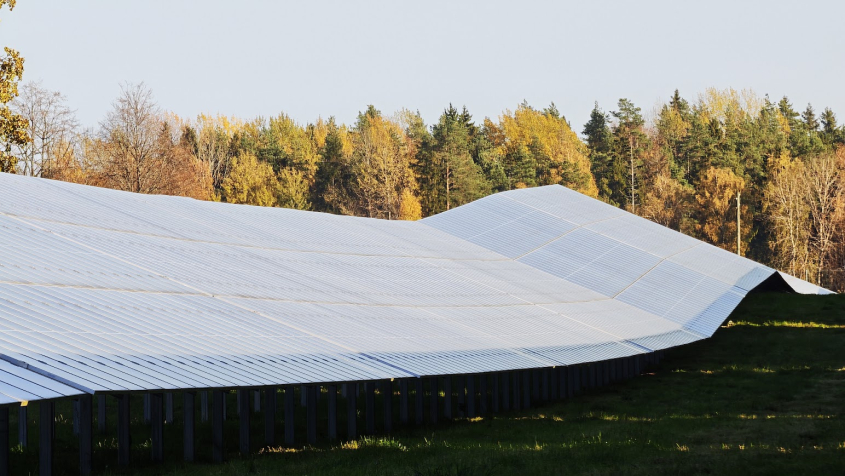
At the conclusion of the seminar, participants visited the Cēsis solar power plant (Cēsu SES), where more than 33,500 bifacial solar panels have been installed across an area of 23 hectares, using both direct sunlight and light reflected from the ground surface to generate electricity.
Māris Plūme, the representative of Cēsu SES and head of the renewable energy project developer Saules Energy, introduced the power station's operation and the experience of managing the area. The park was built on a previously degraded area overgrown with bushes and invasive plants. During construction, the existing terrain of the land was preserved as much as possible, adapting rows of solar panels to it and avoiding extensive land levelling work. Over several years, they have managed to significantly limit the spread of hogweed, while in parts of the area where grain crops were previously intensively grown, a more diverse vegetation is gradually recovering. During the visit, the possibility of reducing mowing frequency in certain parts of the park was also discussed, so that flowering plants could provide food for pollinators for longer.
M. Plūme also spoke about attempts to attract sheep farmers for grazing in the solar park area. Although cooperation opportunities have been sought for more than a year, no interested sheep farmers have been found. One of the main obstacles is the conditions for agricultural support, as solar park areas are excluded from the Rural Support Service's field blocks, and farmers cannot receive area payments for these plots. This reduces their financial interest, even though sheep grazing would allow solar park operators to limit grass growth, reducing the need for mowing equipment. Discussions at the seminar highlighted the need to review support conditions to promote such cooperation. As M. Plūme admitted, what he heard has prompted him to turn to this issue again and raise it with the responsible institutions.
The examples discussed at the seminar confirmed that solar energy production and biodiversity preservation can be combined if nature conservation requirements are taken into account at the very beginning of project planning. Ongoing management is equally important, as it largely determines whether the solar park area will become a suitable habitat for pollinators and other species.
The seminar was organised within the framework of the Interreg Europe programme projects BiodIvErSe 'Development of multifunctional and innovative solar electricity solutions while preserving biodiversity' and POLLINATE 'Improving territorial policy to prevent the decline of pollinator numbers'. Both projects are implemented with co-funding from the European Union. The BiodIvErSe project is implemented in Latvia by the Vidzeme Planning Region, while the POLLINATE project is implemented by the Baltic Institute for Natural Capital.