
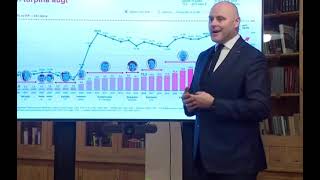
In the current climate, the formula for sustainable land resource use must incorporate geopolitical security risks, predictable long-term national policy, and a comprehensive database tailored to Latvia’s situation alongside social, environmental, and economic consensus. These conclusions were highlighted during a video discussion titled Sustainable Land Resource Use: Yesterday, Today, and in Ten Years' Time, organised by the magazine “Dienas Bizness” and the Latvian forestry and related sectors portal zemeunvalsts.lv.
The definition remains – the understanding is changing
“Essentially, sustainability is about what resources we use, how we manage them, and how well we can do so without causing significant harm to the surrounding environment,” emphasises Agnese Alksne-Bensone, co-founder of CSR Latvia and head of SIA Sustainability Partners. Although the definition of sustainability has not changed over the years, the context in which we speak about it has.
“Geopolitics, resource sufficiency, and availability within our territory, without ignoring the fact that we are in a global market where there is a fight for resources,” explains Alksne-Bensone, stressing that external processes provide a different context for sustainability.
“Natural resources and natural capital have always been used; over time, our understanding of the impact and the need to leave them for future generations has changed. This is nothing new; we are currently focusing on it more actively and viewing it with greater nuance,” explains Dr. Geol. Normunds Stivriņš, a professor at the Faculty of Exact Sciences and Technology at the University of Latvia. He points out that, from a scientific perspective, reasonableness is the determining factor in land resource use both in Latvia and across Europe, although other parts of the world are still relatively far from reaching such a view.
“Our daily life and existence depend on natural resources, including mineral resources. A balance must be sought between the extraction of these resources and their impact on nature, but closing down an entire industry without understanding what it provides for us is foolish,” assesses Stivriņš. He explains that we need to understand how specific food products or mobile phones reach us.
“Before deciding on anything, we must first assess the potential impact of the decision,” Stivriņš stresses. Regarding peat resources, he notes that they have been surveyed in Latvia and their extraction is strictly limited to specific areas – 25,000 ha, while the total area of peatlands in Latvia exceeds 640,000 ha.
“This confirms that there are plenty of natural bogs in Latvia, while in areas where peat extraction takes place, the environment has been altered; once extraction is complete, we will have to think about how to restore them while continuing economic development and ensuring the nation’s survival,” emphasises Stivriņš.
“Even before Latvia joined the European Union, I participated in a discussion about which areas we should leave for nature – where there are valuable habitats and significant bird nesting sites – and which we should leave for economic use, such as peat extraction. Over the following years, in the context of climate issues, there has been an escalation and confrontation between producers and those expressing different opinions, who tell beautiful stories about preserving natural capital,” explains Uldis Ameriks, Chairman of the Board of SIA Laflora and a member of the Council of the Employers' Confederation of Latvia. In his view, this is precisely why it is essential for every company to find this balance and keep track of developments.
“Companies operate within a regulatory framework and cannot do what this framework does not permit,” says Ameriks. In his opinion, it is important to be aware of sustainability issues.
“Although it is not required by regulations, thanks to our cooperation with CSR Latvia, Laflora prepared a sustainability report in which we summarised all factors – production, people, and environmental management, etc. This provided a clear vision of the company’s situation and allowed us to outline a future outlook for how Laflora will develop, especially since the company is a major employer with more than 300 employees and is a significant producer and exporter of peat substrates,” informs Ameriks. It is crucial to reassure employees and business partners that the company is sustainable.
Ownership of resources changes the perspective
“If we had managed to find a good consensus between the economic, environmental, and social spheres, there would not be such aggressive disputes over new regulations in any industry where we use (consume) resources,” concludes Alksne-Bensone. In her view, the biggest dilemma is whether the resources we own are distributed in a way that benefits everyone – the economy, nature, and people alike.
“It will be a major decision what we do with land resources, especially since the European Commission’s direction has always been restrictive,” points out Alksne-Bensone, noting that while several certification systems have been developed in the forestry sector, there are none in the land-use segment, even though the practices exist.
“It is also important who owns the relevant resource. If it belongs to a landowner, they will be interested in the long-term maintenance and restoration of that resource, if possible. Conversely, it is a different situation if the resource is extracted by a consumer who may not be fully responsible for what happens after extraction,” explains Alksne-Bensone. She explains that this is why requirements are being put forward.
“In the peat industry, work has been underway in recent years on developing a sustainability roadmap (memorandum), where all the major players were involved in discussions and managed to agree on specific issues,” says Alksne-Bensone. In her view, the only way to find any kind of compromise is through dialogue.
“Laflora is a major owner of both land and resources, so our task is to think about how to manage these resources efficiently, to think long-term, and to shape our land policy,” explains Ameriks. He notes that Laflora has a land management plan in place until 2050 – the target year for achieving climate goals.
“In our company, we are already dividing up our territory according to usage; in one place there will be (or already is) a wind park, alongside it a green industrial park. Various studies are being conducted because even obvious facts must be proven,” explains Ameriks, acknowledging that the industry can only develop if resources are available. The resulting memorandum for the peat industry is a good basis for agreeing with the state on how the industry can provide economic contributions towards achieving various national goals, while receiving the opportunity to extract these resources from state-owned land in return.
“Laflora already knows its available resources until 2050 and can plan its operations, especially since there are no problems selling peat substrates in global markets, where completely different factors are at play – the quality of the product and its suitability for growing the healthy food people need, whereas the Green Deal is a European mandate,” explains Ameriks. In his view, for these reasons, Latvia needs a land policy that includes resource usage and incorporates planning.
“In terms of planning, we have drifted into endless consultations, listening to every opinion, even marginal ones, without evaluating what the country actually needs,” concludes Ameriks. In his opinion, it is precisely this bureaucratic process that kills investments. That is why a state-level long-term land policy that is understandable to everyone is essential for finding a consensus between the interests of the environmental, social, and economic sectors.
“The scientists' task is to look at the numbers. Naturally, as measurements and studies are conducted, logical questions arise: why does the Latvian state pay the high taxes, rather than the countries that use (consume) the relevant resources, similar to what happens with oil products, for example?” notes Stivriņš. In his view, sustainability is about the traceability of impact.
“If we in Latvia care about the environment, economic, and social aspects, it would be nice if the rest of the world thought about them too, not just Europe. There are countries that don't even think about these aspects; they extract peat and replace the products manufactured in Latvia with it, in a situation where we decide not to extract peat in Latvia,” explains Stivriņš. He concludes that to bring all these aspects together, every company in the peat industry nowadays needs its own scientist, as well as its own sustainability specialists, etc.
The bone of contention – methodology
“It seems the biggest discussion, especially in the peat industry regarding CO₂ emissions and their impact on the climate, is precisely about the methodology,” concludes Alksne-Bensone. Specifically, when working with companies, she has encountered situations where we have not yet solved the issue of accounting for our own data and their methodology, and there are internationally accepted standards. However, it must be noted that in the export market, the battle is fought over percentage points in coefficients.
“This means it is very important to get our data issues in order, not only in the peat industry but also in other sectors, because when we plan large infrastructure projects, we often find that we are short on sand,” emphasises Alksne-Bensone. She acknowledges that there have been talks about this issue with several institutions and the head of the new government has also set a course for addressing the data issue.
“The biggest question is how nature meets the economy, where one of the most significant aspects is – what do we do with the resource we ‘take’ from the land? If we export it as raw material without adding any value within our own country, and that value is added in other countries, it is logical to ask why this resource is so cheap and why its impact is not reflected in other spheres,” explains Alksne-Bensone, noting that one of the ideas circulating that could lead towards a compromise is: we can take the resources, but can we add value to them right here, on the spot?
“There are other countries where enormous stocks of natural resources are extracted – silver, lithium, cobalt, oil, etc. The question is: are they exported as raw materials, or is value added to them in the country of extraction, developing the local economy?” assesses Alksne-Bensone. In her view, such a discussion has not taken place in Latvia, because it would raise many questions, as the state has allowed resources to be extracted and exported without adding value. From 2027, the natural resources tax on peat is being increased from the current 0.71 euros/t to 3.5 euros/t, though this in no way stimulates the processing of peat extracted in Latvia within the country itself.
Facets of data purity
“To make the right decisions and be able to protect ourselves properly, statistics are important – statistics that account for what is actually happening, not just that something has been dug up (extracted) in a certain place. For example, Laflora processes the peat it extracts into peat substrate needed for agriculture, which is then exported, but this processing is not reflected anywhere in the statistics because it appears in the export category as 'peat', which is listed in the same column as coal,” Ameriks is critical, pointing out that foreigners, when looking at the product nomenclature, conclude that it makes no difference whether it is burned or used for gardening and agriculture, even though peat is effectively no longer used for energy in Latvia.
“Latvia processes peat into peat products – substrates, which are the basis of the entire EU Green Deal,” says Ameriks. He recalls a conversation with a minister who suggested banning the export of raw peat; however, to develop local processing, one should not ban the export of raw materials, but rather apply an appropriate tax that stimulates processing them into products right here, in Latvia.
“The owner’s task is to understand how much and what kind of resources are in their possession, what is happening with them, how to work with them, and what is happening with climate issues and emissions, which is why Laflora conducts emission measurements to be able to prepare an objective balance sheet,” Ameriks replies when asked who should take care of the initial purity of data or its correspondence to reality. He points out that, for instance, the largest owner of peat resources is the state and local governments, and they should accordingly think about balancing the economic gains from using these resources with environmental interests. “Unfortunately, the restoration of bogs prevails, even despite the fact that they still contain available resources that represent a significant reserve, which could be extracted before carrying out the subsequent recultivation of the bog,” says Ameriks.
Another factor for sustainability – security
Ameriks reminds us that the overall picture is also influenced by the security situation, with reports of unwelcome visitors – drones – appearing almost daily; this is not the case in Western European countries: “In this situation, we must think as much as possible about how to use domestic resources to be as independent as possible, especially in the energy sector; therefore, the hype around wind parks in the current circumstances should be treated as a crime against the state.” He points out that the largest peat resources are in the countries bordering the eastern neighbour – Finland, Estonia, Latvia, and Lithuania; excluding peat from the energy sector is an ill-considered step. In Ameriks’ view, Latvia must invest heavily in security and convince people that they can work, live, and have a future here, which is why the company’s sustainability report will include another chapter – addressing security issues.
“Sustainability must be balanced with security, because it is a matter of our future existence,” stresses Ameriks.
A clear strategy is needed
“We devote a lot of time to the strategic framework of the national development plan 'Latvia 2050', and we see that resources must be balanced, sustainable, and circular, but it is very difficult to make progress on economic benefits – how to earn money,” points out Alksne-Bensone. She reminds us that setting a single decarbonisation goal does not mean the 100% elimination of fossil materials, because that is impossible.
“If this is maintained, we must ask whether there has been an evaluation of which sectors will not be able to exist at all and what consequences this creates,” asked Alksne-Bensone. In her opinion, a balanced policy is needed without abandoning the set goal.
“While developing various projects, I became convinced that a long-term strategy is needed first, followed by corresponding plans for its implementation. Otherwise, while working on the wind park development project in Kaigu bog, it was like playing football one moment and handball the next – the rules of the game were constantly changing, but a potential investor needs to know what awaits them until the intended project is realised,” says Ameriks. He has heard a list of requirements stating the need to comply with a total of 780 different regulations, which are supplemented over time.
“For an entrepreneur who wants to develop something, the rules of the game are not clear; they don't know what the country will actually aim for over time, including regarding the availability of land resources, which makes it very difficult to work and even more difficult to implement development scenarios,” concludes Ameriks. In his opinion, the only solution is to clarify the conditions of the game in the long term. “If we waver at the national level and perhaps also succumb to pressure from some interesting organisations that appear as suddenly as they vanish but slow down the processes, then it will be very difficult to implement a development scenario,” says Ameriks.
Decisions must be based on true data
“I hope that by 2035-2040 there will be clarity in data, for example, about how many bogs there really are in Latvia, because at the moment we are relying on data from 1960-1980, performing various calculations, and we might even end up paying fines,” concludes Stivriņš. He hopes that there will be data we can trust and that all decisions will be based on that.
“Calculations show that there are currently 120-130 active peat extraction licences. If no new ones are granted, between 2030 and 2040 about 60 licences will expire, and half will remain,” concludes Stivriņš. In his view, we need to understand and define where and what we are extracting.
“While previously the most essential requirements from European structures were the Green Deal and climate goals, quite recently European Commission President Ursula von der Leyen has expressed several significant insights (while keeping the climate goals) – energy security, secondary materials (whether we can return materials for a new life), artificial intelligence, and opening the market (protectionism) for secondary materials,” explains Alksne-Bensone. She points out that the desire is to use various instruments to create a balance between new materials, which are cheaper than those extracted again, as well as making more use of public procurement.
“Scandinavian countries have already formulated what they consider to be sustainable procurement throughout the life cycle of products and services; in Latvia, we have not yet reached such a level,” says Alksne-Bensone.
The discussion video is available here: https://www.youtube.com/watch?v=ZpUxWJT3xew