




The European Union is fighting to decarbonise its buildings, which are mostly heated with fossil fuels that generate planet-warming gases. However, the EU has the technologies to achieve environmentally friendly solutions. Experts believe the greater challenge is overcoming the barriers hindering the adoption of these technologies—namely, convincing people to change their behaviour and housing, and achieving a drop in the costs of cleaner alternative technologies.
When German Economy Minister Robert Habeck tried to ban the installation of new gas boilers from 2024 to reduce carbon dioxide pollution and increase energy security, the country’s most influential newspaper strongly objected. In May, for several weeks, headline after headline on the website and front page of the tabloid Bild read “Habeck’s ‘heating hammer’”. The most widely sold newspaper in Europe warned readers that the law would destroy their savings, wipe out their pension pots, and force them into complicated renovation works. Cracks rapidly widened in the ruling coalition between the Green Party, which wants to heat homes primarily with electricity from renewable sources, and the Free Democratic Party, which calls for “technological openness”, including the combustion of various gases. Boilers that had been gathering dust for decades in basements across the country suddenly became a symbol of Germany’s energy transition and the associated “culture war”.
The German struggle to heat homes without endangering the planet is playing out in countries across the continent. Technologies to reach the 1.5 degrees Celsius target in the buildings sector are available, but society is not ready to accept the problem and the costs, noted Adeline Rochet (Adeline Rochet), an expert in building decarbonisation at the climate analysis centre E3G. “Put simply, it will be very difficult, but not impossible.”
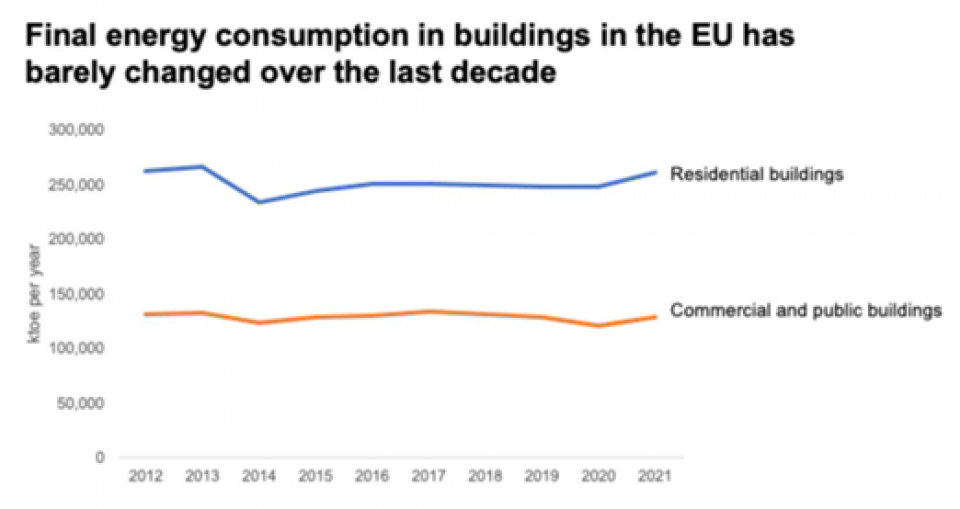
Half of the total energy consumed in the EU in 2020 was used for heating and cooling, typically by burning fossil fuels, with buildings accounting for the majority of demand and industry for one-third. However, despite green ambitions, according to information provided by the European Environment Agency, progress in reducing this indicator has been “slow”. In some countries that have switched to clean technologies, such as Sweden and Greece, greenhouse gas pollution generated by energy produced in buildings has more than halved over the last decade and a half. In other countries, such as Romania and Lithuania, it has barely decreased at all. From 2005 to 2020, building emissions across the EU fell by a third, but they are not falling fast enough to reach the bloc’s unofficial goal of reducing emissions by 60% compared to 1990 levels by the end of the decade. It is expected that only eight countries—Austria, the Czech Republic, Denmark, Greece, Luxembourg, Slovenia, Finland, and Sweden—will reduce emissions by more than 55% using policies proposed by the European Commission that have not yet been incorporated into national legislation.
So far, the EU’s success in reducing building emissions is mainly linked to cleaner electricity grids, better-designed homes, and milder winters resulting from climate change, although these gains are partly offset by an increase in average living space per person. Unlike other sectors, where clean technologies such as vegan meat and electric cars have captured public attention, the means to reduce heat loss in buildings are neither attractive nor widely advertised.
There are two main approaches: reducing energy demand and supplying it from cleaner sources.
Heat for homes—from the outside
The second of these solutions is the most controversial. Experts believe that the most effective technological solution is replacing fossil fuel boilers with heat pumps. These devices act like reverse refrigerators, using a refrigerant to absorb heat from the surrounding environment and move it into the home. They can also serve as air conditioners. If the electricity powering the pump is derived from renewable sources, the heat generates no carbon emissions. If they are powered by a “dirty” electricity grid, they are less climate-friendly, yet their emissions are lower than those of gas boilers. Heat pumps are particularly efficient because they do not produce heat themselves but only transfer it.
According to models developed by the Paris-based International Energy Agency (International Energy Agency), an organisation led primarily by the energy ministers of wealthy nations, to help world leaders meet their climate pledges, a quarter of global heating needs will have to be met by heat pumps by 2030, and half by 2050. The plan for reorganising the German economy developed by the climate think tank Agora Energiewende indicates that by as early as 2035, heat pumps will provide energy for the majority of German residential buildings.
The fastest adopters of heat pumps have been cold Nordic countries, such as Norway, Sweden, Finland, and Denmark, which are wealthy and have plenty of cheap and clean electricity, as well as an appropriate carbon tax on fuel. All of this combined means that the operation of heat pumps is even cheaper than that of fossil fuel boilers. However, experts are cautious when comparing the costs of a heat pump and a gas boiler, as they depend on many factors: the specifics of each building, the level of national subsidies and taxes, and fluctuations in electricity and fuel prices. Nevertheless, they agree that installing a heat pump usually costs more, but operating it costs less.
Despite this, the price is not taken into account in discussions about the dual role of the heat pump, admits Kevin Kircher (Kevin Kircher), a mechanical engineer at Purdue University (USA) specialising in buildings. Since this technology is very similar to an air conditioner, heat pumps can be used to heat homes in winter and cool them in summer, although not all heat pumps are designed for this purpose and not all are easily retrofitted after installation.
According to data from the World Meteorological Organization, temperatures in Europe have risen more than twice as much as the global average over the last 30 years due to climate change, which is why extreme heatwaves are becoming increasingly large and likely. Yet only a few homes have air conditioning, and demand for it will rise sharply. In the US, where nearly 90% of homes are equipped with air conditioning, the cost difference between a gas boiler and a heat pump in new buildings is “negligible” because a heat pump can meet both heating and cooling needs, Kevin Kircher pointed out. “In existing buildings, the calculations are slightly different because a homeowner cannot replace both the furnace and the air conditioner at the same time.”
Sales of the long-overlooked technology have begun to rise sharply. Last year, 3 million heat pumps were sold in Europe, a 39% increase, surpassing the previous year’s 34% growth. “For us, 2022 was truly a turning point for the heat pump industry,” said Jozefien Vanbecelaere, Head of EU Affairs at the lobby group European Heat Pump Association (EHPA). The COVID-19 pandemic made people think about air quality, Russia’s invasion of Ukraine prompted people to stop using its fuel, and the EU responded to the US Inflation Reduction Act by setting “very ambitious” targets.
The most daring of these targets is set by the European Commission, which wants to introduce another 30 million hydronic heat pumps by 2030, which work by using external heat to warm water in pipes. The EHPA predicts that by also adding air-source heat pump systems, which use warmed air to maintain heat in homes, the number of existing heat pumps will quadruple to 60 million by 2030. However, one of the biggest obstacles to the adoption of heat pumps in existing buildings remains the reduction of their relative costs, J. Vanbecelaere emphasised. She added that this includes “shifting taxes and levies from the electricity bill to the fossil fuel bill [and] the introduction of a carbon price”. EU electricity has already been about three times more expensive than gas for several years.
Furthermore, some analysts worry about the threat of a shortage of qualified personnel to install heat pumps and the lack of a serious plan for how to train them. There are also cases where heat pumps perform poorly in homes, for example, at temperatures below -30 °C, or are unsuitable, such as in some apartment buildings with limited space, multiple owners, and strict planning restrictions. Experts point to alternatives such as district heating, where heat is produced centrally—perhaps from a huge heat pump or by burning waste—as well as solar panels that can heat water. Regarding district heating, which is already widely used in many European countries, the fuel source would need to be changed from fossil fuels to cleaner energy sources or be equipped with carbon capture technologies.
To be continued...