



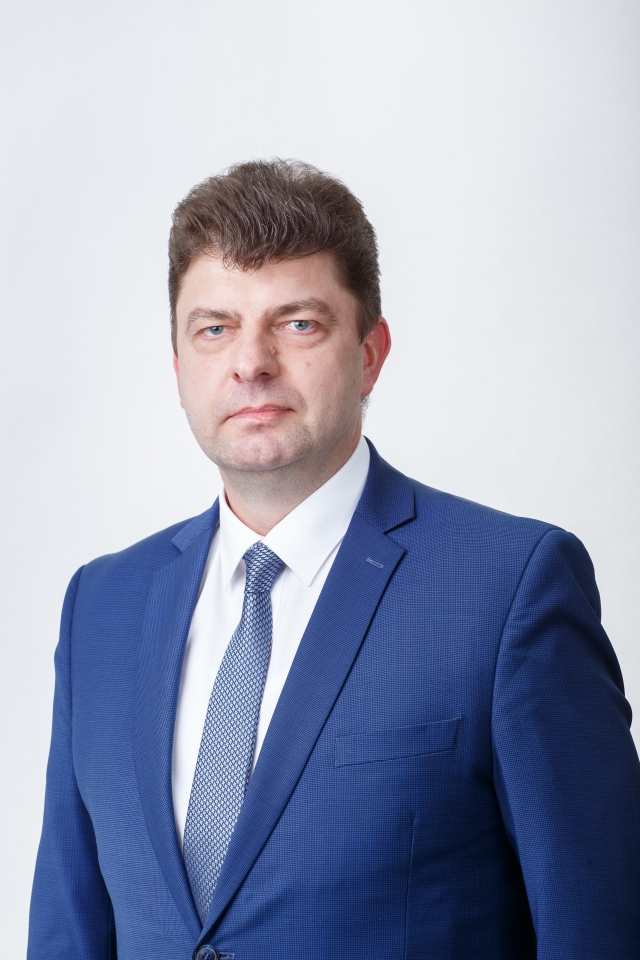
Māris Liopa, Chair of the Forest Certification Council of Latvia (LMSP), and Pauls Rēvelis, editor of zemeunvalsts.lv, speak with Normunds Rečs, Chairman of the Tukums Municipality Council
Before elections, people usually expect something. What are you expecting from the new Tukums Municipality (following the administrative-territorial reform) and the newly elected Council?
Development! Undoubtedly – more rapid development!
What has hindered the pace until now?
Two factors must certainly be mentioned: firstly, national policy towards local governments—specifically, a few years ago, municipal lending was cut off and national investment programmes were suspended; this year, there was also a reduction in personal income tax revenue for municipalities. Secondly, in my opinion, the previous leadership of the Tukums Municipality Council lacked sufficiently ambitious plans and a vision for the development of the region. Tukums still lacks infrastructure facilities that other municipalities have, such as a swimming pool. The Tukums Art Museum houses the second largest collection of national Latvian art in Latvia, yet it is kept in pitiful conditions because there is no exhibition hall where this wealth and value could be properly shown to the public. The Tukums Music School operates in 'dismal' premises. One must also think about the buildings in the historic centre of Tukums, many of which have not been renovated for a long time. Of course, some of these buildings belong to private owners, but the municipality's previous efforts in this regard have also not been sufficiently targeted... I think the residents have a desire for tangible and visible development, and we in the Council must provide our vision. People will certainly respond to good ideas! At the end of 2020, we surveyed residents about which facilities in Tukums should be developed first. The response was great, which resulted in the Council's December decision regarding cultural and sports facilities to be developed over the next ten years.
How are the talks proceeding between the four regions – Engure, Jaunpils, Kandava, and Tukums – regarding the merger into one municipality?
Everyone is participating in the talks, even though the Kandava region is awaiting a ruling from the Constitutional Court. Currently, the formal decision-making body for the four regions is the Finance Committee, which considers the assumption of various financial obligations within the regions. All four municipalities are actively working on creating the administrative structure for the new municipality so that the newly formed authority can continue to operate without interruption from the first day, that is, 1 July.
How do you view the new development – residents' councils?
In the Tukums region, this is nothing new; such councils have operated and continue to operate in all 10 of the region's rural districts (pagasti). I assume that this will be something unprecedented in other regions. I believe that such councils are the first public forum where local matters and issues are discussed. This allows the heads of the relevant territory administrations (rural districts) to pursue these matters further in the regional Council more convincingly, once they have received approval from local community representatives. For us, this system is already working and will continue to do so in the new municipality.
Will the centres of the current regions remain as development hubs in the future?
Definitely! There is no doubt about Kandava; it will be the second city in the region. A peculiarity of the Engure region is that it does not have one distinct centre. Essentially, the Engure region is polycentric because the rural district centres – Smārde, Engure, and Lapmežciems – are equivalent. The aforementioned rural districts are sufficiently populated, and therefore administration will be maintained in each of them. Jaunpils is also a distinct local development centre, and the Jaunpils rural district administration will continue to provide many of the current Jaunpils region's functions after 1 July. The combined Tukums Municipality will have about 47,000 residents, which will give us third place among regional municipalities after Valmiera and Ogre.
Jaunpils makes a good impression in terms of entrepreneurship...
The guiding principle of the merger: after the merger process is complete, the best of the currently available services in each respective location will be preserved. The others will adopt the experience and regulatory framework of whoever currently has the best practice.
What should be done with those residents who turn their yards or buildings into repulsive piles of scrap metal?
Unfortunately, there is such experience in Tukums too, and... it is not easy. There are two paths: the municipal police, who record violations if they disturb public order. On the other hand, regarding dilapidated buildings, there is a mechanism involving the application of property tax at the maximum rate. However, in my opinion, the most correct way to resolve the issue would be through municipal support programmes. There is a good example in Latvia – the Old Town of Kuldīga. Tukums does not yet have such programmes, but one must certainly think about it.
The region will have a wider coastline and the number of specially protected nature areas will increase. Regarding the Talsi region, it was emphasised that you cannot simply take the coastline away from people. This trend is appearing; it may hinder development.
No one is thinking about taking the coastline away from the residents, that is clear! I am aware of the problems mentioned in the question. Not long ago, it was necessary to expand cemeteries in the coastal villages of Lapmežciems, Bigauņciems, and Ragaciems. The plan 'hit' nearby protected territory areas, which significantly complicated the process. Problems on the coast involve both the installation of utility networks and infrastructure in general. People have lived on the Gulf coast for centuries and will continue to do so; a balance must be found between people's needs and their provision, and nature conservation. To say that nature is the complete priority and people must disappear from a place... is a very flawed approach.
The fact that the Tukums region has excellent natural wealth reminds us that we have something to be proud of, and it must be valued in everyday life!
Along with the coastline, you will acquire a small port in Engure...
In the Engure port, the issue of ownership rights for port infrastructure facilities has not been fully resolved: the pier and part of the buildings in the port area have not yet come into the municipality's possession. Municipal participation in port development is thus hindered. Another thing: the Engure port is filled with sand relatively quickly; currents interfere with the shipping lane in this way. It is known that the port needs dredging. As far as I know, there are preliminary plans for the development of a yacht club, where active work is underway. In the future, I look hopefully at the possibility of supporting cooperation between the Engure secondary school and the yacht club to develop interest-based education programmes, such as teaching sailing skills to young people. As is well known, Engure once had a maritime school.
How many secondary schools will be in the region...
...seven. Three in the Tukums area – Tukums Rainis Gymnasium, Tukums Secondary School No. 2, and Zemgale Secondary School in Slampe; Engure Secondary School, Jaunpils Secondary School, Kandava Regional Secondary School, and Kandava Kārlis Mīlenbahs Secondary School.
The Tukums municipality owns large forest areas, how do you manage them?
The forests are managed, and they are a significant source of income for the regional budget. We can manage them even better; we are looking for an environmental management specialist through a tender process who will deal with forest management, public waters, and sand and gravel quarries. In recent years, we have gained about one million euros for the regional budget from the forest, and there have been several auctions this year as well. We must work on forest management projects, where work should be completed on all areas. Of course, it is spring and forest planting is underway.
The municipality also owns agricultural land, which is not strictly necessary for the provision of municipal functions, so when land users or tenants show a desire to purchase this land, of course, we make a decision accordingly. It must be said that for rural district administrations, the disposal of agricultural land is a significant financial source, because a specific amount (percentage) of the money from the sale goes directly to the rural district's budget and is used for the needs of the district.
How does the proximity of Riga and Jūrmala affect Tukums?
Positively. I look at this situation philosophically because Tukums is a very good place to live. Even better than Jūrmala. If we assess property tax, in Tukums it is friendlier to residents compared to Jūrmala. Property prices here are also attractive. Traffic with Jūrmala and Riga is very good (it will be ideal at the moment when the four-lane motorway, promised by the Minister of Transport, is opened). There is train traffic. The city is compact, and the rural territory is accessible via relatively good roads. Services are available to residents. What do we lack? I already mentioned – a swimming pool and high-quality cultural education institutions. The latter would relatively attract more tourists, of course, in normal living conditions without pandemic restrictions.
The proximity of Riga and Jūrmala is in a way even positive, because it is evident that properties do not stand empty, and people move here or continue to live with us. Rental housing prices, however, remain high. There is a plan to create an offering of rental housing in the city: firstly, we are counting on the national programme promoted by the Ministry of Economics, where municipalities will be offered standard housing projects at affordable prices. We in Tukums have identified a piece of land in municipal ownership for this project. The second type of solution is the selection of lease offers from private apartment owners, i.e., the municipality announces a tender: apartments are needed, please submit offers. The third – adapting municipal-owned buildings for living. For example, the former orphanage building in Irlava could be transformed in this way: the ground floor will have creative workshops, the other two floors remain empty, which could be perfectly adapted for living. However, financial resources for reconstruction are needed here.
Swimming pool
The nearest swimming pool is in Ķesterciems, on the coast, but it is in private ownership (the former 'Albatross' pioneer camp), where reconstruction is taking place. Of the nearest ones – pools are in Vaivari and Kuldīga. We hope there will be one for us too.
Tourism objects are currently 'silent'; the region has manors, castles, hillforts, and trails, and... the memorial place for Latvian legionnaires in Lestene.
The Lestene memorial is developing and will be transformed into a higher quality level. The Brothers' Cemetery and the church, which are being restored step by step, will be joined by the restored museum building on the other side of the road. The building has come into municipal ownership through the care of the Daugavas Vanagi and the support of former legionnaires' donations. On 8 April, the founding meeting of the society 'Lestene' for the memory of Latvian soldiers took place right there in Lestene. Six organisations that have participated in the creation of the memorial so far have united in the society; the goal: to jointly create the Museum of the Memory of the Courland Battles. The plans in Lestene are big and, I am sure, they will be realised.
We spoke about Riga and Jūrmala. At one time, the good traffic with Jelgava had faded away slightly: the railway remains, there is no passenger train, only a few buses run
The question is interesting because... there have been attempts to unite Tukums more closely with Zemgale, but... People's habitual paths, transport movement, which has historically formed 'to' or 'from' Riga, usually lead to Kurzeme – Ventspils, Kuldīga, Talsi. That is the Riga – Ventspils highway, at one time also the train. The direction of Zemgale and Jelgava... There are some peculiar divisions about which we sometimes laugh: 'They say Tukums has self-identification problems.' For example, when electing the Saeima, we are in the Zemgale electoral district. In the planning region, we are included in Pierīga (the Riga region). Our court district is Zemgale, our agriculture administration is in Kurzeme, we are also with Kurzeme at the Song and Dance Festival, in the new Law on Historic Regions we are divided between Kurzeme, with some rural districts belonging to Zemgale, and Lapmežciems, as it turns out, is located in Vidzeme. The new head of the Tukums region will have to have three types of folk costumes made.
Adult education in the region – what is the situation, what are you planning in this area?
At the national level, this stage of education has been left to private education organisations and competence centres, and partly also to higher education institutions. For example, if we look at European funding intended for the retraining of employees, we see that municipalities have no opportunity to participate in attracting funding there. The municipality's 'job' is to ensure residents have access to education services (the provision of service), which, in turn, is provided by universities or vocational education institutions. Municipal initiative: adult education centres can be established, looking at the municipality's capabilities and needs. Tukums has a branch of the University of Latvia; at one time, we fought very hard to keep the branch. At the time when RPIVA was liquidated, by adding it to the UL, we drove to Riga, talked at the ministry, met with colleagues... Honour where honour is due, the UL branch was saved, there are successes, the number of students is growing. Also, in the upcoming Tukums Municipality there is the Kandava Technical School, where there is currently anxiety about the possible optimisation of the institution. In any case, we have expressed our position on preserving the technical school in its current status, which ensures the training of agricultural specialists, because there are no similar institutions in the immediate vicinity. We have spoken with representatives of the Ministry of Agriculture and the LLU about the preservation and future development of the technical school.
Comments