


Latvian companies are capable of a great deal, is the firm belief of Viesturs Krēvics, “Stiga RM” factory director, who heads the plywood production division. At the company's Kuldīga production facility, high-quality Latvian birch timber is used to produce birch plywood, which then makes its way to almost 50 different countries around the world. In our conversation, Viesturs reveals that “Stiga RM” is investing several million euros in the modernisation of the factory and can now rightly boast of having the most modern and powerful “fleet” of production equipment to add value to the wealth provided by Latvia’s forests. Viesturs Krēvics is interviewed by Māris Liopa, Chairman of the Forest Certification Council of Latvia, and Pauls Rēvelis, editor of zemeunvalsts.lv.
During our brief introductory tour, some good thoughts came up from time to time that would be useful for an interesting story about the industry, for example, “this machine, if we compare it to a car, is like a Mercedes”. In the world of factory equipment manufacturers, it seems there are not too many – how do they differ? Are these nuances, or serious technological solutions, or something else?

I myself really like the comparison to a Mercedes, which is an acknowledged leader in the automotive industry – safe, reliable, high-quality. In plywood production, I would call the Finnish manufacturer Raute such a leader; its equipment is well-known to industry professionals and highly regarded due to its quality and innovative approach. For example, if a Raute machine malfunctions, the problem can be identified and fixed promptly with the help of a computer, without stopping production. In the long run, the advantages of modern equipment in terms of production capacity and product quality become very clear, which is why we prefer more expensive, but undoubtedly better, solutions.
At the same time, we also use equipment from other manufacturers in the factory, which we are gradually modernising according to current needs and customer demand for products of a certain quality. If you want to be at the forefront in terms of capacity and quality, the modernisation of processes and equipment is a daily necessity, which is why we began an ambitious development project at the beginning of 2023, which will continue until the end of next year; we plan to invest more than €22 million in it.
By improving and automating production processes, better working conditions and a modern working environment are also ensured for the factory's employees.
Automation has a future in the industry, but it is clear that we cannot do without people, no matter how much people talk about it. Are employees trained on-site at the factory, or do they gain their skills in another way?

For the most part, we train our new colleagues ourselves, sharing our experience and the nuances of the work that are so important in the production process. We tell potential employees who come to us for job interviews about the options available – which machines and which workshops they can work in, and which processes they can control. In my opinion, it is very valuable to explain and clearly demonstrate the growth opportunities within the company right from the start; that is, today you could start working here, but tomorrow – somewhere else, where there is more responsibility and more opportunity. The employee, in turn, needs the desire to learn – we explain and provide the rest. The team is very close-knit; good mutual cooperation is a daily occurrence at the factory. It is a major advantage if a person is able to work with several machines, replacing a colleague when necessary. It often happens that after training, employees come to us with suggestions on what and where it would be worth improving or changing. I very highly value this kind of involvement.
How many employees are there at the Kuldīga factory?
Currently 250. Modernisation and automation projects have the effect of increasing the proportion of higher-skilled jobs every year, reducing the demand for medium and low-skilled specialists. For example, we are currently inviting high-level mechanics, electrical fitters, electronic engineers, automation specialists, and also sales specialists to join our team. We are currently building a new boiler house, so the position of heat energy specialist is also relevant in Kuldīga.

We are always happy about the interest of young specialists in coming to us for an internship or starting a career while still studying. We support students' desire to gain practical experience and provide every opportunity to grow with us to become high-level professionals in the industry.
It is important to emphasise that we do not just manage the production process, but we install and know the production equipment well ourselves. This is important because, after installation, we will be working with this equipment ourselves, and when starting work, at least some of the necessary knowledge will already be there – how things were assembled, how this or that technical unit is put together or taken apart, etc. We use the experience gained in further work and, obviously, we can achieve more with the money invested.
Knowing what stereotypes exist about those working in factories, I want to emphasise that in the case of “Stiga RM”, they in no way correspond to the truth. We are breaking stereotypes; in our production facility, you can meet young, educated, highly qualified engineers and engineering specialists of both genders who are able to work with technology and “sophisticated” equipment software. Production is maximally automated, the work environment is modern and pleasant, and at the end of the month – a good salary, for which all taxes have been paid.
Getting to know the factory, we spoke about how, like the legend of Riga, the factory will never be finished. However... Is there a known or guessable moment when it becomes clear that one stage of development has concluded and it is time for the next steps?
When we first started working, it really felt like such a moment might or should arrive. Having gained experience, we understand that development and modernisation is a continuous process. The factory management team has been given the task and the “green light” to dream about the next steps in development – even if what we come up with sometimes seems unrealistic, we share our vision of the future and ideas that could be implemented, in order to find a suitable solution together. Over time, there have been many ideas; we could continue to generate and develop them for at least the next five years, increasing production efficiency and boosting the volume and quality of the products produced.

Answering the question about completion – I could not draw a line, because next year one stage of modernisation will be reached, but the dreams and their flight will continue.
Have there been any problems with selling the finished products?
As in any industry, situations can vary. Over the years, we have developed a number of advantages – there are clear goals and a vision for how we will achieve them; it is also very important that we can provide for ourselves with resources. There is serious reason to think that within the next few years we will remain the only plywood producers in Europe that produce it 100% only from birch. Other manufacturers, both in Latvia and in neighbouring countries, produce a large part of their plywood by combining birch with other wood, which reduces the durability of the finished product and other advantages of the material.
Of course, the market will “fluctuate” in the future too, but we have taken care of the most important resources – the availability of raw materials, the modernisation of equipment, and a strong team, so the work invested will yield results in the coming years.
How many countries do you export to?
“Stiga RM” products travel to approximately 50 countries. The company's sales team is small and works with several clients. Our goal is not to sell to “three big whales” – better to sell to a hundred small ones. Such a principle allows us to sell more profitably and to be more flexible and independent of market conditions.
For example, in 2016, after Brexit, the market experienced a significant shock, but it did not affect the company's operations at all because we quickly compensated for the UK market with buyers from other countries. I have experienced several such situations. If the client base is sufficiently broad, unexpected turns of events allow issues to be resolved much more promptly and easily.

Regarding the mentioned dreaming – does the company's management team also have a solid background in technical knowledge?
That has undeniably been accumulated over the years. When I started working here at the Kuldīga factory, I had no experience in plywood production specifically, but I did have a clear vision of what we wanted to achieve and what result was necessary. In our case, a major advantage was the opportunity to produce and change the old equipment at the same time, to understand what we needed and what we wanted, while learning at the same time. Two projects related to equipment replacement were implemented very successfully – the equipment was installed, it is working and producing, and we are already thinking ahead. Profits are constantly being invested in development, and we are very proud of that.
In Kuldīga, just like in other Latvian towns that have good jobs, things aren't exactly brilliant when it comes to the opportunity to get housing...
For several years now, we have been encountering a situation where strong and hardworking people are ready to come to work for us, but they face a shortage of housing and logistical difficulties, so it was undeniably important for us to start addressing these issues. Given that real estate developers mostly focus on Riga and its surroundings, we decided to get involved in the development of the region's housing stock ourselves. Currently, two projects are in the development process – the construction of a five-storey apartment building for “Stiga RM” employees in Kuldīga and building reconstruction work in Milzkalne, Smārde parish. Total investment in both projects is estimated at €5.5 million.

In this case, we are certainly not talking about profit or other financial gains from real estate development – these are social projects for strengthening the team and promoting employee welfare. Of course, indirectly, this is a great opportunity to strengthen our production, sales, and export capacity, because top-level professionals who come to work for us will increase the team's capacity and, accordingly, the company's performance as a whole. In the long term, this initiative can be assessed as a serious and far-sighted investment in the company's future development.
If those in the dark talk about forests, it usually sounds like “everything has been cut down”; if they talk about production automation, the same people, who are close to politics and activism, but don't actually work in factories, also worry – “well, they will drive everyone out onto the street, well, people will be without work”. On our short tour, you said – in this place and that place there will be a machine, the people who work here will have work elsewhere. That is also planning and development.
Exactly! As I mentioned, we always try to promote the employees who are already working with us. For example, if a new vacancy appears, we will look and invite one of our existing employees to learn the job. When we plan modernisation, we know clearly and in good time where and in what jobs we will subsequently use the people who were previously employed with the old equipment. If we replace “old” equipment with more productive and powerful equipment, we look at how that will change the situation in the factory – often, manpower is needed elsewhere. If the machine is more powerful, it will produce or process more, and this “more” will also need more manpower.
Mentioning the story about the factory again, you said that everything works if you balance development, construction, and production.

I would add “equipment installation” to the word construction, as both go literally hand-in-hand. Our engineers usually work very actively with both the builder and the equipment manufacturer, because the most important thing is to continue producing. You must not stop, because any kind of development requires funds. It is not just about the company's well-being – thanks to the introduction of new technological processes, the company's competitiveness will be strengthened and operational indicators will be improved, which will also top up the state budget in the form of taxes.
By increasing production efficiency and boosting the volume and quality of the products produced, we contribute to the development of Latvia's wood processing industry, the growth of export volumes, and an even greater contribution to our national economy.
Moreover, the modernisation of production processes is a step towards implementing more environmentally friendly operations. We take care to implement more energy-efficient and resource-saving production processes, investing in the promotion of sustainability principles.
Your colleagues – Jānis Osis and Andris Ramoliņš – have emphasised and taken pride in their cooperation with local entrepreneurs and manufacturers in interviews. You also quite proudly said in the factory that “Latvia can!”, because this and that is produced right here.
Good cooperation with Latvian companies has been present in the implementation of several projects. The latest example – during construction, it was necessary to move two pieces of equipment; for this work, we brought in a small local company that handled it excellently. What do I want to emphasise with this story? Latvian companies are capable of a great deal!
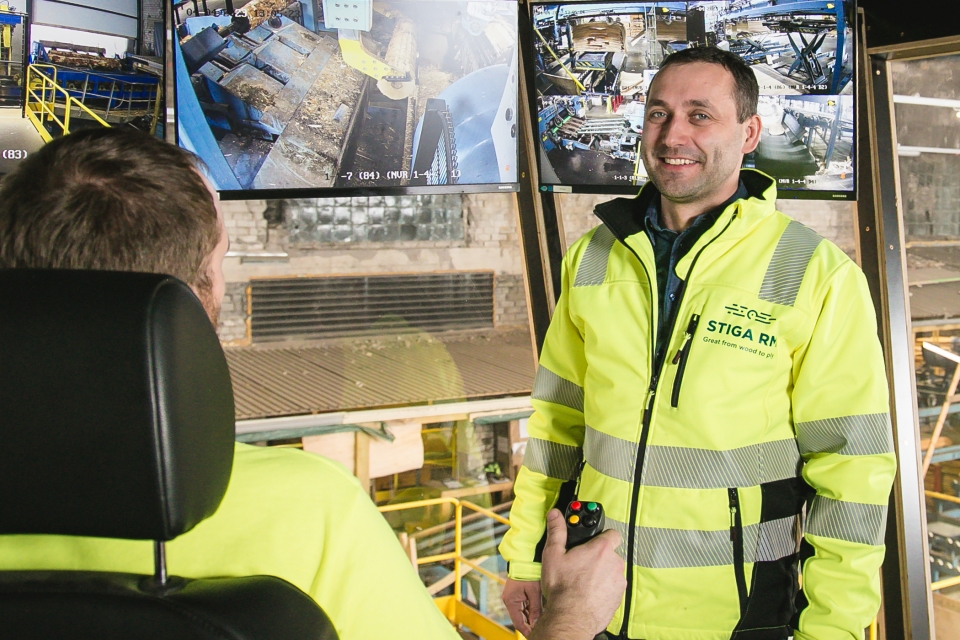
At the same time, we are quite demanding – if it's needed today, that means – today! Unfortunately, a different story is heard more often – it's needed today, but maybe tomorrow or the day after... In our case, such an attitude is impossible – if you want this job or order, you must be able to do it! Suppliers understand and accept these terms. Moreover, looking at future projects, our cooperation partner knows well: if everything succeeds successfully and on time once, there is a very real possibility that they will be invited to collaborate again.
Speaking of the capabilities of local entrepreneurs, I want to emphasise the shortage of technically clever minds even on a global scale – if in a large international company only a few people are well-oriented in technical matters and there is no specialist available for consultation, such a situation does not work for us, because the machine must work. That is why we highly value local experts and are ready to train new talents who know how to work with both their hands and their heads – such people are always welcome at “Stiga RM”!