
Weekly review
Poll
Concern about gaps in the skills and knowledge of our pupils is voiced quite widely from time to time. Unfortunately, only when someone from outside Latvia has concluded as much. Why is that?
There is a political tendency to be busy, to invest, to make promises, but not to think about the results
If you have little knowledge yourself, you do not even know how or what you do not know...
A smart society is not always desirable or welcome
Many interests swirl around education. A "good result" is rarely mentioned among them

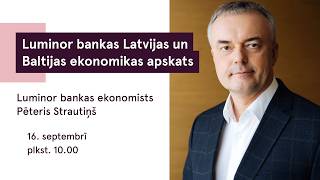

18-24 November

On current and upcoming events
### 30 November at the LBTU auditorium: Forest Sector Conference 2023
### Until 3 December we invite you to vote for the European Tree of the Year
eiropasgadakoks.lv · balsojums 1
eiropasgadakoks.lv · balsojums 1
### 25 November literary and musical composition Senses Games by pianist Andrejs Osokins and actor Gundars Āboliņš at the Column Hall of Jaunmoku Palace
### 27 November “Koka Rīga”, Krāsotāju iela 12, seminar on solutions for the development of Riga's green infrastructure
On official matters
Minister for Agriculture Armands Krauze will pay a regional visit to Kurzeme on Friday, 24 November, to discuss current issues in the sector, assess the situation, working conditions and mutual cooperation with employees of the Ministry of Agriculture's subordinate institutions and capital companies, as well as with Talsi Municipality officials.
Rural areas must be strong and viable throughout the EU, as rural territories play a vital role in food production—which is particularly important in the current geopolitical situation—as well as in nature conservation and climate action. The foundation for all this is rural population—the people who live and work in rural areas.
varam.gov.lv · varam nosaka jaunas teritorijas staignaju mezu aizsardzibai
The draft regulation also provides for the creation of 74 new nature reserves and the expansion of six existing ones. The new reserves are mainly located on state-owned land (93% of the land included in the new reserves is under the management of the state-owned joint-stock company Latvijas valsts meži). In the new reserves, 2.8% of the land is owned by private individuals, 3% by legal entities, and 1.2% by municipalities (including SIA Rīgas meži). In total, the draft regulation provides for setting a protection status for 2,088 ha of the priority EU-importance habitat – bog woodlands, improving their protection level to ~40% of their total distribution in the country, thereby partially resolving the infringement procedure initiated by the EU against Latvia. In accordance with the Latvian position approved by the Cabinet of Ministers in 2020—to establish new specially protected nature areas (ĪADT) for the protection of bog woodlands—work is continuing on the preparation of proposals for the designation of new ĪADT.
The draft regulation also provides for the creation of 74 new nature reserves and the expansion of six existing ones. The new reserves are mainly located on state-owned land (93% of the land included in the new reserves is under the management of the state-owned joint-stock company Latvijas valsts meži). In the new reserves, 2.8% of the land is owned by private individuals, 3% by legal entities, and 1.2% by municipalities (including SIA Rīgas meži). In total, the draft regulation provides for setting a protection status for 2,088 ha of the priority EU-importance habitat – bog woodlands, improving their protection level to ~40% of their total distribution in the country, thereby partially resolving the infringement procedure initiated by the EU against Latvia. In accordance with the Latvian position approved by the Cabinet of Ministers in 2020—to establish new specially protected nature areas (ĪADT) for the protection of bog woodlands—work is continuing on the preparation of proposals for the designation of new ĪADT.
Following the Cabinet of Ministers' approval of the draft regulation “Regulations on nature reserves” developed by the Ministry of Environmental Protection and Regional Development (VARAM), there will be a significant increase in the area of specially protected nature territories managed by AS “Latvijas valsts meži” (LVM), aimed at protecting bog woodlands rare in the European Union (EU), thus laying the foundation for the completion of the terrestrial Natura 2000 network.
On industry matters
To promote the future development of “Latvijas Finieris”, an extraordinary general meeting of shareholders held on 14 November this year decided to increase the company's share capital from 89.6 to 134.5 million euros. Accumulated profits from previous periods were allocated for this share capital increase.
The 29 October broadcast of Nekā personīga featured the Ministry of Climate and Energy's (KEM) plans for achieving climate neutrality in Latvia, namely, by increasing the felling of old forests in Latvia to replace them with young stands. One might think it's a joke. But it turns out, as Minister Kaspars Melnis acknowledges, this is what they have arrived at.
“Stiga RM” has begun work on setting up a metalworking factory in Milzkalne, Smārde Parish, in order to relocate its existing production facility to more spacious and modern premises by next spring. It plans to invest 850,000 euros into expanding operations and improving the new facility, using only the company's own funds to implement the project.
The struggle for forests has resulted in an uncertain pause, as agricultural land and forest land—the source of Latvia's main export product, timber—are currently experiencing a much slower market pace than at the beginning of the year, according to Latio's latest “Rural Property Market Index”.
youtube.com · watch
Forest stories
Forest stories
Deputy Chairman of the Riga City Council Edvards Ratnieks: “The Riga City Council and its capital companies continue to help and support Ukraine. Every donation from the Riga municipality, city companies, and citizens of Riga to Ukraine and its people is a step closer to Ukraine's victory in the war. I truly hope these vehicles can save lives and help achieve victories.”
On hunting and related matters
During the autumn and winter periods, when visibility on roads deteriorates, the number of collisions with wild animals also increases. Collisions involving killed, dead, or injured wild animals must be reported to the State Forest Service, which can also be done using the “Mednis” app.
Amendments to the State Forest Service Law are scheduled to be considered by the Saeima in the third reading on 23 November 2023. These involve significant changes to the State Forest Service's powers, expanding them considerably. The Chairman of the Board of the Latvian Hunters Association, Haralds Barviks, stresses that:
“These legal amendments have been in the works for a long time; they were ‘stuck’ in the Economic Committee and were set in motion again this year. Although we had previously sent objections to such a draft law, it is clear that our opinion is not being taken into account.
On wolves
On environmental issues
Analysts believe that the biggest problems may arise for those electric vehicle manufacturers that have abandoned internal combustion engine production too extensively, failing to compensate for the decline in electric vehicle sales with the sale of conventional cars.
Although the volume of waste in Latvia's state forests is not decreasing significantly, the perpetrators of forest pollution are being identified and held accountable more and more often.
Throughout this summer, a study was conducted on several gravel road sections in Latvia regarding the use of a new and more environmentally friendly product for road dust suppression. Lignosulfonate is a by-product of pulp mills that has the ability to bind dust particles. How did the researchers get on with the experiment this summer, and what are the initial conclusions?
The critically endangered mountain chicken frog was once found on seven Caribbean islands, but currently, it lives in the wild only on Dominica and Montserrat. During a study of the mountain chicken frog population this summer, nature conservation specialists from the Riga Zoo also travelled to Dominica, where they spent 40 days searching for one of the world's largest frogs.
The Nature Conservation Agency (DAP) received a report on Friday about a dead brown bear (Ursus arctos). Agency specialists confirmed the fact at the specified location, and the State Police initiated criminal proceedings. The bear's carcass was taken to a laboratory for examination. The animal's body was discovered by logging workers who immediately reported it to the State Forest Service, which passed the information on to the DAP.
On economics and related matters
Internationally renowned experts gathered at the Bank of Latvia's annual economic conference to discuss the reasons why global economic growth has slowed over the last few decades. Below are the key takeaways from this conference and nine mistakes to avoid in the pursuit of economic growth for any country, including Latvia.
By approving the informative report, the Cabinet of Ministers decided on the investment of 18,755,000 euros of support granted by the European Climate, Infrastructure and Environment Executive Agency (CINEA) for research into the ELWIND project. With a support intensity of 50%, this sum will be used for research in Latvian and Estonian maritime territories. The Cabinet of Ministers approved the implementation of the project and the allocation of the necessary 10,304,250 euros in state co-financing.
Board member of the association Zemnieku saeima Mārtiņš Trons points out that although E. Siliņa and A. Ašeradens finally found an opportunity to meet with farmers after repeated calls to find the time, none of the participants at the meeting were prepared or willing to listen to the farmers and engage in a joint discussion.
The blockade of the Ukrainian economy initiated by Polish road hauliers has created an emergency situation in the Latvian food industry; including a forecast that the export volume of Latvian fish processing companies will decrease by at least 10 million euros, informs the Latvian Fish Processors Association.
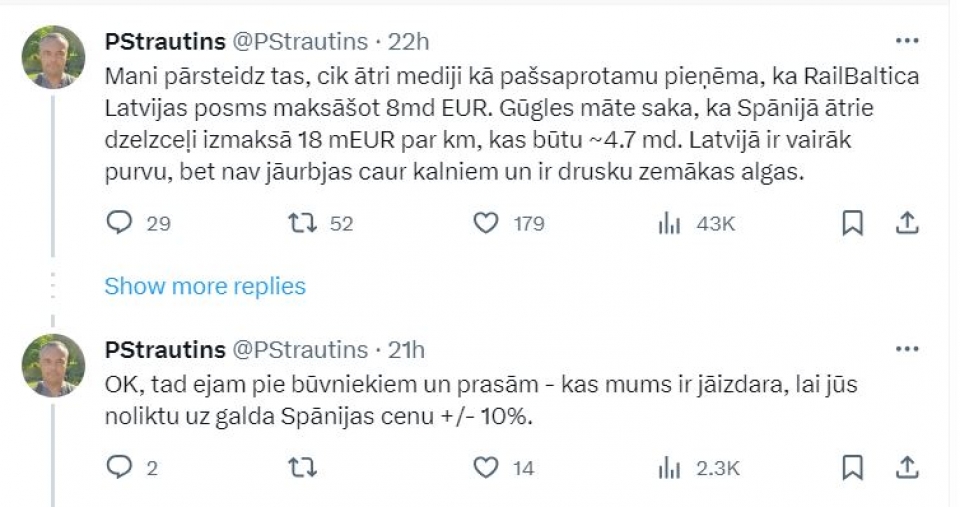
The funding provider, the European Commission, requires that a functioning European-gauge railway line be in place between the Baltic states by 2030. To achieve this, options are currently being sought for what can be abandoned, at least initially, to save time and money; some scenarios envisage that the high-speed train passing directly through Riga will not be included in the first stage.
On comparing Latvia and Sweden
Despite all this, I have been troubled by doubts about the Swedish model for quite some time. Often, I have caught myself thinking that such matters are, after all, handled better in Latvia. The thought, which at first even scared me a little, has now become a kind of conviction; furthermore, having reflected on it over time, I have nuanced my view not only on Sweden but also on my homeland.
On history
The resolution of the Latvian History Congress held last week began with the statement: In recent years, Latvian society has paid increasing attention to history. Perhaps that is true, but it is interesting that essentially only the public broadcaster reported on the congress and the speeches made there. This is not meant as a reproach to the congress participants; however, a number of topics that I personally consider important were not discussed in the hours-long discussions. Perhaps they were discussed during breaks and in the corridors, but that does not add much in this case.
Current cartoons
 |
 |
 |
 |