




Note from zemeunvalsts.lv
This is not the first spring, nor is it the first summer, that has surprised us with forest fires in Siberia. Of course, there is the war, energy issues, and Europe, which is far from Siberia, but!!!!! It seems that politicians, activists, and political activists are desperate and sweating to make Europe, which is small in terms of territory, the planet's climate stabiliser, forgetting geography and mathematics (for example, how to calculate area). For some time (let's say, in the 90s), the rarely heard words “care”, “concern”, and “worry” now, when talking about what is happening far from us in Europe, are heard almost daily. What is being done? The question is by no means rhetorical, but very specific, because here in Latvia it is very important to restrict (which does not mean that one should not protect), whereas elsewhere fire, palm oil, or soy can take a lot. And someone, watching this process and worrying (but no more), wants us to balance it. Worrying, but still...
Forestry professionals are concerned that Russia, given its invasion of Ukraine, may lack the resources (particularly military) to fight fires, for example, in the summer, when fire activity typically tends to increase.
In March, several fires had already broken out in the peatlands of the Russian Far East, which forced the fire services to step up their operations. The Russian Federal Forestry Agency reported that by mid-April, more than 600 fires had been extinguished in the country, covering an area of 37,000 hectares.
One of the regions with the highest number of extinguished forest fires was the Omsk region. Video footage from the Siberian Times newspaper shows forest fires raging in Western Siberia in the Omsk and Tyumen regions, while satellite data indicated several fires across wider Siberia. Some of them lasted for more than a week, even though, for example, the region’s lakes still appeared to be frozen.
Smoke from the fires has “travelled” thousands of miles, even reaching the western United States, where people have observed hazy skies, smoky sunsets, and reddish hues around the moon – signs usually seen during the peak of the summer fire season.
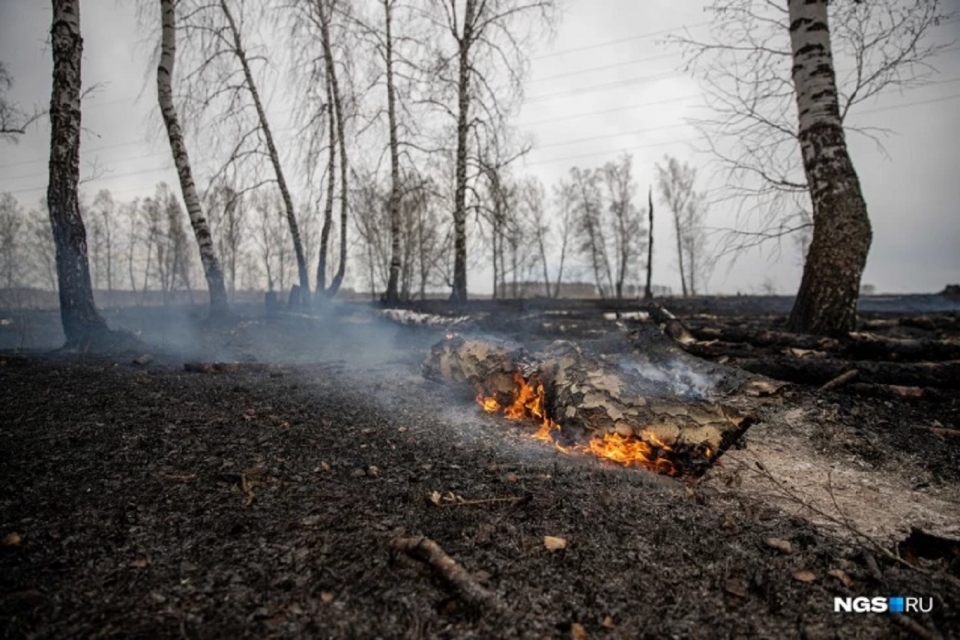
The US National Weather Service office in Tucson published a Twitter post about the origin of the smoke, showing several fires detected by satellites over Russia. The smoke from one particularly large fire, according to the service's data, entered a storm track; the storm moved across the Pacific Ocean on 23 April, reaching the US West Coast. Meteorological services reported that some of the smoke reaching the west coast came from Mongolia and China, and dust from the Gobi Desert may have mixed with the smoke.
In recent years, fire activity in Siberia has intensified specifically in the spring; for example, it was already observed in the region in 2020. Last year (2021), the first fires were recorded at the end of April, although the largest grass fires in the Sakha region in the Russian Far East broke out in early May.
“Data show that the fires started in the spring fire season, the number of fires has been high, and the total daily intensity/emissions have been well above the average characteristic of the early part of the season,” wrote Mark Parrington, a senior scientist at the Copernicus Atmosphere Monitoring Service.
At a press conference held at the end of April, the Russian Federal Forestry Agency reported that firefighters are ready and will work in a high-alert mode to contain and prevent fires in the coming weeks. The agency’s head, Ivan Sovetnikov, said that about 90% of spring forest fires are related to human activity – fires that spread to forests from other areas, for example, caused by prohibited burning on agricultural land or occurring due to carelessness. The agency will use helicopters, drones, and even artificial precipitation in the fight against the fire.
Some industry representatives, however, believe that Russia’s invasion of Ukraine could reduce Russia’s firefighting human resources, as a large number of personnel and a large amount of equipment are directly involved in the war. In previous years, when fires intensified as summer approached, the Russian armed forces often helped the firefighters. Helicopters and planes poured and sprayed water on the flames, while thousands of soldiers waded through swamps and intense heat to take part in firefighting efforts.
“There is no doubt – the war in Ukraine has created a huge shortage of ground resources for Russia,” said Colonel Mark Cancian, a senior advisor to the International Security Program at the Center for Strategic and International Studies. “A large part of the troops have been moved outside the country. The soldiers who return are both wounded and demoralised, and it will be much harder for them to fight the fire.”
It should be noted that even in peacetime, many large fires are allowed to burn if they do not threaten large populated areas, as firefighters do not have sufficient funding.
If adequate resources are not provided for firefighting, forest fires remain uncontrolled and can spread without restriction, including in carbon-rich Siberian soils. As is known, a large part of the soil consists of organic matter that is hundreds or even thousands of years old, and a large amount of carbon is deeply frozen (trapped) in the permafrost. Fires can continue in the thawed soil, thus releasing large amounts of carbon and methane into the atmosphere.
During fires, substances or particles are also released that can be harmful to human health and the environment. For example, black carbon can enter the lungs of humans and animals, causing disease; it can irritate the eyes, nose, and throat. The particles can absorb sunlight and heat the soil deeper, potentially further exacerbating fire conditions in the area.
Although it is too early to predict the intensity of forest fire activity this spring and summer, global temperature rise has intensified and lengthened the fire season, and this trend is likely to continue. Studies show that the number of forest fires and the size of burnt areas in Siberia have increased in recent decades, which correlates mathematically with air temperature and drought. Computer models show that as global temperatures rise, the region’s vegetation will dry out more and more, thus contributing to an increase in the number of fire-prone days and large fires, especially in southern Siberia and the Sakha region in the Far East.
In recent years, such threats have become particularly apparent. Last year, there was a period when fires in Siberia were larger than all other fires elsewhere in the world combined. For example, in the Sakha region, fires released a record amount of carbon from 1 June to 1 August.
In a European Commission report, carbon emissions from last year’s Arctic fires were listed as the fourth highest in nearly twenty years. This level was considered “normal” compared to the historically fire-active 2019 and 2020 seasons, said M. Parrington, noting that in those years, fire activity across the entire Arctic Circle region was higher than in 2021.
“It’s hard to say if the fires are indicative of what we can expect in the summer – for example – I expect fires to rage in the eastern regions of Siberia and possibly in the Arctic in the summer,” writes Mark Parrington. “The risk of fires is likely to be high, based on climate anomalies over the last few years and months (i.e., warmer and drier weather). However, the location and duration of the fires will depend on meteorological conditions.”
https://www.axios.com/2022/04/22/siberia-wildfires-war-ukraine
https://ngs.ru/text/ecology/2022/04/18/71264048/
https://siberiantimes.com/other/others/features/permafrost-is-ablaze-with-hundreds-of-wildfires-in-worlds-coldest-region/
Photographs by Aleksandr Oshchepkov, Ilya Ponomarev, and the original article used
Comments