




Attempts to unify humanity have failed
Globalisation is a real force, yet it is a vast exaggeration to say that it can improve the fate of humanity. Globalisation captivates and holds together a kind of new aristocracy – the golden crust on the loaf of humanity – but the remaining billions, who lack the culture and self-confidence to benefit from “one world”, have already begun to build barricades, ready to fight against the internationalisation of their problems. And from Peshawar to Paris, those who stand on these barricades increasingly turn to violence, feeling threatened in their accustomed way of life. Globalisation represents a liberal world view, but a reborn localism is held in the iron grip of fear, religion and tradition. In any field other than the commercial, you can bet your bottom dollar that the localists will prevail.
Whenever the subject of resistance to globalisation comes up, one usually thinks of a militant French farmer demolishing a McDonald’s eatery, masked anarchists smashing windows during a World Bank summit, or simply an organic producer at a local market stall. Tribal resistance to globalisation is a much more powerful and significantly more complex thing than the few visible gangs of malcontents aiming stones at police in Seattle or Berlin. We are witnessing a process of the return of the tribes – it is a global phenomenon, but the direct opposite of how globalisation is described in popular bestsellers. Once again, both twin sisters, the two tribal affiliations, ethnic and religious brotherhoods, have begun to rage – armed and dangerous.
A generation ago, it was completely unacceptable to use the word “tribes”. And yet, the tribes themselves survived, sticking to their identities – Xhosa or Zulu, Tikriti or Barzani, or, even more strikingly, French or German. In a political context, globalisation reached its peak between the idealistic efforts of the United Nations in the 1960s and the defeat of the European Constitution in the hands of the electorate in 2005 (the decision of French and Dutch voters was not a rejection, it was an assassination). In Europe, which should have led the way beyond nationalism, the European Union will continue its precarious path for a while longer, even achieving success in certain limited areas, but its philosophical foundations have been shattered. Eastern European workers and Western European farmers will continue to use the opportunities provided by the easing of EU border controls and wealth redistribution to an equal degree, but no one believes in some kind of European super-identity destined to replace self-identification as a Dane or a Basque.

The boundaries of national and other local affiliations are far from beginning to blur; on the contrary, they have become even stricter, returning to even narrower principles of blood and linguistic kinship that, according to the assumptions of European dreamers, should have vanished long ago. Who now sees themselves simply as a Belgian, rather than a Fleming or a Walloon? Catalans deny being Spanish, and the Welsh have imagined for themselves a particular national greatness. Over the last decade, after the massive bloodbath of the former Yugoslavia, it split into ineradicable local groups, while Europe turned its head away in horror for as long as it could. The Yugoslav disaster was dismissed as an echo of the past – as if to say, one way or another, Serbs, Croats, Bosnians and Kosovars are not “one of us” – but in reality, the Balkan wars were a signal of a much wider dissatisfaction with the pseudo-identities concocted by political elites. The collapse of Yugoslavia was a hint of the future awaiting Europe – not necessarily one of bloodshed, but of the persistence of historical distinctiveness.
European elites insisted on their own, claiming that the unification of the continent was desirable and inevitable, while at the same time continuing their fussing in Brussels, snatching all sorts of goodies from each other's claws. Until the moment people said “no”.
Right now, in 2006, we are seeing one European country after another introducing self-defence laws that prevent vital industrial sectors (such as yoghurt production) from falling into the hands of foreigners. France paused for a moment while hundreds of thousands of its best and brightest citizens, in a grandiose ancien régime defence action, protested against the creation of new jobs for less privileged citizens. And the new German Chancellor has called for saving the European project by destroying it – or at least pruning the massive Brussels bureaucracy that has divided the continent. The future of Europe is to be found not in a cosmopolitan version of Charlemagne's empire, but in a postmodern variant of the feudal fragmentation that followed the Frankish state. Brussels may be the new medieval Rome; its bureaucratic papacy has the power to judge in limited areas, but the fear of excommunication is ever-diminishing.
Elsewhere in the world, the shift in the level of belonging – from the state to the clan or cult – is proceeding more radically, restlessly and unstably. In Iraq, religious, ethnic and tribal affiliation has determined the composition of a government plagued by difficulties, just as it has in Lebanon, Canada, Nigeria and dozens of other countries (it will be some time before we see an Israeli Prime Minister who belongs to the Baptist Church, or an Islamic Chancellor – despite those who warn of the creation of Eurabia). Even in the United States, with all its focus on integration, the politics of racial, religious and ethnic affiliation continues to flourish; America is still lucky that it does not have one dominant tribe (although minorities might object to this statement).
And yet, the success the United States has had in overcoming feelings of ancient belonging is remarkable – and anomalous. Although the current big American bogeyman is the influx of Spanish-speaking immigrants, most arriving Latinos adapt to a respectable life in a purely American spirit, just as the Irish, Italians, Slavs and Jews did before them. Perhaps American Indians still think in terms of their tribes (especially when it comes to the profits of the casino industry), and there seems to be no end to that long line of minutely divided identities that Americans choose to hold onto in their social and religious life, but even Rome did not manage to get as close to forging an entirely new and all-encompassing affiliation.
But American successes prevent them from seeing the failures in other lands. Other countries and cultures have not only failed to integrate immigrants or reach an agreement on mixed affiliation – they do not even feel the slightest desire to do so. Idealists thought the question of who and what a Frenchman or a German is had been solved a century ago. That was not true. And now, in developing countries, recently forged (and questionably authentic) identities are dissolving in fits of rage.
European borders have turned out to be poorly drawn, European models of statehood and governance have failed, and globally speaking, European civilisation itself has failed. The United States does not know how to look beyond these models, which is why it cannot influence the world in proportion to its power, except in the field of pop culture (a good blockbuster appeals even to Islamic terrorists). The colonial perception of the world has come to an end, post-colonial dreams have rapidly collapsed (and among them, not the least of which is the paradise of socialism), and now the whole world has been gripped by a vacuum of purpose, which the glittering trinkets of globalisation cannot fill. From the fear-mongers in the American media to the sermons of Muqtada al-Sadr, what actually unites the whole world is a fear of change. In Tehran and Texas alike, the established order has slumped into a defensive position.
People dream of change, but cling to what they know. The workers of the world have not, after all, learned to love one another (or at least share a Starbucks coffee) – the economic and informational effect of globalisation has been to remind people once more of how much satisfaction hatred provides. Whether it be threatened jobs, a moral code or religion – people disrupted by change are not interested in explanations. They need someone to blame.
The new global aristocracy
There is a special globalising class; hundreds of millions of people are united by consumer tastes that show they belong to this class: Prada handbags for businesswomen in Tokyo and Manhattan, the music of Cesária Évora born of poverty for affluent fans from Frankfurt to San Francisco, Mercedes limousines and credit cards, the voyeuristic “leftism” of professors from Ann Arbor, Buenos Aires and Vienna, computers for the educated and the affluent from Budapest to Bangalore, a different regional wine every week for residents of London suburbs or the nouveau riche of Shanghai, media conglomerates that keep away from patriotism – and for the platinum crumbs on this golden crust of humanity, private jet aircraft and the opportunity to rent a holiday home for 30,000 dollars a week when they have tired of their own three or four houses.
Such people feel much more comfortable in the company of foreigners belonging to the same cultural stratum than among their own less successful compatriots. For the upper level of these new globalisation aristocrats, place of residence and citizenship are merely a matter of convenience, taste and tax legislation. This is a nobility that comes with no sense of responsibility towards its serfs, and its members are better protected from any life inconveniences than ever before.
But for the remaining billions, globalisation with its partner – the information revolution – merely opens a window to an exclusive shop they are not allowed to enter. A worn-out Pittsburgh Steelers jersey on the back of a beggar in the Congo is not globalisation – it is just the underside of global trade. The new awareness of foreign wealth is by no means comforting. On the contrary, it encourages the conviction (which local demagogues are more than happy to fuel further) that *they* can only be so rich because they have stolen what belongs to *us*.
The unequal opportunity to digest the information feast that has suddenly become available even in the farthest corners of the globe does not promote the unification of humanity (even if Saudi clerics and American bureaucrats visit the same porn websites). It rather introduces chaos into hitherto orderly lives, and creates in people the feeling that they have been robbed of some previously unrecognised opportunities, while at the same time challenging their existing core values. Feeling helpless and surrounded by hostile forces, the victim of globalisation seeks solace either in a fundamentalist religion that explains everything or in xenophobia, which allows them to believe that, however much they may suffer from material deprivation, they are still superior to others.
Those who are confident in themselves can embrace freedom with open arms, but everyone else needs rules. The conviction that the mind can create a new human being who would be free from archaic affiliation and primitive loyalty is an ancient illusion. Rome believed that this new affiliation, which it offered not only to its citizens but also to subjects in the farthest corners of the empire, must be irresistibly tempting. And yet the Roman Empire had to deal with endless unrest among subjugated tribes, from the British Isles and Gaul to Palestine. In the end, the empire was conquered by groups of people with a stronger, undiluted identity. From the short and bloody egalitarianism of the French Revolution through socialist visions that promised us the brotherhood of man and an end to all wars (this conviction was particularly strong in 1913), to the horrific attempt to create *Homo Sovieticus* and export it all over the world – there has never been a shortage of various globalisation projects in the world. Even the most ambitious attempts to unify humanity have failed – namely, the monotheistic campaigns aimed at imposing one God.
One God, one path, one world
Monotheism replaced Roman legal codes with God's law. The first nearly successful attempt at globalisation was the bewildering survival and spread of Christianity; it is a transitional faith between the exclusive tribal monotheism of Judaism and the universal aspirations of Islam. Having started as a cult without much conviction about how legitimate it was to convert people of different cultural heritages to its faith, Christianity quickly discovered a talent for trade, transforming its teachings from a local product to a universal one. Moreover, it appealed to the needy (a clientele that modern globalisation ignores), thus finding as much of a response among the less affluent in the ancient Mediterranean world as it does today in Sub-Saharan Africa. Christianity was the faith of outsiders, which was taken up by rulers, but the goal of Islam from its founding years was to rule – and unite – all social classes.
With the rise of Islam, globalisation picked up considerable pace. Being open to newcomers, Islam moved rapidly, within just a few centuries, from a voluntary to an imposed and later also a forced religion. Violent conversion to its faith has never been a mandatory requirement in Islam, yet it was often practised (just as forced conversion to Christianity was elsewhere in the world). The immediate and prolonged conflict between Christianity and Islam was based on the contradiction between different views of globalisation – a competition of quality, design and capacity (you can imagine it as a clash between Toyota and Ford in the fight for souls). These Christian and Muslim models, having now reached all inhabited continents, are still subject to drastic transformation processes in their battle for new followers in different corners of the world. Their success prevents us from seeing the weaknesses of both religions – neither the one nor the other has been able to defeat its ancient, fatal anti-globalist adversary – magic.
When we talk about religion – the most powerful of all strategic factors, our vocabulary is so limited that we merge radically different drives, needs and customs. For example, when classifying the populations of African countries for statistical purposes, demographers tend to offer the following portrait of country X: 45% Christians, 30% Muslims and 25% followers of animist/indigenous religions. Such figures are highly deceptive (as any honest missionary will admit). African Christians or Muslims rarely abandon tribal habits entirely, freely turning every day to whatever belief system offers better results at the moment. Sometimes the advice of a Christian clergyman helps; at other times, a shaman turns out to be more useful.
An Anglican priest in South Africa condemns witchcraft, but fails to see that his spiritual belief system does not offer an equivalent substitute for solving everyday household problems. It is quite simple – the Great religion and local cults are two different, essentially distinct consumer products. From Brazil to Borneo, local Christians do not consider imported and traditional belief systems incompatible – just as it does not seem to them that a kitchen lucky enough to be equipped with a refrigerator should be denied the opportunity to have a stove as well.
There is a huge difference between the Great religions – Islam, Christianity, Hinduism and others – and local cults, which have lasted much longer than predicted. The difference is significant – not only in itself, but also because it symbolises the obstacles that local affiliation poses to globalisation as we imagine it. Great religion focuses on the world beyond this world, while local faiths have always placed the emphasis on magic (subjecting aspects of the natural world to the will of the practitioner of occult knowledge). Witchcraft influences daily life here and now, and its power and allure can prove to be much stronger than our rational worldview admits – we mock everything we do not understand. (The advantage that Christianity enjoys among the needy of developing countries is the image of Jesus the miracle-worker: he turns water into wine and walks on water – so he is a much more promising shaman than Muhammad.)
Another aspect of belonging that we, the heirs of the eager propagators of world religions, fail to grasp is that local cults are *exclusive*. They not only do not strive for new participants, they would never dream of integrating outsiders (the politicised tribal beliefs of the Ashanti of Ghana are a limited exception, aimed at subjugating neighbouring tribes). Cult beliefs are tied to the local land, trees, waters; in tribal religions, it is about place and personality, about belonging to a certain environment. Although slaves brought voodoo customs with them to the New World, under the stress of relocation, the rituals began to change rapidly. Tribal religions create an invisible defensive wall, just as local customs do – from the Andes to the Caucasus. Ancestor worship, one of the most common localist customs, takes for granted the interference of the dead in the affairs of living men and women. Built on bones, local religions are cumulative rather than forward-looking. Like the Great religions, local belief systems offer creation myths, but in universal faiths, much more space is allocated to the apocalypse of the end of time (in Hindu faith – to repeated apocalypses), but local cults rarely look beyond the next harvest. The Great faiths uplift the heart of the native one day a week, but local beliefs guide him the other six.
What we tend to throw into one “religion” pot would be better divided into separate categories of religion and magic. From Arizona to Ghana, under the guise of Christianity or Islam, there exists a vast amount of local cults, and they remain a constant source of concern for both Wahhabis and evangelists, and the reason is that they arose to meet entirely different needs. At the centre of the Great religions is immortal life. By contrast, magic helps one get a spouse, avoid a snake bite or a traffic accident, gain wealth. Both African tribes and the natives of the Western Hemisphere can quite truly accept a global faith, while simultaneously seeing no reason why they should abandon practices that have proven so useful.
Even with changed names, the old gods continue to live, and our attempts to export Western ideas and behavioural models are ultimately doomed to similar mutations. We might prefer desperate missionaries who seek to dissuade the Christians of the Sulawesi highlands from sophisticated burial ceremonies that lead to bankruptcy because animals are sacrificed in massive numbers (death is still much more important than birth or baptism), but we can take comfort from the fact that in the Indonesian city of Solo, where Abu Bakar Bashir established his famous “terrorist school”, the devout Muslim inhabitants drive Saudi missionaries to despair by holding a large ceremony every year in honour of the Goddess of the Southern Sea of Java. Similarly, Javanese and Sumatran Muslims participate with great enthusiasm in pilgrimage (government-organised tours), but continue to worship local tree spirits, Sufi saints and occasionally even a stone.
In Senegal, I learned that local Muslims are irritated by the superior attitude of Saudi emissaries, who condemn their customs as unacceptable to Islam. Proud of their ancient Muslim brotherhoods and favourite holy men, the Senegalese reply: “We were experts in Islam back when the Saudis were still living in tents.”
From West Africa to Indonesia, an unremarked protection against Islamic extremism is the devotion with which Muslims treat the local variants of their faith. Nobody likes being told that both they and their ancestors have understood everything wrongly for the last five centuries. Foolish Westerners who insist that Islam is a unified religion whose believers are all, as one, hatching plans to conquer the West, refuse to see that the fiercest enemy of Salafi fundamentalism is the attachment of Muslims to their own local customs. The story of Islamic terrorists is a story of globalisation, while the hope for peace is linked to the power of local customs.
Careless of political correctness, a Muslim from Ivory Coast told me: “You can change an African’s clothes, you can educate him and change his table manners, but you cannot change the African living inside him.” He could have said the same of a Russian, a German or a Chinese person. By refusing to acknowledge and even less to seek to understand the ineradicable differences between communities of people, the intelligentsia of the 20th century paved the way for genocide in Rwanda, Bosnia and Sudan, as well as the era of global terror. Denied differences only fester; if the infection is ignored for long enough, it kills.
Our conviction that people will become increasingly similar to one another is contrary to historical evidence, as well as to practical and spiritual needs. Paradoxically: we make a huge fuss celebrating diversity, but claim that human values are merging. We also have our own prejudices and taboos.
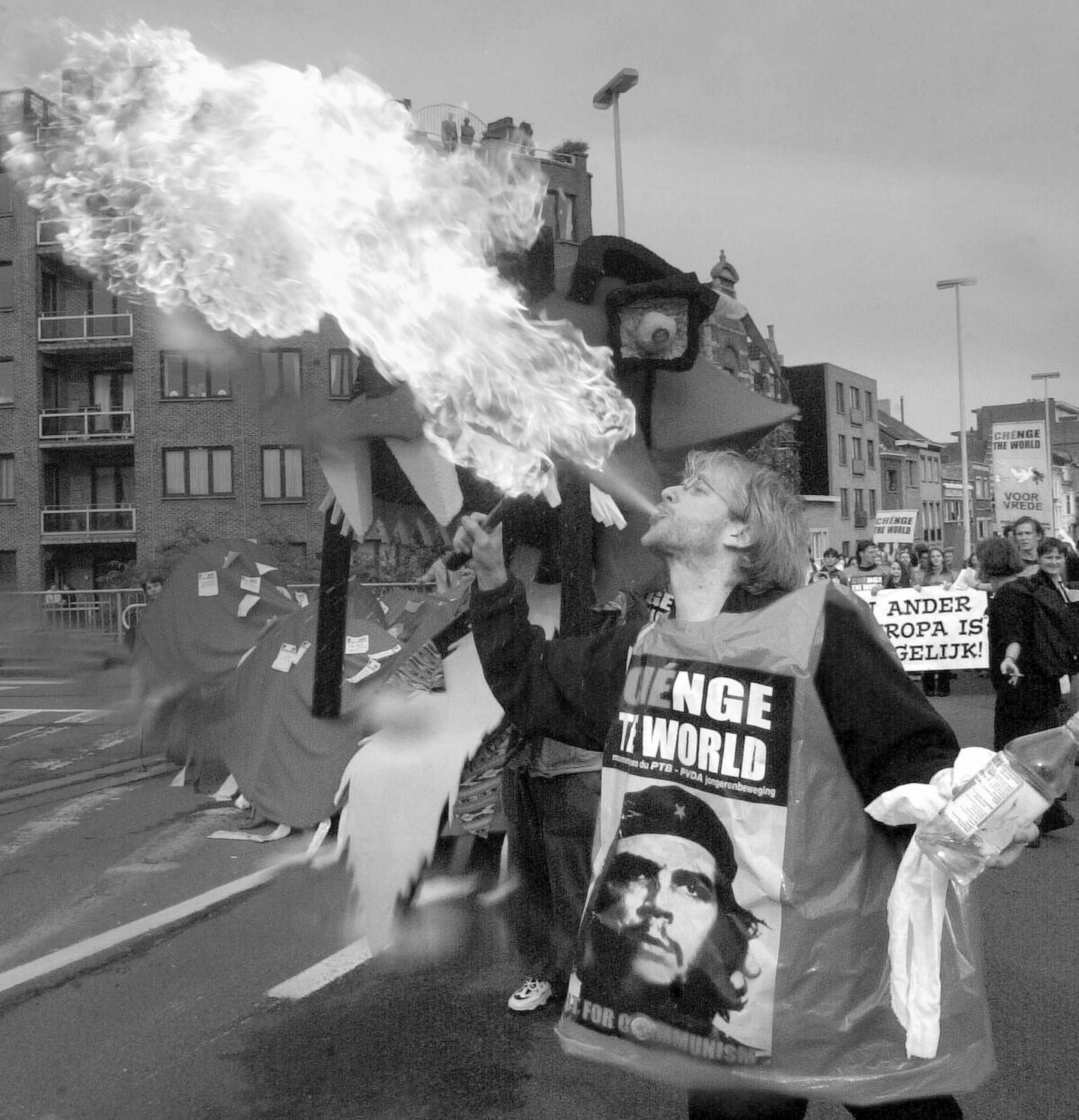 Fire-eater taking part in an anti-globalisation protest march in Ghent, 2001 (Photo: Imageforum/LETA)
Magic against Jihad
The spread of Islam in Europe and Africa collided with very different, yet equally resilient obstacles in the north and south. In Europe, it was unable to overcome a competing monotheistic faith, which possessed its own universal view. In West Africa, Islam stopped approximately five centuries ago, when from the deserts and savannas it had arrived at the entrance to the African forest, this powerful world of magic.
The fact that a militant faith with an unprecedented history of conquest and conversion stopped upon reaching the territories of illiterate tribes who did not even know the wheel should have triggered far greater interest than it currently has: in the forests of Sub-Saharan Africa, Islam was unable to conquer, convert or convince. Within their own environment, local beliefs proved much stronger than the faith that had flooded “civilised” continents.
Forests are the realm of magic. Look for resistance to innovation in forested areas. Even European fairy tales confirm the mysterious nature of the forest. Islam, with its aversion to magic, had nothing to offer the forest tribes of Africa in place of their protective beliefs. In Northern Europe, too, monotheism had the hardest time breaking through forested areas, and the persistence of pagan folk beliefs in the forest-covered mountains of Eastern Europe can surprise a stranger even today.
The forest with its magic is an opponent of globalisation. Unlike the monotheistic faiths, which began in the inhospitable desert, it threatens only those who want to break into it at any cost. A cause for concern is the question of whether the massive urban slum districts in developing countries are not the world's new forests – impenetrable, closed and lethal. From Sadr City to the favelas of Brazil, slum dwellers transform the great monotheistic religions back into local cults, not forgetting human sacrifice in various forms. Far from monolithic, both Muslim and Christian faiths split, giving rise to radical movements that reject God's globalisation and claim that His love is narrow, specific and highly conditional. The Great faiths are once again becoming tribal religions.
The boundaries of globalisation
After approximately a century of Christianity moving inland from the coasts, Africa remains a cocktail of faiths: Muslim in the northern countries – Nigeria, Ghana, Ivory Coast, Sudan and Kenya, but Christian in the south – and everywhere there remains an attachment to local beliefs. Christian “televangelists” (the true vanguard of globalisation) condemn traditional customs in Ghana, but at the other end of the continent, on islands off the coast of Mozambique, the inhabitants are strict Muslims by day, but return to drums and songs at night.
Both Christian and Muslim missionaries believe such beliefs and customs are bad habits combined with naive superstition and general ignorance. But in my travels, I have become convinced that the missionaries themselves deliberately ignore systems they cannot respect, and thus refuse to understand them. Religion is similar to business in that it must offer products that work successfully often enough for clients to come back. Results matter. The psychological comfort and afterlife promises offered by Christianity and Islam work transcendentally, but neglect everyday needs.
In developed societies, the gap is filled by civil, commercial and social institutions; elsewhere, this must be done by magic. Magic continues to exist because the local inhabitants have been sufficiently convinced of its power. It is hard for Westerners to accept this, but whether it be a training camp for African mercenaries or a humanitarian aid programme in Peru, those who ignore the role of magic in other people's lives will never achieve good results: when the global man goes home, the shaman returns.
We laugh at these “follies”, sitting in the safety of our own narrow worlds, but magic is still so persistent that it continues to inspire both human sacrifice in the Ghanaian highlands and self-mutilation in New Mexico and Sulawesi. One explanation for the deeply dissatisfied fermentation in the Middle East is that Islam, especially in its Sunni form, destroyed magic but, unlike Western civilisation, did not offer other techniques in its place to satisfy human needs. In Islamic lands, there is a huge emptiness in the modern human experience: there is a lack of comforting magic, and also a lack of triumphant progress. Islam in the Sunni Arab world, which is an incubator of global terror, is just a ritual without results, whereas even modern Western Christianity has permeated its rituals with agreeable mysticism – from the “born-again” experience to the transubstantiation of bread and wine into flesh and blood.
What if magic – ritual actions performed to meet spiritual, psychological and practical needs – is a strategic factor we have completely neglected? We would not wish to send our troops to a place without a good local terrain map, yet we make no effort to create a map of the spiritual worlds of our enemies or potential allies. Even if magic and local beliefs are just a worthless distortion of faith, our opinion has no meaning – the only thing that matters is what the other person believes.
The power of local beliefs and customs will continue to frustrate our hopes for a global, homogeneous society even after we are gone. If we can acknowledge and utilise the power of local customs, they may prove to be the most powerful weapon with which to curb the religious counter-revolution of our Islamic enemies. If, on the other hand, we continue to deny that local traditions, beliefs and customs possess a power that must be reckoned with, we will lose potential allies and many well-intentioned aid projects will collapse the moment we stop directing them.
The potential violence that could be generated by mocking local beliefs is mentioned in this statement: “They can preach a holy war, and that is most deadly, for they do not count the cost.” This does not refer to crazy mullahs or postmodern suicide bombers. It is a quote from Rosemary Sutcliff's historical novel The Eagle of the Ninth. Published half a century ago, the novel for adolescents describes a druid uprising against the Romans in Britain.
Globalisation is nothing new, but local beliefs rooted in native soil are much older. And these local beliefs may prove to be far more powerful, just as has so often happened already. From Islamic terrorists fighting to prolong the slavery of women to the Armenian obsession with the land of Karabakh; from the French refusal of “Anglo-Saxon” economic models to the resistance of African Muslims to Islamic imperialism – the most complex forces currently acting in the world, those possessing the greatest potential both for violence and for resistance to it, may be the anti-global impulses of local societies. From Liège to Lagos, the tribes are returning.
Translation from the 4 September 2006 issue of The Weekly Standard. First published in Latvian in the October 2006 issue of the magazine "Rīgas Laiks"