




Some claim that Latvians have no food of their own. Rubbish! Alongside the familiar grey peas, sklandrausis (carrot tarts) and soured-milk gruel, which any sensible child would name in their top ten, without even mentioning biguzis and zīdenis or drūdenis, as well as the related koķis, which he will surely come across in the course of his further Latvian education, there is a colourful array of others to be found in texts: stūķis or tempis, kluči or speramie; kuldeņi, spētiķis and skuldurs; biga, pontāgs and baltiņas; bieķēzis and spētiķis; ķenītis, sāltiņš and gailīši; kunkulmozis and tuntuļmoza; ļautiņputra and grūsla; salabuks or pigarica; skranči, kami and kūčas. We have our ķēpas and čuras. We have – cīcari (the very same čuras – i.e., finely chopped and fried pieces of pork lard, fat, liver and kidneys – only with mushrooms). There is also siderbiksis, the popularity of which is evidenced by the many synonyms for its name – for example, čubītes, čumiņas, sigumiņš, privulīna, nabagīne and ņuka. Do you know how to prepare even three of them? I do not, and what’s more, I am almost certain that there will never be a need to learn. Yet I love the names – in all the comical clumsiness of these ūķi, tiķi and mozi, I hear a self-irony of the poor, which sounds beautiful to my ears. We might be slurping potato stalks boiled in slightly greasy water, but at least we are laughing heartily.
That is to say, we laughed, or, more accurately, they, our ancestors, the country folk, laughed.
As soon as Latvians start writing down or transcribing recipes, the laughter is over. The first original collection of recipes, published in 1796, is not full of self-respect, but of dignity: “warm and cold soups, all kinds of boiled, stuffed meat dishes, roasted fish dishes, fillings, puddings, vegetable dishes, fruit dishes, roasts, salads, milk, egg and flour dishes, tortes, pâtés, sausages.” But that, of course, befits a Latvian cookbook for manor cooks – it is a textbook for servants. A century later, it is already quite self-evident that the respective “dishes” could also be tried in more prosperous peasant households, where a hostess who has “not yet attended” home economics school would find Zāle’s "Lauksaimnieču pavāru grāmata" (Cookbook for Housewives) useful for this purpose. From it, she will learn not only how to roast and braise, stir sauces, stew roots – both carrots, swedes and cabbage, as well as asparagus and spinach –, and prepare mousses, jellies and flummeries “correctly”, and not “according to old-fashioned models”, but also to fulfil the important task: “to fight drunkenness among men with all one's might, [..] by serving fruit wines instead of alcoholic drinks to one's own people and guests.” The imperative of both “correctness” and mission is emphasised with the prefix “jā-”: jā-sagriež (must be cut), jā-saberž (must be ground), jā-saviļā (must be rolled), jā-sašķūmē (must be skimmed)… The book is intended for “organising various celebrations” – one must assume that “incorrect” dishes, the recipes for which are kept not in writing but in the cook’s memory, are still placed on the everyday or family table.
Written-down recipes tend to be ambiguous texts in general – on one hand, a moment of pleasure encapsulated in a formula, which is generously shared with others (a recipe seems to reach the perfection of this aspect in Thailand, where every funeral guest is gifted a small book compiled by the deceased with a dozen descriptions of their favourite dishes), on the other – quite didactic reading, which often reflects the writer's tendency to instruct others, to impose their own rules.  One of the first known authorities of this kind is the Greek Archestratus in the 4th century BC – although most of his contemporaries quite willingly ate salted or dried tuna caught in the Black Sea, Archestratus, you see, insisted that the only tunas worthy of the name are to be found only in Byzantium, they are to be eaten only in autumn, around the time when the “Pleiades set”, and, undoubtedly, only fresh. Disciplined pleasure is also the foundation of French classical haute cuisine, which was the undisputed criterion of sophistication in the Western culinary world for a whole century. Until quite recently, in top-class Michelin-starred restaurants in Paris, a maître d’hôtel could discreetly ask you to leave the premises just for having the audacity to ask for salt – an offence of roughly the same scale as interrupting a coronation ceremony to loudly express the opinion that, in your view, the Queen would look better in a hat. The persistence of authority is also evidenced by the fact that the book published by Louis Eustache Ude in 1818, La Cuisinière de la campagne et de la ville, ou nouvelle cuisine economique, which the author modestly described as intended for a “moderate” budget, went through 97 editions by 1901. Monsieur Viard’s culinary advice also had a long life, which he released in 1806, during the reign of Napoleon, under the title Le Cuisinier imperial. When the Bourbon monarchy was restored, the book appeared in circulation with a new title, Le Cuisinier royal, but when the Bonapartes returned to power in 1853 and Louis Bonaparte became president of the republic, Le Cuisinier royal turned into Le Cuisinier national. But not for long. As soon as Louis Napoleon’s metamorphosis into Emperor Napoleon III had occurred, it was already reflected in the rebirth of Le Cuisinier as imperial. Only after the proclamation of the 3rd Republic in 1870 did the book regain the designation national, which it has happily kept to this very day.
The tradition of renaming is, as we know, not foreign to Latvians either, yet so far it has manifested itself primarily in the changing of street names. However, even though Latvian cuisine and its recorders have not reflected social changes as conspicuously and ostentatiously as the French, cookbooks have not entirely escaped them. Of the books in my possession, one of the most politically neutral is the 1922 edition, published in democratic conditions, and indeed quite democratic, Latvijas Jaunā pavāru grāmata – if we don't mention, from today’s perspective of political correctness, that the subtitle indicates the addressee – it is intended for “housewives and maidens”, thus expressing the stance that cooking is purely women's business. Notwithstanding this stance, presumably adopted from the Germans (Germany, unlike France, Italy, Spain and England at the time, is a land where cookbooks written by women and intended for women's use are in the vast majority), it is one of the rare Latvian cookbooks where the introduction – timidly and yet! – mentions that the dishes included have been selected based on deliciousness, rather than any other principle, while patriotically boasting that “the dishes that a Latvian will appreciate most will also be gladly eaten by any foreigner.” The author’s name is unfortunately not mentioned, but perhaps their gender is given away by the designation “zeltenes” (maidens), which in places turns into the affectionate “zeltenītes” (little maidens), just as solid porcini mushrooms seem unintentionally to become temptingly graceful little porcini alongside a roast encased in a “beautiful, brown crust.” Quite often he (she) invites one to splash a glass of good wine into “sauces”, because then they are supposedly even “tastier”, but does not get too carried away with them, and moreover, quite modernly, recommends grilling or roasting meat on a spit as they do in “Southern Europe” and “very fine households”, because it is more “natural”, while for side dishes, without batting an eyelid, suggests not only “small, brown-roasted potatoes” but even chestnuts.
However, this shy playfulness is not destined to grow into a passionate obsession. The sobering thirties arrive and with them new cookbooks. “Long gone is the time when food preparation [..] was not work placed on scientific foundations, which every conscientious housewife can perform correctly and properly”, state H. Birziņa and A. Švāgers-Vīksne in the foreword to their "Latviskā un modernā virtuve" (Latvian and Modern Kitchen). “Every small mistake or carelessness has far-reaching consequences, and they are often felt by more generations”, they warn. “[..] in a woman’s hands, albeit indirectly, is also the health of the nation [authors’ emphasis] and partly even the state’s economy.” A person, you know, is not some “little maiden”, a person is merely a “steam engine”, which, using the “basic principles of modern nutritional science and the demands of the current state of the national economy”, is powered by “fuel material” mixed in the right proportions. This must be remembered when preparing even semolina pudding. It is clear that nothing is just “splashed” in here, everything is carefully measured and weighed; these culinary recipes are just as precise and business-like – and boring – as medical ones. From the thirties right up until the end of the Soviet period, including the frugal war years, Latvian cookbooks begin with a natural-scientific treatise on digestion, proteins and vitamins, which are necessary for “ensuring the organism’s capacity for work” – in a sense, it is a return to the origins of gastronomic literature – the ancient Greeks were also very worried about the medical properties of food, trying to record them as precisely as possible in writing, and this tradition was carefully cultivated right up until the Renaissance. Unfortunately, the collectivism and sense of national responsibility of the twentieth century, as well as the limitations of scientific methods, have prevented Latvian gastronomy experts from drawing such interesting conclusions as the fact that swedes, for example, help against cold feet or that salads protect against sexual over-saturation. Instead, we are presented with, for example, the following text: “As a result of the immense fibre famine, the blood is thick, with an acidic reaction, prone to thrombosis, blood vessels calcified, with cholesterol deposits, it has already gone so far that 86% die from strokes, heart attacks, gangrene, and a large number of the unfortunate live half-dead, paralysed and rotting, and cannot even die…” Bon appétit!
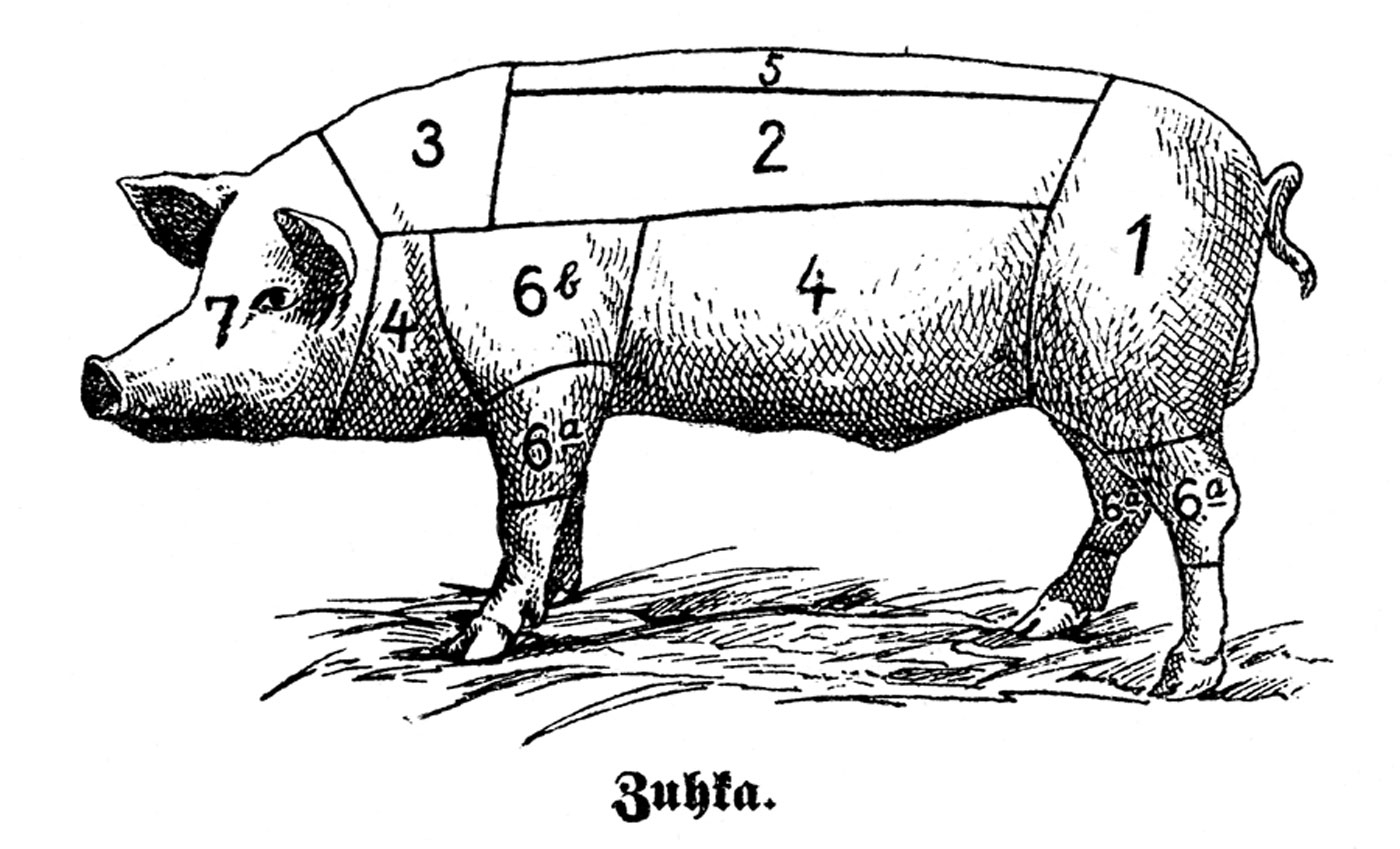
By the way, in the arsenal of Latvian cookbook authors, there is another method for protecting the public from greed – that is, unless one is a sadomasochistic pervert: in almost every one of them, an extremely large amount of attention is devoted to the carving of dead animals. The most effective instruments for this purpose are demonstrated, diagrams are drawn, and the process of cutting and chopping is in some places even shown in detail in photographs. True, in the recipes these same animals are euphemised beyond recognition – minced, ground, drowned in thick, rich sauces. A similar fate befalls vegetables – a natural, honest texture and taste, i.e., acknowledging things for what they are, has not been much valued by Latvians. Instead, there is an unfading interest in “decorating” food – jagged carrot slices, tomato “fly agarics”, butter “roses”. Evidently, for a Latvian, food almost has to be coaxed – like for a child. That the reader (eater) is perceived as a child is also evidenced by the disproportionately large selection of sweet dishes and confectionery in any cookbook intended for general use. Accept this tradition of gastronomic psychology and no longer be surprised that in some eatery you are served not only cake, but even salad with a teaspoon!
Article from the March 2000 issue of "Rīgas Laiks" magazine. Author: Ieva Lešinska.
Photographs from zemeunvalsts.lv and a caricature by Gatis Šļūka have been used