




Note from zemeunvalsts.lv
The year 2019 is significant in this article, as that was when the future was already being considered and planned for nearby in Finland. There is no doubt that the forest sector and forest science professionals in Latvia are working and thinking long-term. But do those at Brīvības ielā 36 know this, understand it, and act accordingly?
At the Salmisaari combined heat and power plant in Helsinki, the share of renewable energy is being increased by co-firing wood pellets with coal. Increasing the production volume of new wood-based products with high added value would create serious problems for forest-based energy production in Finland.
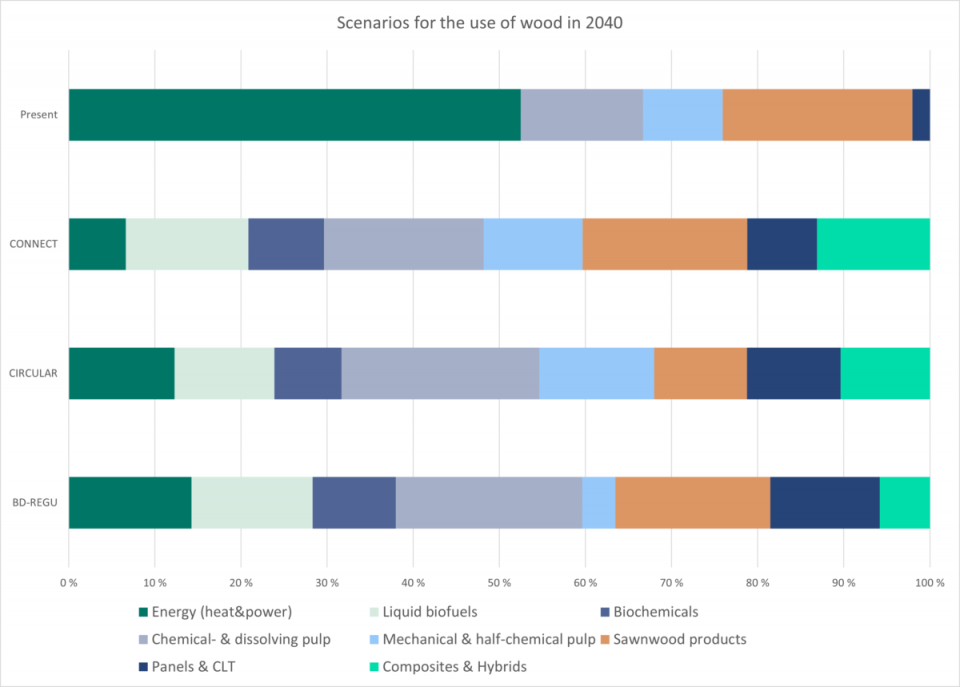
The hoped-for increase in the volume of new, high-value-added wood products by 2040 would significantly reduce the availability of energy from forests. This reduction would be 3-5 times greater than the capacity of Finland's new Olkiluoto 3 power plant, as estimated in the FutureForest2040 project implemented by the European Forest Institute and ETLA Economic Research.
The conclusion is based on three scenarios for the possible situation in 2040, calculated by researchers from the European Forest Institute and ETLA Economic Research. These scenarios assume that in 2040, the share of energy produced in combined heat and power generation and industrial processes will be only 5-13%. Currently, taking into account the use of industrial side-streams and wood waste, approximately half of Finland's total wood flow is used for energy production. According to Statistics Finland, the share of wood fuel in total fuel consumption was 29.7% in 2021.
If the supply of wood fuel decreases, the energy deficit will be 3-5 times greater than the capacity of the Olkiluoto 3 nuclear power plant (1600 MW). “Such radical changes will lead to a direct reduction in energy availability,” explains researcher Janni Kunttu.
A group of experts, researchers, decision-makers, students, and other interested parties of various ages developed three scenarios for the Finnish forest sector in a 2019 seminar (please see the image). Some seminar participants represented the forest sector, others represented the plastics or energy sectors.
Higher added value for wood
Three development scenarios for the forest sector, which were developed by stakeholders at the seminar, were named: Biodiversity and a regulated economy; Circular economy: how to maintain a high standard of living and The era of social bonds. All three scenarios foresee a significant global shortage of resources and collective efforts to move away from fossil fuels.
The scenarios predicted the development (even a boom) of the Finnish forest sector by 2040, with a more diverse range of products expected, steering away from the use of wood for energy. The seminar participants considered wood too valuable a raw material to be used as an energy source. Instead, wood would be turned into new, high-value-added products, with a particular emphasis on cellulose-based textiles, biochemicals, composite materials, and modern construction solutions. This direction of sectoral development would lead to a sharp decline in the use of wood for energy production. Janni Kunttu explains that this would happen in two ways: high-value-added product manufacturing naturally requires energy, and the raw materials used for them would not be available for energy production.
How this potential energy deficit could be compensated is something no one can say right now, notes Janni Kunttu. None of the possible substitutes are available in the required volume. The new solutions are based on forest sector by-products; currently, they are largely used by the sector itself to generate energy that exceeds its needs. According to the 2040 scenario, the forest sector could become dependent on external energy sources. The industry's cost increase would be in the thousands of millions of euros, although part of this could be offset by profits from more valuable products. However, at the same time, Finland's global competitiveness could diminish as production volumes and the number of jobs decrease.
One of the scenarios is actually developing already now
Janni Kunttu sees signs that one of the scenarios developed three years ago is becoming reality: Biodiversity and a regulated economy. The scenario predicted both the threat of war and stricter regulations on wood products within the European Union. What happened? On 24 February, Russia invaded Ukraine, and as early as May, the European Parliament's Committee on the Environment, Public Health and Food Safety voted against including forest-based energy in national renewable energy quotas. “We never expected that even one of the scenarios would turn into reality within just a few years,” says J. Kunttu.
In this scenario, an increased threat of war due to consumption and the expansion of renewable energy production was assumed, weakening the positions of countries that produce or extract fossil resources. “Three years ago, we believed that moving away from the use of fossil resources would increase the risk of conflict worldwide. Competition for resources and the divide between rich and poor countries also indirectly affect the forest sector,” explains J. Kunttu. The scenario also foresees political debates about wood products. “We are beginning to see signs that some wood products might not automatically be considered carbon-neutral. I think it is possible if the situation continues to develop in the current direction,” says J. Kunttu.
Higher added value is commendable
Janni Kunttu believes that the increase in the added value of wood is a good sign. In the future, this could also be reflected in prices. “This could be used to finance greater support for maintaining biodiversity and for energy purchases,” explains J. Kunttu.
These explanations from the researcher do not sound hopeless. Over twenty years, new energy-saving solutions could be developed that could be used in new manufacturing plants. There is progress in this regard, but at the same time, the lack of time is acutely felt. “We must immediately start developing new energy supply solutions in cooperation with other sectors. We need technologies that do not force us to worry about the energy shortage, which, as mentioned above, was a common issue in all three scenarios,” emphasises J. Kunttu.
The project “FutureForest2040. Structural changes in the Finnish forest sector and visions for markets and employment for 2040” has been financially supported by the Metsämiesten Säätiö foundation
Translation from English
Comments