




There are more and more wild animals in Latvia's forests. In some places, questions about the coexistence of people and animals occasionally bring things close to a state of war, and the number of such situations could well grow in future. Some predator species have been placed in a “greenhouse regime”, and the situation is made still more problematic by that part of society which does not know, pretends not to know, or simply ignores the laws of nature.
These were among the conclusions voiced in a discussion titled “Animals and people: in search of optimal coexistence”, organised by the magazine “Dienas Bizness” and the Latvian forestry and related industries portal zemeunvalsts.lv. Over the past 30-odd years Latvia's population has fallen substantially (from 2.67 million to 1.87 million), while at the same time the number of wild animals has risen, which frequently creates problem situations or losses for foresters and farmers. The situation is complicated by a section of society whose “understanding” of what happens in nature comes from cartoons and bears no real relation to the laws of nature in the forest. All of the above, together with a lack of understanding, makes it harder to draw up and adopt decisions grounded in science and in reality. For example, there is no definition of how many individuals of a given species Latvia actually needs; in practice their numbers are regulated by nature itself, while human regulation is currently prohibited for a whole range of species, which causes problems now and may cause even greater worries in future if the present approach continues.
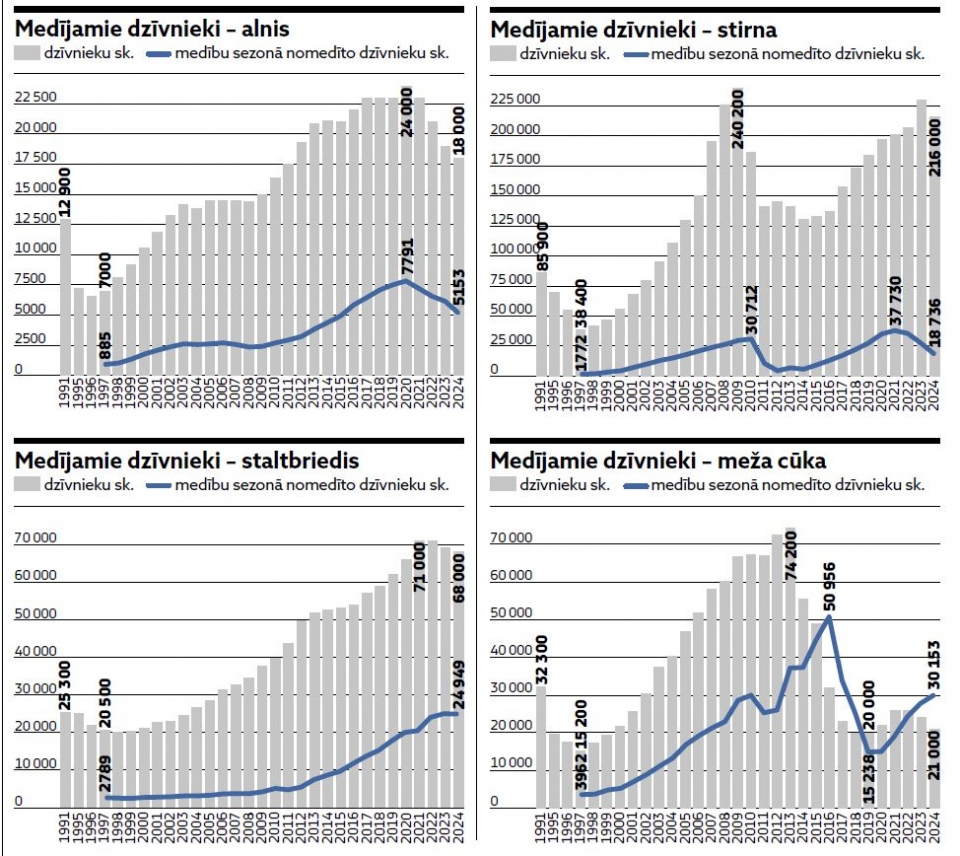
Data from the Central Statistical Bureau show that in 1991 there were 16,800 beavers recorded in Latvia, while by 2024 the number had reached 57,000; the number of red deer rose from 25,300 in 1991 to 68,000 in 2024. Similar growth dynamics can be seen among predators too: in 1991 there were around 400 wolves recorded in Latvia, and by 2024 the number of this species had reached 1,400, with a similar picture for lynx. Something of an exception are wild boar (1991 – 32,300; 2010 – 67,200; but 2024 – 21,000), which have been heavily affected by African swine fever.
More and more inhabitants in the forests
“The situation with wild animals in Latvia has improved substantially over the past 30 years. At the beginning of the 1990s the numbers of many animal species were comparatively small, and some ungulates (the edible ones) had all but disappeared; at present animal populations have grown larger and are stable,” says Haralds Barviks, chairman of the board of the Latvian Hunters' Association, describing the situation and noting that many different and even opposing opinions are voiced in society — for instance, that Latvia has too many individuals of one particular species. “That, however, should be judged from the point of view of a specific place rather than applied to the whole country,” H. Barviks adds.
Linda Dombrovska, vice-president of the European Federation of Associations for Hunting and Conservation (FACE), founder of the Latvian Ladies' Hunting Club and editor-in-chief of the magazine “Medības”, is convinced that no clear answer can be given about the size of wild animal populations, because there is no benchmark for how many individuals of a given species Latvia needs.
“Latvia has as many wild animals as it has, because the country has no criteria for how many individuals of a given species there should be at any particular moment, so that one could conclude whether there are too many or too few,” L. Dombrovska explains. She points out that a section of society genuinely delights in the animals in the forests and in the chance to see them in the wild. “A great many animals live in Latvia's forests; the question is how well people are able to live alongside them and their numbers,” L. Dombrovska says, citing as an example the currently prevailing view that Latvia has too many wild boar because African swine fever is raging, and that their population therefore has to be reduced. “It is not clear how large a population of wolves, red deer, bears or elk Latvia would need,” L. Dombrovska stresses.
Andis Purs, director general of the State Forest Service (VMD), points out that it is impossible to count every wild animal with 100% accuracy — one can see trends. “The number of wild animals is influenced by several factors that interact with one another. Take the number of predators (around 1,400 wolves) and how one arrives at the permitted culling figure, the limit for which will already be exhausted in December; is that a lot or a little,” A. Purs explains. He notes that the situation is not uniform across Latvia, because animal numbers differ from place to place, as does the food base available to them.
“There are a lot of red deer and a lot of damage caused by them in Kurzeme and Zemgale, while at the same time there are many elk and corresponding damage in the eastern part of Latvia,” A. Purs points out, recalling that the VMD's task is to look at the situation as a whole, not just at individual animal species. “We look at the predators — lynx, wolf and bear — but it would be time to think about the mountain hare, which ought to have a species protection plan,” says A. Purs.
An individual approach
The VMD director general notes that the question of how many individuals of a particular species there should be in a given area will be assessed differently by different interest groups, because farmers will have one view, foresters another, and hunters yet another. According to A. Purs, questions about additional permits to cull wild animals mostly come to the fore once the damage has already been done.
“Complaints do come in, but the most important thing is to base all the information received on facts, so I urge everyone who encounters damage caused by wild animals to report it through the “Mednis” app, which will make decision-making easier for the VMD,” A. Purs urges.
L. Dombrovska draws attention to a situation in which the culling limit is one thing and hunters' ability to fulfil it quite another — all the more so when hunters have to comply with a great many different requirements and are also subject to restrictions (hunting equipment during the hours of darkness, locations and so on).
“I believe the system has to be flexible enough that individual cases do not force us to talk about changing the whole system. If there is specific damage, the appropriate mechanism is triggered to deal with the problem,” L. Dombrovska suggests, noting that serious problems are seen in particular places, not across the whole of Latvia. In one parish, for instance, red deer are “eating the hair off your head”, while in another you are lucky to meet an individual of the species once a year.

“Those options already exist, where farmers and foresters, together with VMD hunting specialists, decide on the culling limit for game animals. There is a second option too — the hunting coordination commissions operating under local authorities, where the problem of damage caused by wild animals is dealt with,” A. Purs says. H. Barviks adds that it is precisely those hunting coordination commissions operating under local authorities where a finger has to be kept on the pulse, since they have not yet been set up everywhere.
Fewer and fewer hunters
It has to be borne in mind that the population of rural regions is shrinking, and in recent years the number of hunters has fallen too, since some were “struck off” for safety reasons.
“One reason for the decline in the number of hunters is the fact that they are regularly criticised for something or other and remembered only when problems arise. Hunters are literally caught between two millstones: on one side are active animal lovers who believe there should be no hunting at all, and on the other side are landowners who believe hunters do nothing — and, on top of that, Latvian non-citizens may no longer own firearms,” H. Barviks explains. In his view, these processes have to be reckoned with, so in future the number of hunters will most likely be smaller still, meaning that the burden on those who remain will grow.
“Hunters are people who provide society with a free service (for traffic and public safety, for the protection of forest stands and agricultural crops, and of livestock too), spending their own money and time. If nothing were hunted in Latvia for a couple of years, we would see a stark picture,” H. Barviks warns.
A. Purs also urges attention to the image of the hunter, noting that he knows of only two fairy tales (Little Red Riding Hood and Snow White) in which the hunter is portrayed positively. “The most important issue is knowledge, which shapes understanding,” A. Purs stresses. In his view, it matters what source information is obtained from and what information is then passed on.
Protecting some, losing others
“Forestry and farming are by no means the only users of land; every animal, from the hare, roe deer, elk and red deer to the fox, wolf and bear, has its place in nature. The problems begin the moment one species is deemed bad (harmful) and, in someone's opinion, has to be eliminated, while another is deemed untouchable and its numbers must not be regulated,” L. Dombrovska explains. In her view, this creates curious situations, for example with the mountain hare and the lynx. “The mountain hare, alongside roe deer, is one part of the lynx's natural menu. As we know, lynx may no longer be hunted in Latvia, and yet... we are worried about the state of the mountain hare population,” L. Dombrovska observes, adding that the most important thing is to understand that damage is possible, but its scale cannot be so great that it “eats the hair off your head” and leaves the owner in question unable to carry on their business at all.
“If we are talking about wolves — how many sheep farmers in a particular region have given up the occupation in recent years because of the grey ones?” L. Dombrovska asks, noting that the sight of sheep torn apart by wolves is neither pleasant nor attractive, and is even traumatic, yet part of society blames the sheep farmers for the situation. The BBC recently reported that 45 years of strict protection for grey wolves in Europe has come to an end, as the protection status of these animals has been downgraded from “strictly protected” to “protected”, and many of the protective measures that allowed Europe's wolf population to flourish will be lifted. The number of wolves in the EU has almost doubled — from 11,000 (in 2012) to more than 20,000 today — and they are causing too much damage to livestock.

In search of balance
“There has to be a balance; we must not fall out of one ditch into the other,” Linda Dombrovska stresses.
“Talking about wolves, lynx and bears, I do not want to dramatise things and claim that people are under threat from these predators, but the possible risk cannot be forgotten,” H. Barviks replies when asked whether, as the predators' natural food chain disappears, people could be drawn into it. He points out that the number of red deer is directly linked to the number of wolves, and as deer numbers fall sharply one must expect the number of wolf attacks on domestic animals to rise. “If the numbers of one animal species fall, the species that feed on them will have to switch to a different food base, and people will have to reckon with possible trouble,” H. Barviks explains, predicting that sooner or later we will also see trouble from the “furry-pawed ones” (which are only sweet in books, since in nature the bear is a clever, bold and aggressive animal) — something people ought to take into account in good time, rather than trying to ingratiate themselves with bears or make friends with them by leaving food by the corner of the house.
“A wild animal must retain its respect for — its distance from — people; if that is lost, sooner or later we will see attacks on people that in the worst case may even be fatal,” H. Barviks says. L. Dombrovska draws attention to the fact that the presence of large predators also changes deer behaviour, which is why the view that the more wolves there are the fewer deer and the less damage does not match reality: under pressure from large predators, herbivores start gathering in larger herds for greater safety and seek out feeding places where calories can be taken on more quickly, and this in turn creates all the greater pressure on farmers and foresters. “You cannot remove one term from nature's equation and hope that something very nice will happen. The opposite may occur, with the little house starting to lean the other way and producing a negative effect we have not even imagined,” L. Dombrovska warns.

Furry-paws and wolves — terrorists
Data from the Estonian Environmental Board show that in 2021 the neighbouring country registered 790 beehives raided by bears; in 2022 the number of damaged hives was 364, and in 2023 it was 343. The highest number of beehives destroyed by bears in 2023 was recorded in Järva and Viljandi counties. The scale of spring damage to bee colonies depends largely on the spring weather, which determines the bears' natural food base. In addition to the damage done to beehives, the state also assesses and compensates owners for losses caused by bears to livestock and to silage bales. Bears attack livestock rarely, yet the number of damaged silage bales is comparable to the damage to beehives. In 2023 the Environmental Board registered 1,260 silage bales damaged by bears. A higher number of damaged silage bales has been recorded only in 2021 — 1,461. As wolf numbers rose, so did the number of livestock killed by wolves, the data show. In 2023 the Estonian Environmental Board registered a total of 1,411 sheep and 25 cattle killed by wolves. For the fifth year running the highest number of livestock torn apart was in Rapla county, and damage also increased considerably in Põlva, Pärnu, Viljandi, Valga and Võru counties. In Saare and Hiiu counties there were no losses caused by wolves. In 2023 there were 14 registered attacks on dogs, compared with 16 cases a year earlier.
The distorting mirror of understanding
A deeply worrying picture emerges from the distorted understanding held by part of society, in which the wild animal is a cuddly creature out of a cartoon. “An acquaintance sent me a photo of a wild boar basking on a cycle path in Jūrmala, with a lady who had decided to make friends with it, go over for “a chat” and feed it as well. I don't know why people have lost their fear of, or caution around, wild animals whose appearance in a town raises questions,” L. Dombrovska says. She stresses that nobody should approach a wild animal — not a fox, not a wild boar, not a beaver, not an elk, not a red deer or a roe deer — because they are unpredictable and can be dangerous, with unforeseeable consequences. H. Barviks suspects that the wild boar in question was sick, since a healthy wild animal avoids contact with people.

“Statistics on animal attacks on people show that the most dangerous wild animal is precisely the wild boar, since the only registered attacks involve them; the reasons for an attack are young, injuries or an unknown coincidence of circumstances,” H. Barviks explains. L. Dombrovska notes that the magazine “Medības” shows and reports on all of the above and gets a fairly sharp reaction, argued along these lines: “you are running a campaign against wild animals so that they can be hunted”.
“It seems that for part of society evolution has taken a detour,” is L. Dombrovska's harsh assessment of the situation. In H. Barviks's view, attention should be paid to what is depicted in the cartoons children watch, and how, because wild animals in them are made equivalent to people and are the positive heroes; in this way a view at odds with reality is formed from early childhood. “If scenes of wolf attacks on sheep are deleted from social media because in the view of the little censors they are harmful and undesirable for society, it is impossible even to talk about developing objective solutions,” says a critical H. Barviks. It should be borne in mind that there are comparatively very many video stories in which a small predator (a lynx, a wolf and so on) is taken into a family, grows up and becomes a wonderful friend to people, dogs and cats.
“The young generation spends a great deal of time in the virtual world; the question is how to apply the understanding and information gained there in the real world,” A. Purs adds. He recalls the situation in which, asked where milk comes from, most children answer “from the shop” and only a few answer “from a cow”.
“Norway is a good example, where children in nursery school see real life and understand it, which only confirms the importance of education,” says A. Purs. H. Barviks stresses that an understanding of real life (where milk and eggs come from) is an advantage for children living in the countryside, but most people in Latvia live in towns or near them, where a child has no chance to go to the byre for hens' eggs or to feed a rabbit.
“Did you know that 23 million Americans believe chocolate milk comes from brown cows?” L. Dombrovska asks ironically. She also points to the good news of teachers who, not knowing the answers, invite specialists into nursery schools and schools to explain the laws of nature to children. “There are cases where a child wins a competition but is then disqualified for turning up in a dress with a hare-fur collar. What are we teaching with behaviour like that? What sort of thinking does someone who acts that way have?” H. Barviks says of the situation. In his view, appropriate education programmes need to be developed and people who know real life should go into virtually all schools and nursery schools to explain what is arranged how in nature and what happens there; summer camp programmes should also be expanded so that children gain not only theoretical but also practical knowledge of what goes on in the forest and how. “Another important segment — the mass media — has a very significant role in educating society, all the more so if, unfortunately, part of the adult population has a child's level of understanding of what happens in nature,” H. Barviks concludes.
A video of the discussion is available here: https://www.youtube.com/watch?v=tx2CJ_B9u_g
 |
 |