



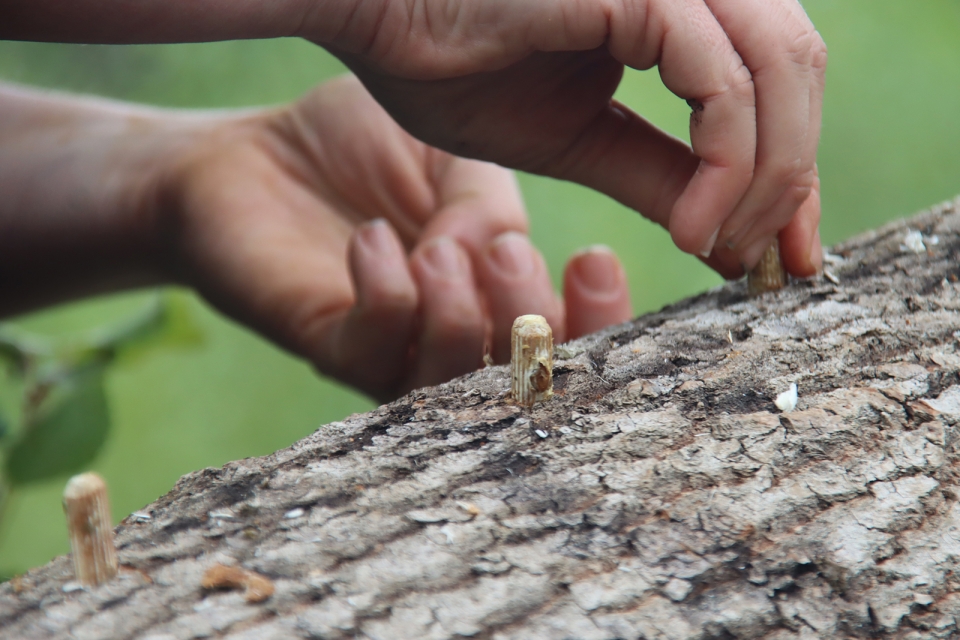
Fallen (dead) trees are inoculated (inoculation – the introduction of living microorganisms into a medium, soil, or a plant or animal organism; also known as seeding or infection) with small wooden plugs containing the mycelium of endangered fungi (saprophytes).
Fungi that live in wood, or polypores, undoubtedly contribute to forest biodiversity; unfortunately, many of these species are endangered. Researchers in Finland have found a way to introduce the mycelium of these fungi into wood.
“I’m not doing well!” – exclaims Finnish Natural Resources Institute researcher Reijo Penttilä (Reijo Penttilä) as he steps over a spruce log lying on a forest path. Underneath it hides a pink colony of the rare Fomitopsis rosea species. It is precisely because of these and other endangered species that the Natural Resources Institute’s polypore expert has invited journalists on a tour of a forest in southern Finland. Despite a long career in fungal research, R. Penttilä is surprised by the number of fruit bodies found under the log. “It looks really good,” he says excitedly, having also found a few Skeletocutis odora specimens nearby.
Both Fomitopsis rosea and other polypores are crucial for forest biodiversity; they cause the host tree to decay, and in turn, decaying wood is vital for the survival of many other species, though it is too scarce in Finland's commercial forests. The spread of polypores is good news not only for the fungi themselves but also for many other species.
R. Penttilä did not find the polypore fruit body colonies by accident. Unlike the easy transplantation of many plant species, relocating fungi has only been successful in very rare cases. The promising but new method being used by Finnish researchers could also be applied to other fungi that live on tree trunks and in other geographical areas.
The best results have been observed for species whose status is highly critical
The aforementioned study was produced in collaboration between the Natural Resources Institute Finland and the University of Helsinki. In 2019 and 2020, polypore species living on spruce, willow, aspen, and Scots pine were relocated to forests belonging to Metsähallitus, the City of Helsinki, and the forest industry company UPM. This project is currently considered the most extensive experiment of its kind to date.
“We are investigating whether the mycelium manages to grow and reproduce, and produce fruit bodies and spores,” says project leader R. Penttilä.
The spread of fungi in the host tree is studied by taking trunk samples and performing DNA analysis. It currently appears that the Skeletocutis odora mycelium R. Penttilä just found, which was used for spruce inoculation, has not only managed to spread but also to produce fruit bodies visible on the tree trunks; this happened faster than the researchers had hoped.
“The results are quite encouraging. For example, regarding species whose host is the aspen, relocation has been most successful for Radulodon erikssonii and the critically endangered Perenniporia tenuis,” says a satisfied R. Penttilä.
Many variables must be taken into account in the experiments. For example, whether the trees fell on their own or were felled, and whether they are located deep in the forest or at the forest edge. Important factors include how long the tree has been lying on the ground and how many other fungal species are already growing on it. Based on what is already known about the spread of transferred mycelium, comparisons can be made; for instance, transferring mycelium to a freshly or recently felled spruce has been at least as successful as transferring it to a fallen and already partially rotten spruce trunk.
The wood is inoculated with small wooden plugs containing the mycelium of endangered saprophytes, which is grown in the Natural Resources Institute’s laboratory from fungi collected in the forests. The plugs are inserted into holes drilled into dead or felled trees. Only one species is inoculated per tree, and different strains of the same polypore are inserted into a single tree. This is done to ensure (promote) a successful outcome and genetic diversity.
The goal – spontaneous spread of fungi
The pink fruit bodies of Fomitopsis rosea can be found in a commercial spruce forest owned by UPM, where there is plenty of deadwood and the stands are of varying ages, making these areas suitable for such an experiment. Former clear-cut areas where many still-firm, dead aspens remain are also useful. These are suitable for inoculation with Perenniporia tenuis, which prefers more open areas. “Relocating this species to open areas has been sufficiently successful,” R. Penttilä proudly notes.
Dead and fallen trees left in managed forests are part of daily nature management and are very, very important for the protection of saprophytes.
“Approximately a quarter of the species found in Finnish forests are dependent on deadwood. One of the most important measures taken by the company UPM to promote biodiversity is to double the volume of such wood in the company's forests in Finland,” says Sami Oksa (Sami Oksa), UPM Director of Stakeholder Relations for the forestry sector.
S. Oksa says that since the early 2000s, UPM has not removed deadwood from its forests. Both S. Oksa and R. Penttilä point out that leaving deadwood in the forest is one of the most important ways to protect and improve the living conditions of various endangered species. “Relocation is a kind of first aid to help the most endangered species survive. The operation is a success if the species begin to reproduce spontaneously,” says R. Penttilä.
Photos by Anna Kauppi and zemeunvalsts.lv used