




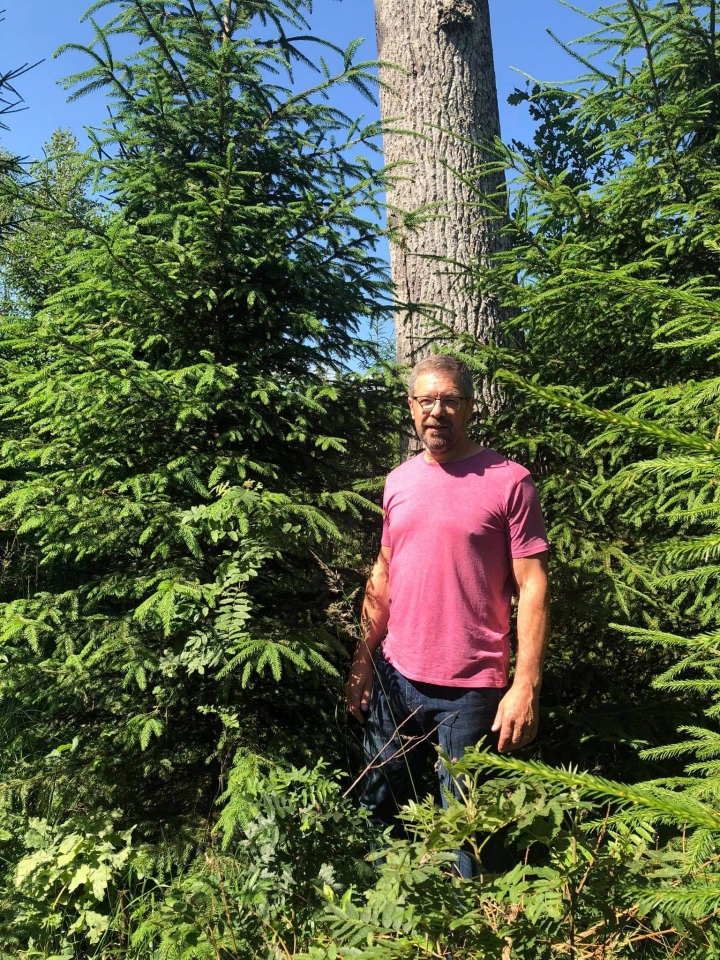
Vilmārs Katkovskis, Head of Forest Management Planning for the West Vidzeme region, speaks with Māris Liopa, Chairman of the Forest Certification Council of Latvia, and Pauls Rēvelis, editor of zemeunvalsts.lv
Before we started our conversation, you were on a call where you mentioned RailBaltica...
It is a very common and topical issue these days, as the RailBaltica (RB) project is ongoing and gathering pace! We at Latvijas valsts meži (LVM) regularly receive requests for technical specifications from the project designers. Since the railway line significantly affects state forests, specifically in West Vidzeme, the Mid-Daugava region, and Zemgale, and taking into account that the deforestation of an area of more than 500 hectares is expected for the track, amendments to the Forest Law have been adopted, granting Latvijas valsts meži the rights to fell trees on land under the possession of the Ministry of Transport. Therefore, we will organise logging both in the areas transferred and in areas expropriated from other parties.
The total area of state forest land to be transferred for the track, as I mentioned, is large (500 ha), and we are talking about more than 100,000 m3 that will need to be harvested. LVM has established a working group for cooperation with RailBaltica (RB), and I have the honour of chairing this group, so I am fully involved in the work process.
How many seasons are the works related to RailBaltica planned for?
Until 2026 or 2027, realistically speaking, and knowing that the work is already running with some delay. We are currently working on unclear issues, the number of which continues to grow as the work progresses.
For example, one of the most pressing issues is the railway line crossings (viaducts or tunnels) on land belonging to Latvijas valsts meži. We do not see ourselves as the manager of these crossings, even though they are designed on LVM land and roads. The reasoning is: our (LVM) roads are commercial roads; they are built and intended for a specific purpose. For example, a recommended speed of 30 km/h, a width of 4 m, with passing places rather than a road width intended for two-way traffic; furthermore, we only clear roads when there is an economic necessity, not on a daily basis.
If a track crossing is planned on such a commercial road in the RB project, it is clear that sooner or later it will turn into public infrastructure. If any of the parties involved – the state or the municipality – decides that such a crossing is necessary on land managed by LVM, our proposal is for the relevant institution to take the road and the crossing into its own management up to the next piece of public infrastructure. That is LVM's current position.
How do your cooperation partners view this?
The position of the Ministry of Agriculture is the same: LVM, as a commercial entity, does not have the delegated functions of public infrastructure supervision. While it happens in practice, one must understand that if we currently see a small forest road in the wild that is only occasionally used by mushroom pickers, after the railway track appears, it will definitely turn into a traffic road, which will long-term raise questions about road reconstruction, safety, maintenance, control, etc.
Another very important issue to discuss: the small forest patches "returned" by the track. The track where trains will whizz by at 240 km/h cannot be "bent or twisted". What to do with the land that is "left over" and which effectively turns into "land without access"? For larger plots, we want to maintain access, and the project provides for this, but what to do with 0.1 ha, 0.3 ha, or 0.4 ha, and if such a plot is in a narrow strip? For example, a 330 kV power line was recently built in Vangaži; the railway will be parallel to it, but when looking at the protection zones, a forest or forest land remains in a 10-20 m wide strip. What to do with it? You cannot grow a forest there, but the law imposes such a requirement, and the risk is that trees could fall onto the power line or the railway. The designers have been informed about the risks; we have to wait for a solution.
In parallel to the aforementioned work, we are preparing technical conditions, for example, by suggesting that the designed crossings be replaced by parallel roads. In our opinion, this would also be more cost-effective, as one crossing costs about 0.5 million euros. For this sum, we can build 5 km of road. If our recommendation and solution are accepted, RailBaltica will build the roads.
The project stipulates that if any property is burdened, alternatives are sought. Currently, 8 crossings are planned on state forest lands, and we are offering viable alternatives. This is allowed. LVM employees in the regions are actively participating in this work; they know the situation best and offer the most rational solutions.
RailBaltica is a very ambitious project. There is still relatively little talk about its impact on the national economy...
It is currently difficult to understand the wider impact of the project. At Latvijas valsts meži, we work with what is clearly known, such as the route. There is still a lot of the unknown; we will discuss it when we get to the first technical design – approved, with a building permit and a deforestation plan.
What are we trying to achieve? We are looking at how we can continue to manage all state forest territories; we are doing our homework, for example, by looking at every individually issued building permit (there are several dozen differently divided building permits), which accordingly forms a separate set of logging areas. For example, we are planning the deforestation and its organisation for the moment when work must begin: how access to the site will take place, which stands the track will affect and which will have to be removed, and we are planning the extraction of assortments. When there is a deforestation plan, we will immediately plan the logging, where the work will be for contractors. We will start from the Lithuanian border; there will be less work in the Riga area because there are few state forests there. There will be more work in the Vidzeme region.
Environmental issues
We are actively discussing eco-ducts or animal crossings. The project includes something that we, as foresters, think is ill-considered: planning and building an eco-duct for animal migration while simultaneously allowing motor vehicles to drive across it.
A herd of deer and a jeep...
To someone with forest knowledge, this seems wrong, but to a designer – why not? We received a sample from the designers – an animal crossing that also allows vehicles, which crosses the Tartu-Tallinn highway. Looking at the image, it can be seen that the area in question is not busy. In our opinion, this solution is not logical; there is no place for cars on an eco-duct.
Another option: frogs, toads and cars...
We are thinking very seriously about small animals! We are talking about culverts – in addition to their direct function, they can serve as migration corridors between both sides of the railway. The project provides for a culvert diameter of 1.2 m, and we are suggesting 1.5 m, because then they will be used not only by amphibians but also by wild boars and deer. Of course, this is a certain risk and surprise, because the culvert will be like a large corridor or tunnel – 60-70 m or even 100 m long. We see this as an alternative to an eco-duct. Of course, a 1.5 m diameter culvert costs more. The result? We are waiting for questions from the designers. The discussion is ongoing.
Currently, if I may say so, the "most unfortunate" is the designer, who has received and must take into account several technical regulations and conditions. It is not easy! As I already mentioned, the most visible object of discussion at the moment is the crossings.
How do the Estonians rate the eco-ducts?
Nothing brilliant – there is an eco-duct crossing the Riga-Tallinn highway, and our Estonian colleagues do not praise it at all – elk do not want to use it, though smaller animals do move through it. In summary, we currently do not know how the track will affect the environment, animals, people, migration, how transport flows will change, etc. Time will tell.
The wider impact of RailBaltica...
At the moment we are still talking about theoretical things; work in the field has not yet taken place. When the work "goes out to the field", we do not know what else to expect. The number of issues for discussion will definitely increase, for example, where the excavated soil will be placed, where stumps will be placed, where construction equipment depots will be provided, construction materials, etc. I can only repeat: the volume of expected work is substantial!
LVM's position is simple: we have our own requirements for ensuring state forest management, but our conditions will not delay the design.
Every serious construction-related project has areas it will undoubtedly affect. An environmental impact assessment was conducted for RailBaltica a long time ago. Understandably, the railway as a "large footprint" will lie on a part of Latvia. There is a wide range of unclear issues, such as the hydrological regime, because the embankment, the structures... In our conditions, we emphasise that the railway must not worsen the hydrological situation, the ditch network must be respected, etc. The impact will, of course, exist; the railway embankment will act as a dam, affecting water flow, groundwater, but how? Hydrotechnical and geotechnical research is still ongoing.
Working group...
If we talk about the LVM working group, both planning colleagues, real estate managers, the logging group, etc., participate in our meetings. It takes time, but it is interesting.
Colleagues from various structural units are involved in the preparation of technical regulations. Everything is also evaluated by the company's supervisory group – LVM is doing its utmost not to delay the project, but at the same time to observe forest management interests. Understanding this is quite difficult; there is a lack of state-level interest: we have not had a project like this, and it is unlikely we will have one in the next 100 years. A serious, high-level inter-institutional working group would be required, involving ministries, the Forest Owners' Association, LVM, Rīgas Meži, etc. Sometimes conversations in meetings go "as if over stumps". For example, about preparing the route. The next issue will be the one I mentioned about small land plots separated by the track, where a decisive decision will be required. The laws do not provide for the expropriation of forest land, but it would be logical to sell these small pieces or offer them for purchase to the adjacent owner.
Will they want to?
That is an issue to be resolved. It must be understood: what do we do with the small "pieces" without access? We don't yet know the total number. As for private forests, we know very little, only what we can see on maps; that is future work. It is possible that amendments to the Forest Law will help and the small pieces can be sold for their true value.
When are the saws planned to start?
For now, we can only guess. Optimistically speaking, in the second half of 2022, with the idea that the major works will start in 2023. Not everything depends on us; we are doing our homework promptly! If access to the areas is resolved, the technically necessary forest work is simple to perform. The time of year is also important; if work is allowed in a wet place in spring, it is clear that work will be delayed. It is possible that somewhere the deforestation deadlines could be affected by nature conservation restrictions.
Forest areas are being expropriated not only for the railway but also, for example, for army needs
The area required for the Ādaži training ground was 5000 ha; we naturally have no direct forestry operations in the training ground territory. Regarding tree felling rights: both in Ādaži and in East Vidzeme, when expanding the Lāčusils training ground, etc., it was agreed that they remain under LVM's supervision. Everyone wants to use forest territory, starting with mushroom and berry pickers, orienteering enthusiasts, the army, car drivers, motorcyclists, hunters – everyone wants to coexist in a certain territory. Hunters, however, don't really want to see anyone, because they pay money for the lease of hunting rights. We, in turn, must invite everyone to live together amicably.
On purchasing land for the needs of state forests
We do buy land, albeit a little. The market is "wild"; LVM is not the strongest player in the land market: we cannot act or work like in an advertisement – "we will buy without seeing" or "money in the account the very next day". However, a forest seller can be 100% sure that in a deal with LVM, they have no risks regarding the receipt of money and legally correct documentation. LVM has defined regulations on how we handle money and how we buy properties. We receive offers; it happens that a person comes who wants to sell land only to Latvijas valsts meži. Last year we purchased about 500 ha.
What is noticeably affecting our operations is not the decrease in forest area, but the "shrinking" of managed areas. This is a clear and visible trend: thousands of hectares in Latvia are being removed from economic circulation (micro-reserves, EU-important habitats), which is noticeable and accordingly affects the planning of forestry operations. In 2015, about 30,000 ha were intended for nature conservation purposes in West Vidzeme, now it is 44,000 ha. The Lesser Spotted Eagle in the form of a micro-reserve "visits" me almost every week. In short: the territory where we can manage is shrinking, while the demands of the national economy are not decreasing. That is why many feel: they were just working on this plot and now they are doing it again... We are beginning to lack territories in which to plan normal management. Reserves create a greater load on commercial forests, and seemingly well-planned nature conservation measures cause harm to the remaining areas. This is a serious reason why forests must be grown faster. As long as a series of issues are deliberately delayed while looking at resource availability, the situation will not improve! The demand for funds needed for the state budget is growing, the manager (owner) has their own thoughts, but...
...the owner puts the documents in a drawer and sweetly says: come to an agreement!
I accidentally found a 1938 Latvian statistical atlas on the web... Great numbers! There isn't much there about forests, although their share is significant. The best thing in this statistics: they count forests: 80 years old and older, so if a forest is older, it is no longer divided into more detail. If someone philosophises and talks about the conservation of forests in the Ulmanis era, let them find and look at this official state document! In those days, the countryside dominated in Latvia; today the landscape has changed significantly. Not quite 90 years have passed since the preparation of this statistical report – what are our country's fundamental things (?) – agriculture and forestry! That is how it has been and that is how it will be! You will not replace both sectors with virtual things!
In Europe, about 5% of people work in IT matters. One must look at people's abilities; not everyone is an IT specialist, not everyone can sing, not everyone can write projects...
Of course, everyone needs to eat! When you put down your phone or tablet, you need to sit down. Where? On a wooden chair. A person can be a vegan, but are they prepared to do without wood?