



Juris Paiders writes in the 27 May issue of the magazine "Dienas Bizness":
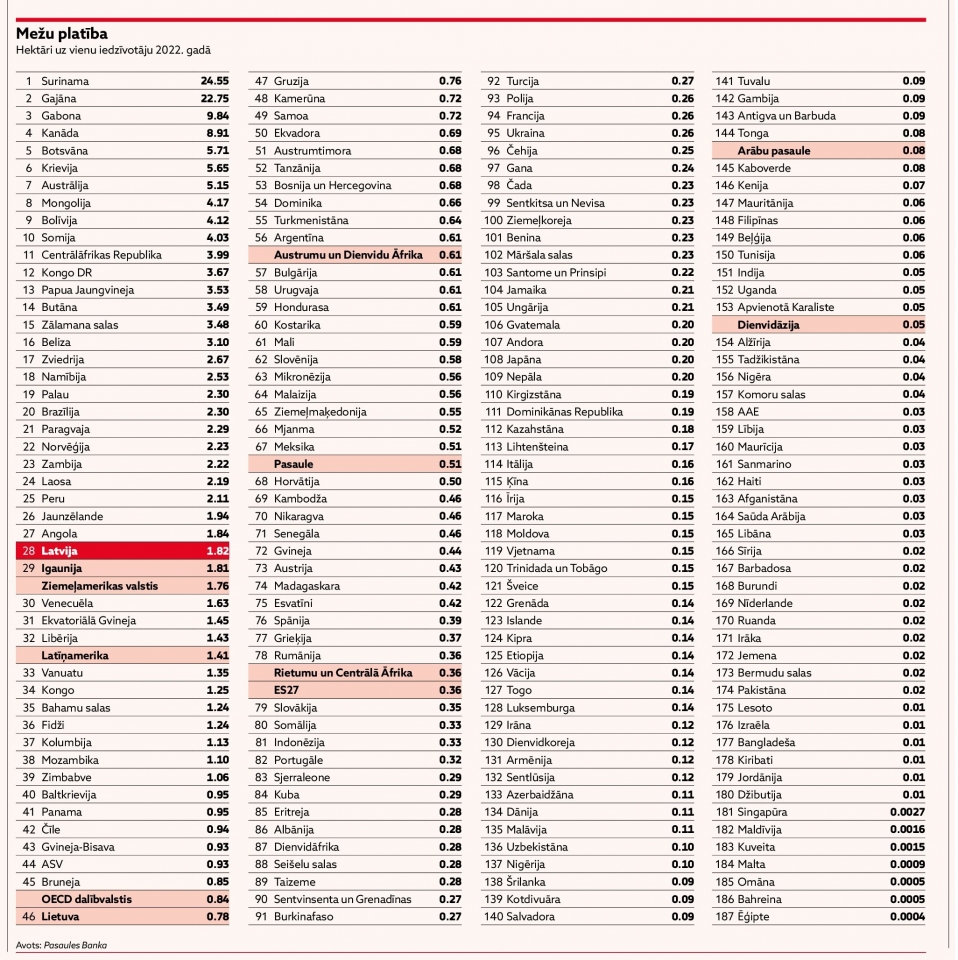
"Latvia is among the 30 countries in the world with the greatest forest resources per capita. According to data compiled by the World Bank, in 2022 the largest forest resources per capita were found in the South American countries of Suriname (24.55 ha per capita) and Guyana (22.75 ha per capita), as well as in the African country of Gabon (9.84 ha per capita). The World Bank uses a slightly different definition of forest from Eurostat.
A forest is taken to mean wooded areas where the average tree height exceeds five metres and which are not gardens or plantations established for growing particular tree species. The World Bank's definition of forest also includes some young stands, as well as wooded areas that are not legally forest. The differences between World Bank statistics and Eurostat statistics are negligible and have practically no effect on the final calculations.
Very large forest resources per capita are also found in Canada (8.91 ha per capita), Botswana (5.71 ha per capita), Russia (5.65 ha per capita), Australia (5.15 ha per capita), Mongolia (4.17 ha per capita) and Bolivia (4.12 ha per capita). Finland, meanwhile, with a forest area of 4 hectares per capita, ranked 10th in the world in 2022. Sweden was in 17th place (2.67 ha per capita) and Norway in 22nd (2.23 ha per capita).
Latvia, with 1.82 hectares of forest per capita, was in 28th place in the world, and Estonia, with 1.81 hectares per capita, in 29th. Forest area per capita in both Latvia and Estonia is greater than the average in the countries of North America (1.76 ha per capita) and Latin America (1.41 ha per capita), and only slightly smaller than in Brazil (2.30 ha per capita), home to the equatorial rainforests of the Amazon basin. In 2022, Latvia's forest area per capita was 3.6 times the world average (0.51 ha per capita) and 5.1 times the European Union average (0.36 ha per capita).
In 2022, Belarus, with 0.95 hectares per capita, was in 40th place in the world, while the USA (0.93 ha per capita) was in 41st. In 2022, forests in OECD member states averaged 0.84 hectares per capita. Lithuania, with 0.78 hectares per capita, was in 46th place in the world.
Among European Union countries, forest areas above the EU average in 2022 were recorded in Bulgaria (0.61 ha per capita), Slovenia (0.58 ha per capita), Austria (0.43 ha per capita), Spain (0.39 ha per capita), Greece (0.37 ha per capita) and Romania (0.36 ha per capita). In Slovakia (0.35 ha per capita), Portugal (0.32 ha per capita), Poland (0.26 ha per capita), France (0.26 ha per capita), the Czech Republic (0.25 ha per capita), Hungary (0.21 ha per capita) and Italy (0.16 ha per capita), by contrast, forest areas were below both the world and the European Union average. In 2022, Ireland had a forest area of 0.15 hectares per capita, while Cyprus, Germany and Luxembourg had 0.14 hectares. In Denmark, forest area was only 0.11 hectares per capita.
The forest resources per capita of Denmark and the Netherlands are even smaller than those of China (0.16 ha per capita). Leaving aside Malta, which has virtually no forest, the European Union member state with the least forest per capita is the Netherlands – just 0.02 hectares. On this measure the Netherlands ranks 169th in the world, behind mountainous, arid Afghanistan (0.03 ha per capita) as well as desert-covered Saudi Arabia (0.03 ha per capita) and Syria (0.02 ha per capita). The Netherlands' forest resources per capita are even smaller than India's (0.05 ha per capita). In 2022, the smallest forest areas per capita among the world's countries were in Singapore, the Maldives, Kuwait, Malta, Oman, Bahrain and Egypt. There are also countries with no forest area at all under the World Bank's definition – Nauru, Qatar, the Vatican and others – and these are therefore not included in the table."
The full article can be read in the 27 May 2025 issue of the magazine "Dienas Bizness"