For many, Sweden has long seemed like the embodiment of the capitalist social welfare dream, where corporations and trade unions cooperate harmoniously with the government. The Swedish people are among the wealthiest in the world, with state-provided health insurance and other generous benefits.
However, lately, Sweden no longer seems quite so traditionally Swedish. The far-right Sweden Democrats party finished second in the September 2022 elections, running on an anti-immigrant campaign. The party’s votes in parliament now influence national policy within the new centre-right coalition, raising questions about whether the country is moving away from the liberal Social Democratic Party, which has been the benchmark for the system. Fewer young Swedes are joining trade unions, and American-style private schools and medical care have taken root.
Could this lead to the end of the "Swedish model" with high taxes, which has been admired by like-minded nations? Harvard Business School professor Debora Spar (Debora Spar), who has extensively analysed the Swedish model, argues that it will not—the Swedish model is robust and will likely continue. In reality, Sweden itself is not quite the Sweden that many imagine.
"Americans, including myself, do not have a complete understanding of what Swedish capitalism is like," explains Debora Spar. "We thought it was more like socialism, but it is not. It is deeply capitalist. It just functions differently."
Sweden struggles with immigration
Although Sweden has a wealthy high-tech economy and a large number of start-ups continuing to develop in the country, it is grappling with the long-term consequences of an exceptionally inclusive immigration policy.
Sweden, with a population of only 10.6 million, has taken in a higher proportion of recently arrived migrants than any other European country. The Organisation for Economic Co-operation and Development (OECD) notes that there are currently 1.3 million foreign-born residents living in the country, which is 14% of the total population. Sweden has also opened its doors to more than 45,000 refugees from Ukraine. These figures have allowed the far-right to expand their political platform, linking migrants to rising crime rates and other social ills.
"It is a problem that is manifesting not only in Europe but also in the USA," Debora Spar says regarding the growing number of immigrants. "Sweden is an example of both the fact that the issue of immigration must be addressed and how complicated it will be."
Spar points out that the Social Democrats "tried to do the right thing" by accepting migrants. "But there is a quiet consensus that this process moved faster and further than the country could handle, which is why the Social Democrats are trying to correct the situation that has arisen."
Nothing like Sweden
At the same time, Professor Spar notes that the current problems are unlikely to diminish other countries' respect for the Swedish model. This is partly because no other country has managed to replicate this model.
Although the professor sees strong echoes of the Swedish model in Taiwan, Singapore, Costa Rica, and Germany, all of these countries have their own style. "Nowhere else is there anything like Sweden," notes Debora Spar. "One of the reasons why models work is because they fit [each country's] social context. That is why the Swedish model works so well for Sweden. The US could not adopt the Swedish model. It simply would not work."
Sweden's distinct business and welfare model is rooted in the country's long and stable history. Sweden was the land of the Vikings, and a small kingdom was formed in the southern part of Sweden in the 11th century. The Riksdag, Sweden's parliament, first convened in the 15th century. The country began selling iron ore and coal to Germany and Great Britain in the early 19th century. When Sweden began industrialising in the mid-19th century, "the Swedes did it quickly and methodically." They adopted the most successful examples of production practices from the most advanced countries in the field.
One example is unique to Sweden: in 1898, trade unions formed a federation, and manufacturers and other employers also formed an association—not for opposition, but for cooperation. This was the first cornerstone of what became the Swedish model after the Second World War.
The cost of social services
This model flourished after the Second World War, when the Social Democrats implemented three policy directions: an active state administration aiming for a fair distribution of income and wealth, a generous social welfare system funded by taxes, and a shared corporate governance structure involving companies, employees, and the state. Excluding the severe recession of 1991, this model has been successful for both liberal and moderate governments. It happened not in spite of one of the highest tax levels in Western Europe and Scandinavia, but precisely because of the Swedish state’s successful model (as the country's former prime minister said, "entrepreneurs in Sweden have the courage to leap" because there is a "safety net").
Sweden has had a high property tax since 1948 and state health insurance since 1956. Currently, employees pay 7% in social security taxes, while companies pay 31%. Local sales taxes reach 25 per cent, while taxes on food and other goods are lower.
Americans might not tolerate such a tax burden, but Swedes do not mind "because they feel they get enough back for it," Professor Spar notes. For example, as of 2022, Sweden’s health insurance and other benefits account for 30% of government spending, compared to 10% for social security and Medicare in the US.
The future of the Swedish model
Sweden is also struggling with the same high inflation that is plaguing other countries. This was partly caused by the aftermath of C19 and Russia's invasion of Ukraine.
Spar believes that, given the existing problems, the Swedish people are not in agreement on whether to transition to private education and healthcare. Such a change would undermine decades of stability. The public has largely been satisfied with a government that provided these services. "In a unified society, education is crucial to building a sense of national, collective identity. It should not be fragmented," Spar emphasises. "Then the country starts to feel that it has lost something intangible." (Swedish historian Lars Trägårdh thinks that then "Sweden would no longer be united.")
Despite the doubts and stress, Professor Debora Spar argues that the Swedish model remains strong. The government, entrepreneurs, and employees continue to manage the national economy together. "The government does not regulate the market," Spar notes. "It is governed by a strong employers' association and stable trade unions for workers. They have fostered growth in the country."
Therefore, Harvard Business School professor Debora Spar emphasises: "When thinking about Sweden, I remain an optimist."
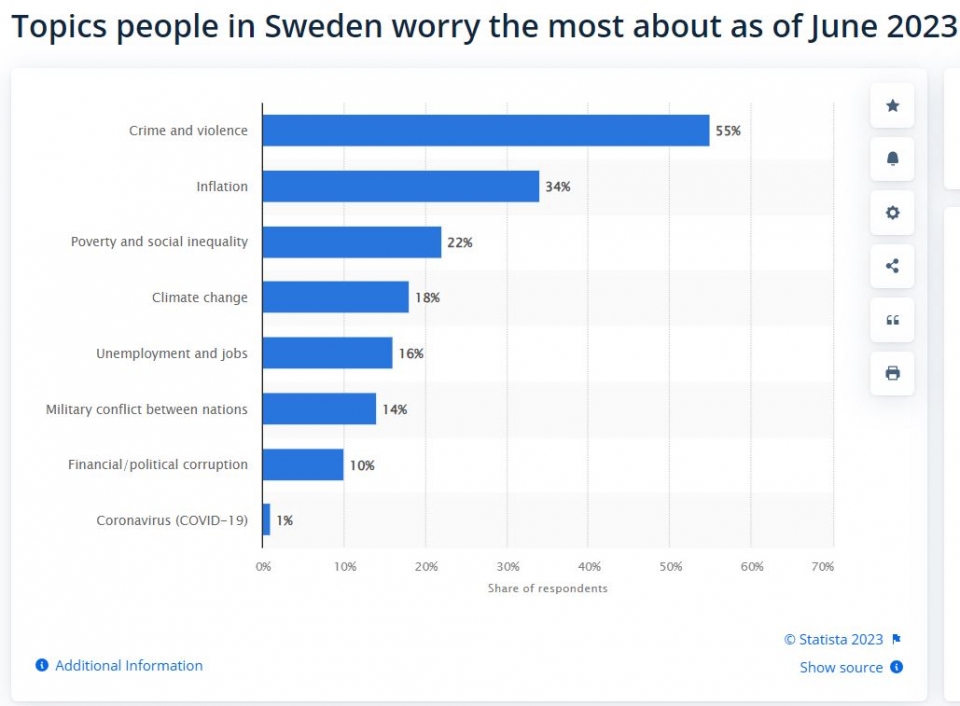
Issues worrying Swedes in 2023: