



Jānis Zvejnieks is interviewed by Māris Liopa, Chairman of the Forest Certification Council of Latvia, and Pauls Rēvelis, editor of zemeunvalsts.lv
I am not a native of Strenči through generations. Upon finishing my studies, my parents were assigned to work in Strenči (at that time, the Strenči Forest Management Enterprise). As for the locals, people from the nearest settlements work in the nursery – initially from Strenči and Trikāta, but over time this circle has widened, and employees now also commute from Ēvele and Jērcēni. Local communities are quite distinct; if a person has lived here for generations, it is noticeable.
Traditionally, the largest employers in the Strenči district are also major agricultural companies, forestry, and the timber industry. I am not speaking about nearby Valmiera; that is a different story. There are no free corners of land around here! Everything is being managed.
Close to Strenči is the former peat extraction town of Seda...
One can and should visit Seda on an excursion. Peat extraction on a small scale still takes place there, there are nature trails, and you can watch birds. From the Jērcēni side, it is possible to engage in water tourism in the Seda bog. It is a great place where there will never be forestry, but there will always be a large, valuable habitat. Commercial activity in the bog, as I mentioned, is gradually coming to an end. The town's population has decreased by about 5 times (from 5,000 to 1,000 residents).
What was your path to the position of nursery manager?
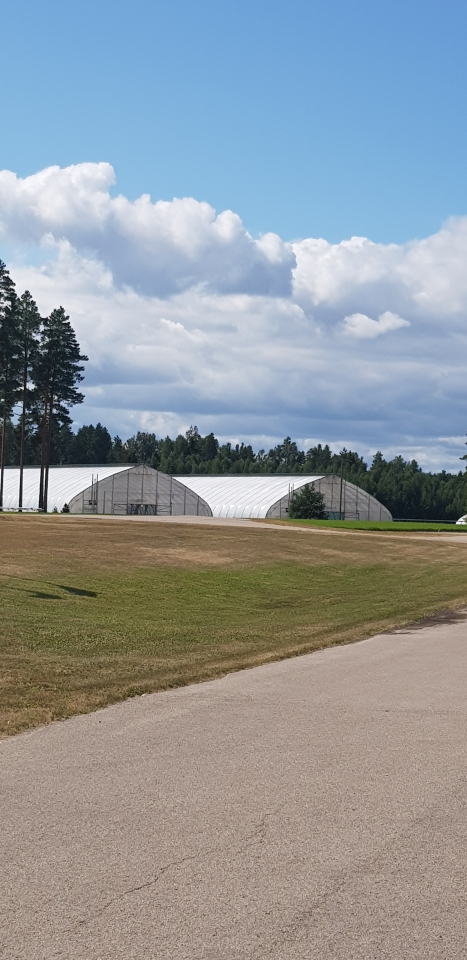
My mother worked in the nursery; she was the nursery manager for about 20 years. I think it was in 2003 when the previous director had noticed me running around here, working during the summers, or occasionally covering for a security guard or another employee. At that time, the nursery “counted” as a wooden building of about 30 m2 with a dry toilet and 40 employees who worked from the end of April until the beginning of October.
Currently, a lot has been invested in production, and the situation is completely different. I hadn't even really started my studies when I began working at the nursery (I was 19-20 years old). As I mentioned, the situation is now completely different, but at that time (15-20 years ago), nobody wanted to work in a nursery: “What is that, what is there to do?” Nurseries were historically considered a bad place to work. Discussing this issue with Swedish colleagues, I learned that in the 1950s in Sweden, there was a principle: those who had unfortunately suffered an injury during forest work would work in the nurseries; it was considered a low-category job. Not quite as harsh, but similar views prevailed in Latvia as well.
The idea of a network of nurseries has proven successful and correct for “Latvijas valsts meži”. It was not easy to create, however.
First of all, both faith and an idea were needed: that seedlings and their production can be a good business. The thought originated with two people: Laima Zvejniece (my mother) and Mārtiņš Gaigals (member of the LVM Council). In the early 90s, there were many trips to Sweden to see how forestry issues were resolved there. In the early 90s, surges of patriotism and a wave of freedom were still felt: “Now it's going to happen!” Seeing the then-superiority of the Swedes in forestry, the thought arose: “We are not worse, we must work! We can do better.”
Selection work in Latvia was already proceeding quite steadily, the experience and skills were there, and the seeds were there, as was the place to store them. If you have good genetic material, you can work. The joint-stock company “Latvijas valsts meži” was established, business thinking developed, and both visits to Sweden and conversations about possible cooperation, etc., continued. Gradually, we educated Latvian forest owners; I personally travelled a lot across Latvia, much like musicians touring community centres, with lectures and information about forest regeneration. We told them what we were doing and why it was needed, and what the benefits would be for everyone. Step by step, the process developed, and we saw the first fruits around 2015. Events have not unfolded rapidly; mistakes alternated with successes, and luck with misfortune. In the nursery, we still invent and implement something new every year; we make many mistakes, we do many things. It should be added that our mistakes do not cause losses, but strengthen our experience and the opportunity to stay one step ahead of competitors.
Sometimes forest owners are heard complaining: “We cannot buy seedlings...”
We must rewind the film: in 2004-2006, there was an overproduction of seedlings in Latvia. We worked and searched for a market. We concluded that the solvent market was actually small and narrow. We went to Southern Sweden, spoke with a range of potential clients; the talks were slow, as the Swedes were interested in long-term relationships. In 2007, we experienced a “good jump” in development when the Swedes finally realized that we were a normal, Nordic-thinking people, not “crooks from Eastern Europe.” Before us, the Swedes had been quite “burned” by Polish and Lithuanian produce, which is why our path of negotiation was not easy. We started to export, the Estonians started doing it too, cooperation of various levels formed, and we agreed on cooperation for at least 15 years.
Answering the question: “Yes, we export seedlings, but not in huge volumes!” This year we have “issued” 50 million seedlings, of which 10 million were exported. That is not too much. At the same time, in the spring we informed: “In the autumn, 2 million seedlings will be available, sign up!” By mid-July, about 900 thousand had been reserved. Of course, it is understandable that in the spring, at the start of planting, it is difficult to get seedlings, while in June the opportunity to get them already appears... In 2018, there were enough seedlings for everyone.
In nurseries, they try to “transfer” or implement forestry science work into production and the forest. For example, the pine that was planted in private forests in the spring was 100% from 2nd-degree seed plantations. In young growth stands, this can be clearly seen; the little trees are growing, the needles are healthy, and the seed material has been good.
At science days, in the context of climate change, people are talking more and more about the common beech.
Yes, people are talking a lot about the common beech right now! From a production perspective, the common beech is ungrateful, very different from the usual species. I look at this issue this way: if after 12-15 years we reach the point of growing common beech seedlings and we need to sow... do we already have a plan on how to do it? What will happen after that?
If back in the day, as I mentioned, we travelled to Sweden to look and learn, the Swedes talked a lot about autumn frosts, which was a surprise to us. Now we also regularly face them; even high-quality genetic material can be sensitive. How to protect plants against frosts? Usually, employees smoke straw on frosty nights. Now we have planned something new that has been used in the world for a long time; we called it an inversion fan, it is a powerful fan with which we will operate during frost.
The nursery's future plans are...
I will tell you in more detail: a new nursery is being built in Kalsnava in Latvia. Why? It is clear that forest regeneration by planting is more valuable than leaving it to regenerate naturally. The proportion of artificially regenerated areas is increasing, which, understandably, requires seedlings. In 2018, we had reached the peak of production.
There is a certain cycle in the nursery: the plant must germinate for a certain time, this time cannot be shortened, plants must be moved, sowing must end in mid-July, etc. From the perspective of proper seedling cultivation, it became clear: we need a new nursery. (The one being built in Kalsnava) The Swedish example and experience show that, in fact, all nurseries have a capacity limit: 12-15 million seedlings, no more, that would be optimal. In Latvia, it is similar. In Kalsnava, they are trying to observe and summarize all the experience to date to become a model nursery. There will be something there for the Swedes I mentioned so much to see as well. I believe that Kalsnava, Smiltene, and Strenči have long been the centre or region of Latvian nursery growing.

New personnel
If there is an opportunity and the conditions align, we train the new generation ourselves. So far this has worked well; this year we have one Forest Faculty graduate who has been working for 10 years, and in two years we expect another one. Experience comes along with education. In Lubāna, at the Podiņi nursery, and at the Mazsili nursery in Stende, there is no longer seasonal work; people work there all year round. In Strenči, there is still work from 1 April until the end of January, but there aren't large gaps if you consider that we start sowing in March, and real rest is only in February.
Your voice has a very pleasantly optimistic tone. Latvia 2051: your vision.
Not so long ago, the tone was not overly optimistic; there was a possibility that forestry could become unpromising. I very much hope that in the future we will have logical, scientifically-based forestry; there will be both green zones and a proper forestry cycle. Common sense will prevail!
Comments