




An important question, to which there are many different answers: “What does the word “green” mean to you?”
I would like to associate the answer with another word – sustainability. To “live green” means to live as if we have borrowed nature from our children, rather than it having been gifted to us.
Does the meaning of the word fade if it is used too often?
There are certainly times when the word “green” is used inappropriately. There is the term “greenwashing” (green washing), which quite often discredits the concept of greenness. In the future, in my opinion, “green” will be one of the words most frequently used by politicians in their daily lives because it is the only possible direction – to think green, to think about nature conservation.
Not long ago, it was said in a conversation: “As soon as the word “green” starts to be used in politics and by politicians, its meaning is essentially dead.”
In Latvia, many decisions have been made over the last 30 years that have been justified by various “green” arguments. The best example is small hydroelectric power plants (HES), which initially appeared as a very green initiative with the goal of reviving ancient mill lakes, providing jobs for people in the countryside, etc. How did it end and how much green is left in it? At the same time, if this issue had been managed by responsible politicians who understood both the potential benefits and the risks, the situation would have developed differently. Certainly, we would have had more than one small HES built, but on a different scale and with a different understanding. It is clear that in many places and on many rivers, nothing would have been built. This is a vivid example of how poor policy can spoil an initially good, “green” idea.

Were there active, loud, and widespread protests against the construction of HES at the time? Everything seems to have proceeded quite calmly...
The problem did not arise in a single day. We did not wake up and suddenly, behold, dams appeared on significant fish migration rivers! The process took place slowly. When the idea started to be floated and developed, people associated with nature conservation did not realize how it could continue and how it would end. By the time the realization dawned, it was too late for protests. In some cases, even legal proceedings led nowhere, and HES were built that had “legally survived” the entire assessment process, received opinions, and, despite protests, were constructed.
What should be done so that, for example, most of the small HES disappear?
I am convinced that the majority of small HES will disappear from Latvia's rivers. The question is different: how we will reach this result and who will pay for it. Of course, it is also important when it will happen. A nice scenario would be if the small HES were bought from their owners and subsequently dismantled. The people who built them or purchased them after they were built, in many cases, did so completely legally, using the legal opportunities of the time. I cannot blame the owners; the blame lies with the politicians who created a system where such events were possible.
How fair would such a buyout be to the majority of the public, including us, who have not supported such a political direction? We have already paid with the OIK and will pay more, because someone was once deliberately or unprofessionally mistaken. Is that fair?
The question is valid. But one must understand that one has to pay for bad policy, and this is one such case. One also has to pay for the results of other bad policies; for example, we have been working on restoring river bends and floodplains. Those were historical decisions driven by economic benefits, while forgetting nature conservation. Currently, ditches are being filled in and there is an attempt to put rivers back into their former bends, for example, in the Ķemeri National Park. Money was invested back then, and now we have to pay again for the opposite actions. It could be similar with HES.
Would the straightening of rivers be considered a correction of Soviet-era errors?
Yes, of course! Although similar activities are still being carried out today, they are now called “reconstruction.” If a river has already begun to “naturalize” since being straightened, digging it up again will now set it back to the starting point.
Let's assume there is a forest owner with 4.5 hectares of forest where people live quite well with a lesser spotted eagle, which they are proud of, without telling anyone outside their circle. What must the owner do to have a desert instead of a forest?
You would have to work especially hard to have a desert instead of a forest. In Latvia, there will never be a desert instead of a forest because we live in a forest zone. If you decide to cut the forest, there will be no room there for the lesser spotted eagle, but a new forest will grow. For a while, the young growth will not be suitable for the lesser spotted eagle, but it will still be a forest, not a desert.

Is it possible in Latvia, thinking realistically (without exaggerating, telling fairy tales, or playing on emotions), to cut everything down?
Of course it isn't! You have to look at the forest statistics, what the proportion of forest is, what the areas of protected forests are... We know well that not everything has been cut down. Those who use the “everything has been cut down” argument in conversations are not doing so scientifically accurately. That is not the truth. The question is different: should a portion of what is cut down in forestry be allowed to be cut? That is a different and very essential question.
Did you get an insight into forest science and forest economics while studying at the Faculty of Biology of the University of Latvia?
We learned more about forest ecology and, for the most part, from the perspective of forest (environmental) protection, but, of course, it was not classical forestry, because that is not what is taught at the faculty of biology.
I have had to encounter professional biologists who know little about the forest. Couldn't that be improved?
I would rather be pleased if the aspect of biological diversity and conservation appeared more in classical forestry and forest education. Unfortunately, I know that colleagues who once studied at the Faculty of Forest to be able to work in the field of nature conservation supplement their knowledge at the Faculty of Biology. In my opinion, a deeper integration of nature conservation would be necessary in forest education.
You are often referred to, alongside Uģis Bergmanis, as a specialist on eagles in Latvia...
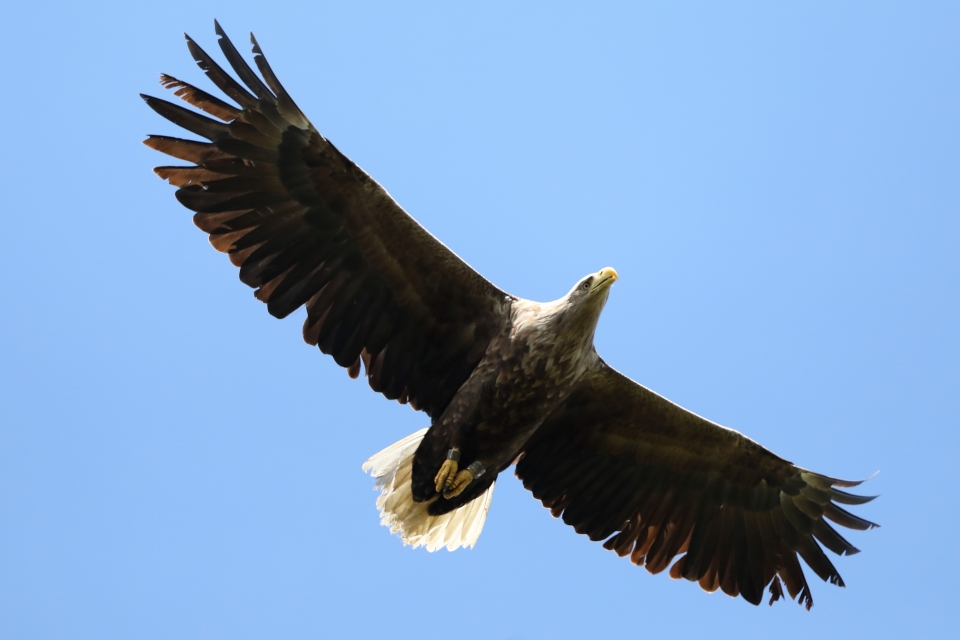
That would be a bit of an exaggeration. I basically study one species of eagle – the white-tailed eagle, which I have been doing since the late 90s. For about 15 years, I coordinated the white-tailed eagle monitoring in Latvia, and for another 10 years, I worked quite actively with the golden eagle, monitoring the population in Latvia together with Uģis Bergmanis. For the last four years, while working on a project about identifying and providing protection for nesting sites, I have also been working with the lesser spotted eagle.
In the 80s, the number of white-tailed eagle and golden eagle pairs in Latvia could be written in single digits... Now it is the 21st century and, for example, fish pond owners have come to know the white-tailed eagle quite well. What is the positive aspect of the increase in the number of golden and white-tailed eagles?
The golden eagle comes to us from Estonia; the population in the neighboring country has grown to 60-70 pairs. We know that new territories in Latvia are being occupied by young birds of Estonian origin. The number of golden eagles in Latvia is increasing, with about 10 pairs nesting, but we expect a population roughly twice that size within the next 10-20 years.
Talking about the white-tailed eagle, the population has recovered from almost zero since the 70s and 80s (it was zero in the 60s). A “surge” in population numbers has been observed in the last 10 years; we estimate there could be about 150 pairs of white-tailed eagles in Latvia. The reason? Ironclad Europe-wide protection measures. Another important fact is that the white-tailed eagle can easily adapt to landscape changes, unlike, for example, the black stork, which is very conservative in its choice of nesting habitat (the black stork needs an old forest). About 1/4 of white-tailed eagle nests are located in ecological trees, which is a relatively new sight in the Latvian landscape. By the way, the white-tailed eagle is a good exception, as birds can occupy ecological trees as early as the year of felling. In Estonia, it has been found that when nesting in ecological trees, nesting success is lower compared to the forest. This can be explained by the impact of greater disturbances—for example, in the forest, if a nest is located in the top of a tree, you can walk past the tree and the eagle does not abandon the nest, whereas in a clear-cut, it is enough for a person to reach its edge for the eagle to leave the nest. If there are eggs or chicks in the nest, and the eagle returns after 5-6 hours, anything can happen.
Large predators and pine martens...
Pine martens appear as food scraps in the nests of large predators, especially young animals. A marten appears rarely in the nests of the white-tailed eagle, and even if we find any remains of an animal used for food, we do not know whether it was hunted by the eagle or if it was hunted by someone else and the eagle collected the leftovers.
At one time, it was believed that the marten was the most significant nest destroyer for the black stork; newer data indicate that the impact of martens on the black stork has been overestimated. However, the marten as a predator does have its impact, for example, on various cavity-nesters, owls.
Can we conclude that at one time (in the Soviet era) eagles were included in the Red Book, but there were effectively no protection measures, if you mention the flourishing of species only in the last decades?
One cannot exactly say that. The protection of nesting sites for individual scattered nesting bird species, which we briefly call and know as micro-reserves, has been used in Latvia for about 40 years. The system has evolved, but its beginnings can be found in the Soviet era among specialists from the Ornithology Laboratory of the Institute of Biology. This should be considered a success for nature conservation in Latvia: the preservation and development of the system. Of course, one can talk a lot about how micro-reserves are managed, applied, and how losses are compensated, but the principle came from the Soviet years, and the first white-tailed eagle nests were protected with the help of micro-reserves.
Talking about the protection plan for the lesser spotted eagle, there was a choice of what to apply.
You have to ask the Nature Conservation Agency about the result because they decided on forwarding the final version of the plan to the Ministry of Environmental Protection and Regional Development (VARAM). An alternative option existed, but it was offered as a temporary option, which I want to emphasize especially. Namely, the species protection plan describes and justifies why micro-reserves are necessary and how they should be created, but taking into account that the current compensation system is what it is (insufficient, inadequate), a temporary solution was offered. Given that a temporary system would require serious work on changing regulations, its implementation was not considered expedient. The decision was made with the belief that the issue of compensation would be settled soon, which we in the nature conservation sector are very hopeful for. In our daily work, we see what problems the lack of an organized compensation system causes. So I will repeat again, the alternative option was a temporary solution.
Clear. “Temporary option” actually sounds not quite right, because even being a huge optimist, it is clear that the issue of compensation will not be solved in the near future. Why is compensation not included (built into) the expenses of the lesser spotted eagle micro-reserve project, which would only be understandable and fair?
The issue of compensation cannot be solved with the help of projects; it requires stable and predictable state funding. The species protection plan for the lesser spotted eagle includes the arrangement of a compensation system, but... the problem applies not only to the lesser spotted eagle; it applies to all micro-reserve species and specially protected habitats in private forests in cases where restrictions require a solution in the form of compensation.

I want to emphasize: it does not matter what we call protected areas. I know that for many in the forestry sector, a micro-reserve is equivalent to a swear word, and the bureaucratic process of how we arrive at a micro-reserve is equally secondary, but the result must be the protection of our most valuable forests. These are forests that contain natural values that are incompatible with forestry activity. If we talk about bureaucracy, undoubtedly, priority should be given to a system that is friendlier to the forest owner. In the lesser spotted eagle project, we have also sought compromises, reducing the area affected by restrictions and the buffer zone as much as possible. We understand well what the existing compensation system and its flaws mean for an owner: they do not foster a healthy atmosphere. I hope that VARAM takes this issue seriously enough and will offer an acceptable solution in the foreseeable future, because at present, the dissatisfaction from the owners' side is growing, which is to no one's benefit.
We talked about small HES and mistakes. How fair is it, seeing one mistake, to start another – establishing micro-reserves without arranging compensation? Is it smart and far-sighted to have a deliberately formed view that everyone (meaning – absolutely everyone!) who knows about the existence of natural values in forest properties will rush to develop them. That is not and will not be the case! Perhaps a fairer situation would be: there is money, there are restrictions, there is no money, there are no restrictions.
It is a similar story as with habitat mapping. It was determined: finish it, evaluate the results, and in a “beautiful future,” give a conclusion on what from all of this should be protected. While the evaluation is ongoing and we arrive at recommendations, habitats are disappearing every day. It is similar with the nesting sites of protected birds: while we would wait for the arrangement of compensation and establish micro-reserves only when we have honestly settled with the forest owner, many findings would be lost; there is no illusion about that. Undoubtedly, the situation where nature conservation seriously conflicts with the economic interests of the forest owner causes great discomfort. That is why I will say that we have always been as accommodating as possible to the forest owner. At the same time, we cannot accept that nest trees are being cut down. Within the framework of the project, we have estimated that about 10% of nests disappear or are affected by forestry activities each year due to various actions. This means that nature conservation norms are not functioning or are “full of holes.” The question would be: why is this happening.
One could talk for a long time about the lost eagle nests: where, when, how one can go and look at the nests that the owners have allowed to disappear. We are told about data protection or “we cannot disclose,” but phrases are heard publicly: “Forest owners (unnamed) destroy nests.” How can one be sure of that? One cannot!
Speaking of habitat mapping, a double-edged sword is visible: there is a process that keeps the owner in tension – will it be or will it not be, will I be able to or will I not be able to. There is no certainty, as you yourself mentioned. Talking about the conflict between the owner and the nature conservation sector: maybe a good advisor is needed, who, at the same time as developing conservation projects, evaluates where to get the money for compensation?
I object: the problem is caused by the existing forest management practice, because if it were organized and carried out in such a way as not to create risks for natural values, we would not create micro-reserves. It is just that simple! I have met forest owners about whom I am sure: if everyone worked like them, there would be no micro-reserves in Latvia.
If the existing forest management practice creates prerequisites for natural values to be threatened, solutions are sought; currently, the only mechanism is micro-reserves. It is not an ideal mechanism, not at all. There is much to be improved, for example, better communication with the forest owner, meeting, explaining, jointly surveying the relevant forest, etc. At the same time, it is the only system that exists. Where to get funds for compensation is a question to be solved by politicians.
That cannot be agreed with: if I want to be honest and I have to take something away from someone, I have to figure out what to put in its place instead of loading the solution onto someone else. It is doubtful that politicians will solve it!
Nature conservation is a state political duty. The fact that a part of these state functions in Latvia has been assumed by non-governmental organizations does not mean that NGOs should also solve the compensation problem, because even the initiation of micro-reserves, which is done by a number of NGOs, is in essence a state duty. It should be a state institution, either the State Forest Service or the Nature Conservation Agency, that evaluates natural values before issuing a felling permit and ensures their protection if necessary. Currently, NGOs are doing the state's work, which should not be the case.
True, that is true! In your opinion, are felling permits given without controlling anything?
We know how it happens. Of course, databases are checked; normally, no one will give a felling permit in a micro-reserve, although there are situations when micro-reserves are also cut down. In this regard, we are waiting for answers from the Ministry of Agriculture on how this could have happened.

The problem is the situation that in Latvia there does not exist an honest mechanism that would evaluate natural values in a forest stand before issuing a felling permit, similar to how economic values are evaluated. In order to develop or cut an area, forest inventory (which can be considered an assessment of the forest's economic resource) is needed; with this document, one must go to the State Forest Service for a permit. There will be cases where a forester will go and look at the situation in nature, but a certified expert who could evaluate the natural values of the stand will not go to the site. And, it may happen that as a result, a stand containing an excellent European-significant protected habitat is cut down. Or a large nest is located in the section, the tree of which is not cut, but only a few more trees are saved nearby, as often happens, and we achieve that, for example, the black stork's nest will be abandoned. Currently, the requirements of European directives have been taken over formally and integrated just as formally into regulations. There is a law that stipulates a prohibition on destroying findings of protected species, but this law has not been incorporated into further regulations, and it is unknown how the processes happen on the spot, in the forest. Here we return to the 10% of lost lesser spotted eagle nests. There are cases where the forest is clear, but the tree of the easily visible nest has not been left for preservation; there are cases where the nest is so well hidden that even a good specialist would not notice it.
A system that would be purposefully built to find (filter) natural values does not exist in Latvia. There is incidental data that has ended up in the database Ozols as a result of various studies, but a systematic approach is missing.
Who should do this?
A good question. First, there should be an honest discussion, because the owner pays for the inventory. What do we understand by inventory? If only economic value is evaluated in it, that is normal. If we also included natural values and their assessment in the inventory: what would the owner say if he also had to pay for the work of several certified experts in the forest stand. This is for the responsible authorities to solve. More thorough forest assessment before forestry should be made the norm; this has been talked about for years. No receptive ears have been found in either VARAM or the Ministry of Agriculture.
Is there such a system in European countries experienced in forestry, and does it work?
I don't know any good example. It should be added: one should not assume that everything is in order with nature conservation in European countries with old and good forestry practices. That is definitely not the case. Usually, Scandinavian countries are cited as an example in the context of the liberalization of forest management regulations, but... even there, there are serious problems with nature conservation. I think one should look at one's own experience and evaluate the situation from one's own positions.
Is there any country in the world that does not have major problems with nature conservation?
Another good question! There are countries that are solving this problem (talking about forests), reaching good results in the respective situation. Central American countries are solving the disappearance of rainforests with the afforestation of territories, creating the interest and initiatives of the local community, which work. Talking about our own, the boreal region, I do not know any country that could be called a good example for nature conservation in the forest.
In the sense of sustainability, have you thought about balance – environment, social sphere, economy? What does it require from a person?
Yes, of course, I have thought about it. The most essential thing is to speak honestly. In Latvia, too, we say that forestry is based on three stable legs, while at the same time we understand that the nature conservation leg has been sawn and is not working as well as it should. What is happening right now with the protection of natural values? What is happening with European-significant protected habitats? Are the latter being cut down or not? What is happening with the lesser spotted eagle? It is the only bird species for which Latvia is internationally responsible, and the only bird species for which a significant part of the world population nests here. We have available an excellent sample group that we have obtained within the framework of the lesser spotted eagle project, we have found >500 nests, the total (including other species) number of found nests is higher (it is measured in the thousands). The sample group shows the weak points of the nature conservation system: how easily one can get a felling permit and cut a stand where a bird nests. What happens at the moment when the creation of a micro-reserve is initiated, what is the reaction of the responsible institutions? I would only be pleased if the information we have obtained would patch the existing gaps in nature conservation.
Birdlife on the website, looking and reading about the lesser spotted eagle and eagles in general, the mark is “least concern”. The point is not that one shouldn't protect, the point is about the protection exaggerations defined in Latvia, as many perceive it.
One can look at it differently. One – how we protect each specific finding. Here I remind you once again: in the last four years, micro-reserves for the lesser spotted eagle have been created according to the principle of a minimal approach, namely, their average area is 7 ha (30 ha is allowed). The species protection plan includes a recommendation to reduce the area amplitude, with the maximum area not exceeding 16 ha, so we are trying to protect more gently. Regarding the population – one must take into account that there are countries in Europe where the lesser spotted eagle is in a bad state, for example, Germany, there are countries where the population is decreasing, in Latvia, a long-term problem was low nesting success, which is also a risk to the population. We cannot afford to “pretend to protect,” we have to do it in substance.
Latvia is relatively a forerunner in the protection of lesser spotted eagles. ... Forest management practice should be changed, but... Where does good forest management practice work, from which to learn?
As I already mentioned, I do not know good examples in the boreal region. What to change? When planning forestry activity, natural values must also be evaluated – very simple. The point of micro-reserves is not to create problems for the forest owner, but to preserve values that require an old forest. There are habitats that form and are located in places where economic activity has not happened for years. The worst thing you can do is to go there with a saw. Such areas should be left untouched, honestly paying the owner for it. Whether you call it a micro-reserve or something else, it doesn't matter. This should be a normal process. What must be changed in the system to patch the holes – that must be asked of the bureaucrats.
At the moment when the bird (or the protected subject) has disappeared from the micro-reserve, should the restriction remain forever?
A topic for a wider conversation. The micro-reserve system requires constant work. At present, it flows in one direction: we create them, in rare cases we cancel them, monitoring takes place in them either within the framework of some project or for individual species. For example, we check the micro-reserves created in the lesser spotted eagle project every year. There are situations when we conclude: the bird has moved, and the situation would be correctable. The micro-reserves for the lesser spotted eagle “work,” we often conclude that the eagle builds a new nest in the same micro-reserve, sometimes, the relocation happens in the buffer zone, rarely – outside the reserve. One should work similarly with the entire micro-reserve system regardless of species. I can say right away, there will not be the capacity needed for this work in Latvia. There is a shortage of people. Maybe one does not need to monitor every year, but once every four or five years, finding out what is happening with the target species and what is happening with other species. We have good experience with “old micro-reserves,” where we enter after 20 years – the lesser spotted eagle is still there, we also find the black stork, the forest has become older and more valuable. Old-growth forest islands often become a refuge for species with special requirements. The importance of protected areas should not be underestimated, but they must definitely be monitored, boundaries can be modified, they can be expanded or reduced. For example, talking about the white-tailed eagle: if I had to re-plan the micro-reserves, I would modify a part of the originally created reserves, and “take out” part of the areas (mainly young stands).
Do you think of micro-reserve monitoring similarly as of the forest monitoring realized by Silava?
One must look at the capacity of researchers: we check a certain number of micro-reserves each year. It is important to be in the micro-reserve territory (to survey it) in the right season and to evaluate the situation in substance.
Photographs by Jānis Ķuze and zemeunvalsts.lv used
Comments