



Latvia must be able to defend its interests at all levels, particularly within EU structures, while not yielding to populist promises of a better life without any guarantees, says Māris Liopa, Chairman of the LTRK Land Use Committee and Chairman of the Forest Certification Council of Latvia, in an interview with Māris Ķirsons
What is the current situation in the country?
Cloudy. It is made so by the simultaneous interaction of several factors. The energy crisis has forced everyone to implement diversification at a very rapid pace – either by changing supply chains for natural gas and oil (including fuel) or by implementing energy independence measures, in which renewable resources play a significant role. Of course, solar panel parks can be built and commissioned relatively quickly; it is more complicated with wind farms.
Current circumstances are forcing a significant shortening of permit processing times so that these stations can be built as quickly as possible and start producing the much-needed electricity, the maximum price ceiling of which – 4 euros/kWh – shocked local producers and residents who purchased electricity at NordPool exchange prices. It should be noted that after reaching this peculiar record, the NordPool exchange has already raised the maximum price ceiling to €5,000/MWh from the previous €4,000. Many energy-intensive producers were forced to idle at an electricity price of €4/kWh, because such a price destroys competitiveness and consequently raises questions about the sustainability of companies, which also means questions about jobs not only in these companies but also in those that provide services and supply raw materials to these firms. One might cleverly argue that everyone is in a similar situation, but that is not the truth, because there were no such electricity prices in Finland, Poland, or even Germany.
I can only recall the paradoxical situation where the implementation of at least a couple of wind farm projects in Latvia has been significantly delayed – by several years – due to intentional or unintentional actions. Unfortunately, the situation with traditional renewable resources and their use, or more accurately, their wider use, is just as strange. Wood, fuel peat, and even waste are resources that Latvia can use to increase energy independence, specifically in heating. To use these resources, we need the desire from decision-makers to actually implement these plans, but in reality, there is yet another procedure, as a result of which only a few companies that are fighting for it themselves will be able to implement the transition from gas to wood chips this winter.
For example, energy peat is an essential, traditionally used local energy resource that can contribute to Latvia's energy security and independence, as well as to the abandonment of Russian gas. Furthermore, this is true if the extraction of fuel peat does not reduce the volumes of peat used in agriculture and the production of substrates made from it. Finland announced additional fuel peat extraction volumes back in the spring to protect against potential fuel shortages and to minimize fuel price increases. Latvia should also undoubtedly have used the experience of neighboring countries. To make fuel peat usable in Latvia again, changes are needed in the Energy Law, as well as in the Natural Resources Tax Law, thus avoiding the situation where heating companies that use fuel peat would still have to buy CO2 emission quotas, because currently, peat – even though it is a slowly renewable energy resource – is equated to coal. It is paradoxical that in a situation where an energy crisis is brewing in Latvia, the majority of Saeima deputies simply reject this idea. Of course, not all centralized heating companies can technologically use peat as an energy resource, and capital investments are needed to solve these problems. According to scientists' estimates, it is possible to extract up to 700,000 tonnes of energy peat in Latvia each year, thus providing an additional two million MWh of energy. Will these opportunities be utilized? Time will tell. It would be nonsense if Latvia were to extract and export fuel peat, for example to Estonia, but then import electricity from it that had been produced from that very same exported peat. It should also be borne in mind that peat is not burned in its pure form, but as a mixture – 30% fuel peat and 70% wood chips. This would reduce the pressure on wood chip demand and prices, which is more than essential in the current situation.
An important resource for our country is wood, as Latvia is a forest-rich country, and in current circumstances, this resource must be used to strengthen Latvia's energy independence, especially since more than half of the country's territory is covered by forests, the area of which continues to increase. Latvia's climatic conditions and soil provide excellent conditions for forestry. As studies by the “Silava” Forest Research Institute show, the amount of energy that can be obtained from lower-value wood assortments and logging residues is estimated at 1.05–1.15 million TJ. I will add that this does not include the amount of energy that could be obtained from wood located outside the forest, such as growth in ditch edges. Latvia has a huge volume of over-mature, economically low-value tree species stands; for example, adult and over-mature grey alder stands contain about 23 million m3 of wood. The very high prices of firewood are a good incentive for forest owners to harvest tree stands that are in low demand for processing, such as grey alder and over-mature aspen, from which nothing can be obtained but firewood. A shortage of wood, especially firewood, is currently being observed in many European countries, so the pressure on this resource is and will remain quite high with high prices.
But the government did change the tree-felling conditions!
Yes, these external circumstances convinced the government to change the cutting diameter, which the so-called “friends of nature” very categorically opposed, frightening the public that “everything will be cut down.” Felling by diameter is not allowed in any protected territory, including the North Vidzeme Biosphere Reserve, which occupies a large area.
At the same time, I would like to hope that the vocally active “friends of nature” are not inadvertently supporters of the foreign competitors of our successfully operating forest industry, because Latvian entrepreneurs compete with producers from Finland, Estonia, and Sweden. In Latvia, forestry regulation (when and what can be done on your property) at the state level is very strict. By comparison, our direct and closest competitors in Scandinavia do not have such specific state requirements for when and what you can do in your forest. For example, in Finland, there is no tree-felling diameter or age limit; the only condition is that harvested areas must be regenerated. In other words, a forest owner in Finland can harvest when they want. In Sweden, there is also no tree-felling diameter limit, and trees can be harvested from 45, 50, 60, 65, 70, 80, or 90 years of age, depending on growth conditions. The only country that has a tree-felling diameter limit is Estonia.
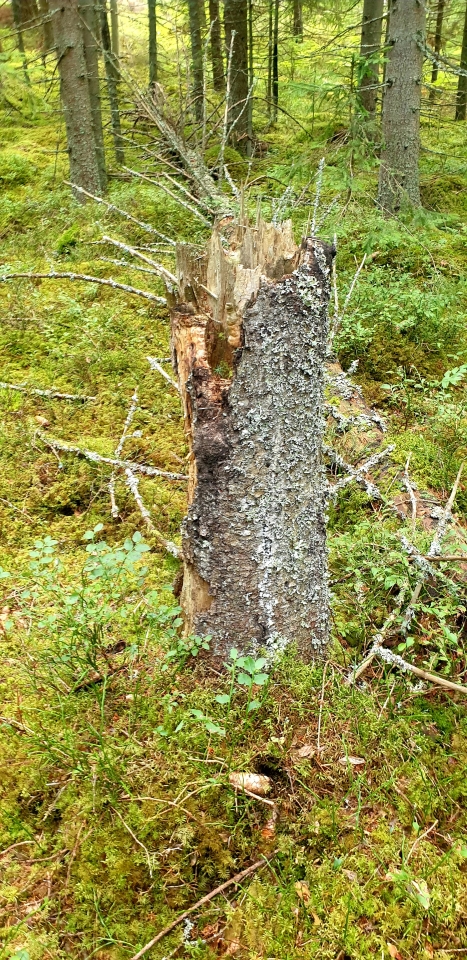
The aforementioned differences explain the significant volume of dead wood in Latvian forests, and when assessing the amount of this (dead wood), we are among the leaders in the European Union. At least 1.3–2 billion euros are rotting in Latvian forests – at current prices, possibly even 2–5 billion euros – even though the wood left to rot in the forests could serve as a resource in both energy and woodworking. At the same time, in the forest-rich neighboring countries that are Latvia's competitors – Finland and Sweden – the amount of dead wood per hectare is three to nearly five times less. Latvia is a very rich country if wood in the amount of 64.3 million m3 is not utilized in its forests and is left to rot. Forest monitoring data show that an impressive amount of wood has been allowed to rot in Latvia over 11 years. A tree from the forest has only two possible paths: one – to become a table, chair, or other wood product that has sequestered carbon; the other – wind-broken or otherwise damaged trees are left in the forest, and over time they decompose and emit carbon into the atmosphere.
Currently, a shortage of wood is being felt in Poland. Even before the sanctions imposed on Russia and Belarus, a shortage of wood products was felt in Europe, which was covered by supplies from Asia and South America, where, by the way, forest areas were decreasing, unlike in Europe. It is a logical question as to which resources and from which countries this wood shortage in Europe will be addressed, especially if the area of protected territories increases. Specifically, there is a requirement for at least 30% of land and 30% of sea territory to be under strict protection and to protect at least a third of EU protected territories under this regime, including all of the EU's primeval and old-growth forests. It is not clear, however, how these tasks are to be accomplished.
In Latvia, protected areas, including the North Vidzeme Biosphere Reserve, are only 18%; now 30% is needed. Where to “get” the missing 12% is unclear. If we have so many natural values of European importance, it would only be logical if the funding (compensation) for their protection came from the EU purse, and not solely and exclusively from the Latvian state's meager budget.
Furthermore, a decision is expected from the government in connection with the results of the obtained mapping of European-importance habitats (which is called the 'nature census' in Latvia). Nature census takers use the handbook of European-importance habitats as a basis for their work, and the characteristics contained therein could correspond to a potential area of forest-related habitats of approximately 345,000 ha. If such areas are indeed removed from economic circulation, this step will have an impact not only on forestry and woodworking but on the entire national economy, on jobs not only in the forest sector but also for the service providers associated with it, and, of course, it will also affect tax payments, jobs in the regions, etc. Without a socio-economic impact assessment (as was promised in 2015), no decisions on the designation of additional habitat areas can be either considered or evaluated. Every now and then, announcements are heard that habitat quality has deteriorated, but there are no answers as to why this has happened – whether as a result of human activity or, after all, the actions of “Mother Nature.” General phrases are often used, but the reality is different.
Are new draft documents being prepared in EU institutions that could also affect land use sectors in Latvia?
The European Green Deal is just, figuratively speaking, a framework, because various requirements and corresponding draft documents are in different stages of development.
For example, the EU Green Deal also affects the Renewable Energy Directive – and it has been proposed to remove wood biomass (which can be used for creating other wood products) from the list of renewable energy biomass. This means that only wood chips (including wood pellets) obtained during the processing process – by sawing, planing – can be used for burning, and not wood that can be used for the production of other wood products. Thus, Latvia will return from being the third-largest producer of wood pellets to the situation of 20 years ago. In large cities, it will no longer be permitted to heat with firewood, as it supposedly harms air quality. Strange, forests cover 52% of Latvia's territory, but heating with firewood will be forbidden. What can be greater energy security than having your own stove and fuel? Latvia must block the further progress and, even more so, the adoption of such a draft document!
Modeling the potential impact of restrictions potentially set by EU regulations, scientists have concluded that a significant decrease in logging volumes is expected in Latvia, by even 3–4 million cubic metres per year (in recent years, these volumes in Latvia have been in the 12–13 million cubic metre range). According to rough estimates, this will affect Latvia's wood product exports – reducing them by about 800 million euros (at current prices, about 1.5 billion euros) per year (about a third of 2020 exports – 2.59 billion euros) – and result in the loss of about 14,000 jobs. Do these essential issues really seem unimportant to anyone? Moreover, there are initiatives not only to reduce wood harvesting volumes but even to stop them. If wood extraction is reduced or, even more so, stopped, it must be asked: what will heat be produced with, and not only in Latvia or Finland and Sweden, but also in Germany and the Netherlands, which are some of the largest consumers of wood pellets produced in Latvia?
The EU Green Deal will also affect farmers. From the consumer's point of view, it might even be more attractive – fewer emissions, healthier food (grown with fewer or entirely without mineral fertilizers and plant protection products). At the same time, there are a great many unanswered questions in this “beautiful future.” For example, there is a desire to reduce fertilizer use by about 20%, alongside a second goal of reducing the use of plant protection products by about 50%. This also means lower yields and more intensive mechanical soil cultivation; there is also the climate neutrality policy, which requires farmers to move towards as little soil cultivation as possible and lower greenhouse gas emissions. Reducing CO2 emissions and the use of plant protection products in agriculture will likely mean significantly higher food prices. It is not known (because it has not been calculated) whether the incomes of Latvia's residents will allow them to purchase them. Will we “relocate” dairy and livestock farming from the EU to another country that is not an EU member state and does not have to comply with EU mandates on climate neutrality and restrictions on the use of plant protection products and mineral fertilizers? In fact, such an arrangement is an incentive to relocate agricultural production from the EU elsewhere. This is a dangerous trend, as it brings with it the issue of employment in the regions, tax payments, and livelihoods (incomes), as well as food supply security.
Therefore, a situation must be achieved in Europe where identical requirements and identical restrictions (if they are necessary) are set for all producers of a given product, thus preventing unfair competition. For example, those working in the EU are forced to submit to higher requirements and stricter prohibitions compared to competitors from third countries, who would become more competitive for the aforementioned reasons.
I hope we do not repeat anything like Sri Lanka, which ended its organic farming experiment this winter. Specifically, the country's president promised in his 2019 election campaign that the country's farmers would transition to organic farming within 10 years. In April of last year, the government fulfilled this promise by introducing a nationwide ban on the import and use of synthetic fertilizers and pesticides, ordering two million of the country's farmers to switch to organic farming.
The result was very swift and harsh. Contrary to claims that organic methods can achieve yields comparable to traditional agriculture, rice production in the country decreased by 20% in just the first six months. Sri Lanka, which had long been self-sufficient in rice production, was forced to import rice for 450 million US dollars even as rice prices in the local market rose by about 50%. The ban also ruined the production of tea, which is Sri Lanka's main export commodity. It is estimated that the decrease in tea production alone caused economic losses in the amount of 425 million US dollars.
Furthermore, New Zealand reports a plan to tax emissions produced by cows and sheep, only it is unclear what the prices of these animal products will be and who will be able to afford to buy them.

What to do?
Tell people what specific measures mean and what their impact and consequences will be. In turn, Latvia's leaders should defend the rights of those living in our country, and especially those working here, while also protecting their own taxpayers and jobs. State leaders, heads of associations, entrepreneurs, and every citizen must follow what is happening and what is being devised in the structures and offices of the European Union, while state leaders should not be afraid to disagree or use veto rights on draft documents that are against Latvia's interests.
In any case, under current circumstances, wood and peat resources are an excellent reserve for Latvia; they must simply be put to use for our own well-being, not solely and exclusively for nature, especially if in many so-called old, economically developed European countries, biodiversity lags significantly behind that which exists in Latvia. Thus, it is not the case that something here needs to be restricted or new protected territories designated, eliminating or significantly restricting economic activity and reducing jobs in the regions, but rather this would be necessary in countries where there is a scarcity of biodiversity.
The European Green Deal essentially requires that forests sequester CO2 and produce oxygen, which means prioritizing young stands. Why? Because young stands sequester CO2 , while old stands, as they rot, generate it. This means that old forests (which are not protected) should be harvested and new ones planted. Many benefits: for forest owners – income; for loggers – work; for wood transporters and woodworkers – raw materials for production, jobs, taxes; and also CO2 sequestration. In reality, we see that a part of society openly protests against the felling of old forests, even though it creates jobs, taxes, exportable products, and increases energy security. It looks even more paradoxical if it is known that, compared to wood growth, significantly less is harvested in Latvia each year. Wood accumulates in our green warehouse, where a large part will simply rot without any economic or social benefit to those living in Latvia.
One must be especially careful with issues that affect the work of farmers, because this is not only a problem of this field but will affect each and every consumer. Specifically, some time ago, events were organized against the consumption of animal products. Many people considered this good, seemingly without thinking and understanding that animal products are also milk, cream, butter, cheese, cottage cheese, and eggs. I doubt that the majority of society has an understanding of what food store shelves look like without animal products. It would be useful to “open the eyes” of people by specifically explaining what this means. When such a campaign is organized next time, it is necessary to reach an agreement with food stores – on the given day, animal products are not for sale. No meat, fish, and their products, no milk, cream, butter, cheese, cottage cheese, and eggs. None! This must be communicated and understood by every consumer and especially by state leaders.
Interview first published in the 31 August 2022 issue of the newspaper “Diena”