




zemeunvalsts.lv introduction. Here in Latvia, too, situations quite often arise in which residents object to the felling of trees in urban areas – felling needed to carry out new projects or, simply, to remove trees that are dangerous and pose a threat to people. In many towns and cities “pseudo-arborists” have appeared who, through insufficient knowledge or in carrying out senseless orders from municipal authorities, mutilate trees and prevent them from growing, irreversibly transforming the urban environment in the process (in Latvia this can be observed particularly in spring, when self-proclaimed “environmental architects” run riot to the sound of saws, both in Riga and (especially) in Latvia’s small towns…
Each situation must most certainly and unquestionably be assessed on its own merits, leaving no room for fanaticism or for unjustified, unreasonable action. In many cases people are not properly informed and do not understand (or do not wish to understand) the need for tree care (crown shaping). We can conclude that society must be talked to and given explanations and that, of course, objective circumstances must be taken into account… It should be added that, in the light of the storms we have been through, the question of professional tree care and assessment has become all the more important.
Abrupt changes to a familiar and habitual environment stir deep emotions in some people
The felling of one tree became one of last year’s biggest news stories in the United Kingdom. The illegal felling of the veteran tree at Sycamore Gap by Hadrian’s Wall provoked not only public outrage but also deep sadness. This happens not only in the United Kingdom but right across Europe: the felling of trees provokes outrage among people who have grown fond of the urban landscape in question.
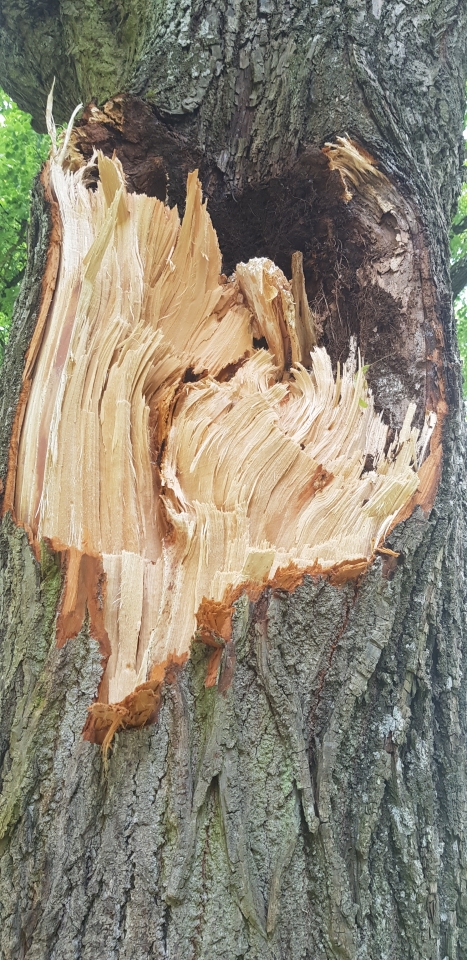
It is not only emotional feelings that inspire residents to stand up for the tree, that essential symbol of nature; when trees in towns and cities are felled thoughtlessly, the scope for reducing carbon dioxide emissions shrinks, biological diversity declines and, of course, the shade cast by the tree in question – so badly needed in hot weather – is lost for good.
Three Europeans tell of how it felt when well-known trees near their homes were cut down.
“They were too big, too strong to fall – until this moment.” Gareth Jenkins, United Kingdom
It was a hard day. I heard the saws going as I set off for work, but I did not dare look in that direction. When I came back, the tree was gone. It was a magnificent tree, at least 20 metres tall, with a broad and beautiful crown. It must have been a good age. The tree stood there, embracing our street and drawing people’s gaze, freshening up a rather bleak suburban landscape.
Other trees on our street have also died recently – from the heat in very hot summers, from drought or from too much moisture, but not this one. It was too big, too strong to wither or to fall.
I went to see what had happened. I met two neighbours in very high spirits. One said the tree had blocked the light, the other explained that the birds had regularly made a mess of the cars. I looked at the car – a six-year-old red Nissan. No doubt the neighbour will soon swap it for a new one…
In a few years these people, too, will be living somewhere else. Perhaps we will all have moved away, but the tree could have stayed where it was, capturing carbon dioxide, carrying off some of the rainwater and giving countless species a chance to rest, if only a little, from the grip of the omnipresent asphalt.
It is a pity I had not found the time to get to know my neighbours sooner. If I had told them about this tree’s value, perhaps they would not have decided to part us from it. I wish I had told them that we suffer from a terrible collective amnesia about what was, and a terrible lack of imagination about what could be.
Now I want that amnesia to come over me too. I want our great and beautiful tree still to be growing there when I come home.
“It was heartbreaking.” Susana de la Higuera, Madrid, Spain
Susana is vice-president of the Asociación Vecinal Pasillo Verde Imperial (Green Corridor neighbourhood association) and a representative of the No a la Tala movement.
In February 2023 a red-and-white fence appeared in the middle of Madrid’s Arganzuela park. That was the start of one of the largest residents’ protests against the felling of trees in the city. This was work to extend the metro, for which an environmental impact assessment (EIA) had been carried out beforehand, providing for 79 and 22 trees respectively to be felled at various sites.
When the fence appeared in the middle of the park, we discovered that the regional government had changed the project without informing the public and without preparing a new EIA. The number of trees due to be felled was increased to 1027 trees, and to roughly 250 trees in Arganzuela park, which is a protected green space.
The first protest was staged by three adults and two children who went to the park with a few sheets of paper and some markers. We wrote “I am defending this tree” and attached the sheets to the “condemned” trees inside the fence. That is how it began. Other people joined us later. The very next day we managed to form a “human chain” inside the park. It made the press, and from that moment a tsunami of citizens’ protest quite literally began. The movement grew, and other organisations and individuals joined us. After months of action we managed to save half of them – about 500 trees.
In a big city like Madrid, where you have to contend with the heat and with “heat islands” (a common phenomenon in southern European urban areas), it is foolish and criminal to destroy existing green spaces and mature trees merely because “it is easier that way and the work can be done faster without disrupting traffic”.
Another reason that prompted me to act was the social impact of losing green spaces and parks. I remember one lady’s reaction on learning that her park was to be destroyed. She was 89 years old and she wept. The park was part of her life. She had always walked there with her children and later with her grandchildren too. It was her daily routine… “Where am I supposed to go now?” It was heartbreaking.
Today I can see that most of the park’s trees have been saved, and I look at the elderly people, families and young people enjoying themselves and enjoying life in the park. It is wonderful that so many people spoke up, fought and came together to make it possible. I hope and believe that what we did has set a movement in motion to make cities greener and more liveable.
“I realised how cruel it was.” Sabrina Guarnieri, Adria (Adria, province of Rovigo), Italy
I remember the day when, on the council’s say-so, the trees in front of the town theatre were cut down, because the planting of laurels was casting shade over the square. I also remember the desperate flight of two blackbirds. They were disorientated and frightened. For a couple of days they circled around, calling out, and then, of course, they had to look for another nest. That sight affected me deeply. I realised how cruel the whole thing had been.
In Italy roughly 30% of roads are covered with asphalt; we badly need trees. Right now, with intense heat upon us, the lack of trees is palpable – there are too few of them in our towns and cities. I have heard people say: “There is no oxygen in my town.” Over the years, more than 100 trees have been felled in Adria, some of them even hundreds of years old. It is shameful and a terrible example to future generations. On the riverbanks, too, the council ought to plant fruit trees, as it used to. We are losing native plants such as figs, elders and brambles. Restoring those plantings must be a priority for the future.
Unfortunately, in many places I see felled trees, which is shameful. On one of the town’s main streets, 60 healthy pines were recently cut down, leaving only stumps. You could even call it murder… What is more, these pines were felled a few days before schools marked “Tree Day”. A very – indeed excessively – bitter irony.