

I would like to begin with a question about the more distant future, namely: during the pre-election period, or within the Jelgava council coalition, has there been any discussion or debate about the relatively recent municipal (administrative-territorial) reform and the prospects for the expected merger of Jelgava city and Jelgava municipality?
I am happy to set out my personal view, not that of Jelgava local government. The most important thing to be done for Jelgava city and the municipality is to work together at administrative level, and also in sport, education and so on. As is well known, the city and the municipality already share a single registry office, but joint work should be organised and developed in every possible field. Looking at the long term, we as a society will not be able to maintain, and will not be able to afford, a great many things. If we look at the demographic indicators (births versus deaths), in the city we are still “more or less holding on”; the negative trend is unfortunately there, but it is comparatively small; in the municipality it is already substantial. It must be remembered that the circle of taxpayers is growing ever smaller and, as time passes and demographic trends remain unchanged, we will not be able to fund everything we fund at present, and we need to be thinking about that today.
A serious question is in order here (without direct criticism of politicians or of society, since part of society supported such a policy): what have we done since joining the European Union? Where have we piled up heaps of so-called European funds money? Into small rural schools, renovations, libraries, sports halls and so on. At the time it looked good. What is happening now? We are assessing all of it, reviewing it and... closing or winding it up. A sizeable amount of money has effectively been thrown to the wind. I dread to calculate how much money that was not invested in serious national development ended up in short-sighted, short-term projects and events. What is the return on that? Either there is none, or it is negative, because the infrastructure that was invested in still has to be maintained somehow.
Of course, I cannot generalise this critical assessment, and there will always be positive examples or exceptional cases that still work successfully. Thinking about what comes next, for example, we as a society can maintain a kindergarten and the first three school years in small rural schools, that is to say, we can afford to pay for work that can be done by a small number of people – nursery assistants, kindergarten teachers and a teacher for the first three years who teaches everything. As soon as more subjects come in, we have to think about schools in the nearest development centres, in towns and so on, where a teacher has a full workload and earns a normal salary working in one place, rather than driving from school to school.
In my view, such a solution to the long-standing school question would be sensible and useful, allowing us to think both about good education and about spending money to good purpose.
Returning to cooperation between the city and the municipality: in Latvia, at many levels and in many spheres, normal, businesslike cooperation is a huge problem. The reasons vary; I have personally come up against “that is not how we are used to doing things”...
What cooperation there will be between Jelgava city and the municipality, or whether there will be any, I do not yet know. Talks have begun; so far they are mutually agreeable and positive. How the plans work out I will tell you at another meeting. I will repeat myself, but in my view cooperation is all but obligatory.
Before the local elections I argued on social media with a few Jelgava activists about the idea that we should replace the current leadership and then think about what to do and what to offer... I also heard a phrase that still sticks in my mind – vote for anyone at all, just not for the previous city leadership. “Anyone at all!” It surprised me that opponents of the city's former leadership called on people to vote for almost any list, rather than concentrating on the two or three that would seem more sensible. The coalition in Jelgava is a real medley; you could compare it to a colourful rag rug.
The question has several parts. If we are talking about the time when the election lists were being drawn up, we were ready (open) to stand on a joint list, but for various reasons that did not happen. There were and are people who look at others with a good deal of suspicion and, as is known, during the previous term we (the movement “Par!”) were, or were counted as being, part of the governing group on Jelgava council. Our idea before the elections was not to campaign against the previous city leadership, but to emphasise what we can do better and how; one of my goals is certainly to halt the fall in the number of residents.
During the pre-election period, on the streets and in the campaign tents, you could sense a mood that the city's government had to change; even so, I doubt anyone expected the previous leadership to take such a drubbing in the election results. And after the elections... What does “rag rug” mean? If it were possible to talk openly with the ZZS deputies of the previous term, you could probably use the same description, because within the party too there was no agreement on many issues.
The present coalition of 9 deputies, made up of deputies from 6 lists, shares a vision of what needs to be done in the city — I am not exaggerating — on almost 95% of matters. I am convinced that in local elections people mostly vote for individuals, not for lists, which is precisely why our coalition's 9 deputies matter so much, and in them I see a team with a shared vision. So far we have had no serious disputes; I dare say some will arise when we draw up the budget and so on.
Are local government deputies sufficiently independent in their decisions? From time to time, in various places in Latvia, you hear that one vote or another might have gone differently, but that a specific instruction came from Riga, from the party leadership.
In our movement there is no such problem. Of course, information is exchanged, but there have been no instructions of any kind regarding votes. As far as I know and have sensed, the other coalition partners are just as free in their choices and decisions. I do believe that the situation described in the question does “work” in national politics and that decisions taken in that way sometimes affect local governments too.
A brief digression – in my opinion, injecting the party system into the work of local government is wrong at its very root. A party is an ideological construct; a local government is a team of managers. We deal with practical matters that have nothing to do with ideology. I fully agree with the view that our coalition parties would never cooperate at national level, precisely because of ideological contradictions. In Jelgava we have no problems.
Yes, as I have already said, I believe that in our city people voted for individuals, not for parties. If someone in Riga disagrees, let them come and prove otherwise. Deputies elected to a local government have a very specific responsibility before their voters, not before the party leadership.
After the 2021 local elections, Uldis Dūmiņš (also from the “Par!” movement's list) had to explain on social media why he joined the previous coalition.
Both Uldis and I had to explain ourselves; people did not understand our choice. I have explained it a great many times: after the 2021 elections we concluded that the old city leadership would continue in office. What to do? Sit in opposition and talk about how bad everything is, or try to achieve at least some improvements. I very much disliked, for example, the fact that Jelgava teachers had no health insurance. I found out that the city's schools were looking for teachers, and that those who might have been available had no time because... they were working part-time in another local government, which paid for health insurance. That was not normal. We also pressed for, and achieved, live broadcasts of council meetings, a participatory budget and so on. Our plans included, if you can put it that way, waking up Jelgava's civil society, which had been in a deep sleep for many years. For instance, the “Depo” case, which I expect we will come back to, was one of the first activities that shook a larger number of people into acting. Jelgava people have rallied; neighbourhood associations are being formed and so on. The local government has to create ways of involving people; four years ago that was not the case.
In Latvia's municipalities and cities, the duties of local authorities are growing while the available funding is shrinking. How is this to be resolved?
When thinking about generating (earning) money, we must certainly not forget science and its application; we invest very little in development and technology (and that applies to the whole country). In my view, such an attitude threatens us with falling even further behind. For example, questions connected with artificial intelligence have been very topical for some time now. I do not see anything serious or noteworthy being done in this field in Latvia. I would very much like IT companies to come and work in Jelgava, but that is not a question that can be solved in a few months.
Yes, a city needs factories, but factories alone are not enough; there has to be a balanced direction of development – manufacturing alone will not get us to the level we want, we also need high-technology services. I do not see any work being done on this at national level.
Perhaps it is happening privately?
Something is happening, but far, far too little. If we look at Latvia's development curve: after 2004 we received a good deal of European Union money and, viewed over the long term, a large part of it was invested unsustainably, which we have already talked about. Now we need to look at what will be needed in 5, 10 or 20 years' time, rather than hunting for a building to renovate or something similar. There is a palpable lack of long-term vision. Latvia has good, strong scientists who have surely recommended what should be done, and more than once, but politicians, following their own political priorities rather than the country's, have not listened to them.
One of the first ideas voiced more loudly by Jelgava's mayor concerned river banks in the city being suitable for blocks of flats, and the immediate surroundings do have plenty of rivers and banks.
If we look at other European countries and consider how rivers running through cities are used and “inhabited” – they are primarily a residential zone. Along the river there can be shops, cafés and restaurants, and further back offices and residential buildings. Such development often follows what is known as a stepped height principle – the further a building is from the river, the more storeys it has. In my view, riverside areas in a city should be devoted primarily to living, to small services and to small-scale retail. Places to live like that could help attract entrepreneurs. We can of course say: “Listen, IT entrepreneur, come and join us!” But where is such a person to come to? For the moment there is nowhere. That is our task – to create a place where people would want to live and work.
It should be remembered that a riverside development plan certainly does not mean closing off access to the river or building on natural areas. The area to start with is the one between Rīgas Street and the railway on the right bank of the Lielupe; another good site for this purpose would be the old market on Uzvaras Street. The city needs places like these as badly as it needs food!
Speaking of the right bank of the Lielupe on the far side of Pasta Island, the question of the site where the “Depo” store was to be built is still topical. If it is private land and the city wants to carry out specific plans there, should the land be bought back?
Speaking about the activities against “Depo”, I have been involved in this process since the beginning of 2017 – I was the lawyer who fought in court against the store being built on that particular site. At that time, and precisely in connection with this, like-minded people came together and the association “Jelgavas attīstībai” was founded. It was a period when I was working in Riga, travelling there and back every working day, and I read the news about the building permit being issued while on the train. Really? That situation filled me with enormous enthusiasm; I concluded that even if I were the only one, I was ready to object and to go to court, and I searched the internet for like-minded people, who had already set up a group against the construction of “Depo”.
If we are talking about that particular plot of land and about investors, this site has enormous potential. In a very high-value location in the city, there is no need to build “boxes” or hypermarkets; this environment needs to be inhabited.
The Lielupe bank promenade next to it is very nicely laid out...
The promenade is fine, but it is not enough! On its left-hand side, looking towards the Railway Bridge, there should be the restaurants, cafés and other things I mentioned earlier. At the moment it is just a place to go for a walk.
The precondition for the further development of an area is not that something must necessarily be bought back, but that we as a local government set the conditions for what we want to see there, so that the person who owns the land can develop it accordingly. If they cannot do it themselves, they can sell it. If there is no solution at all, the local government can step in. Of course, there have to be clear rules.
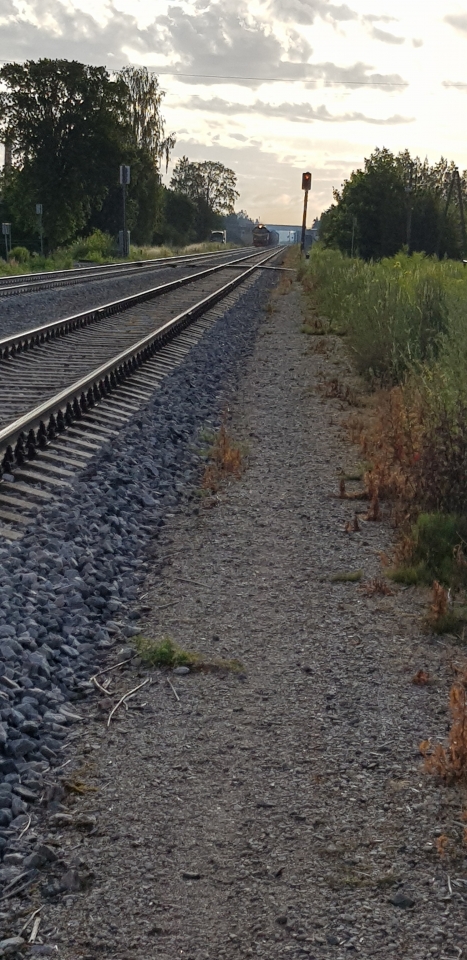
If you travel from Riga by train, between Cukurfabrika station and the railway bridge there are large empty hangars, a fence, rails and long, long grass...
That is an area belonging to several owners. Looking from the Rīgas Street side, we have already talked about the land on Cukura Street where “Depo” was planned. Beyond that are the owners of the office building near the bank, which is clearly visible. Further on there is a fairly large plot whose owner is thinking about residential development (we have already met him). The last one is the plot on which the unfinished hangar stands; I read on ss.lv that it has been put up for sale. We know nothing about buyers and sellers, but we can see that there is a certain amount of interest. Clearly there will be no heavy industry there if a residential district is planned alongside, but reasonable industry, if you can put it that way, could be. A drone factory, for example. On the other side of the tracks a pea protein plant is going up, and work on it is advancing rapidly.
Is there also a plan to develop the area of the old locomotive depot in connection with the construction of the protein plant?
For now we have to deal with the priority areas – besides those already mentioned, the old market, and the bus station definitely needs to be moved...
Will it be moved? I doubt I am the only one who has heard that the bus station would “go away” at the same time as the old market. For the time being it is not going anywhere.
That is what was supposed to happen, but... We will certainly work on it, because then we will finally be able to sort out the current, truly dreadful bus station, which I would call the city's badge of shame. In my view, that would be a superb site for a new city centre.
The bus station area belongs to various owners.
Part belongs to the local government, part to private owners. In my view, situations and questions like these should be approached simply – if the local government states clearly, “we want this area to develop, we will not obstruct you, you will be at the front of the queue at the building authority, and we will help as much as we can,” then investors will come when they hear that. I can feel the interest from investors; we have to create the conditions. That is all.
Moving the bus station to the railway station and the new market looks neither resource-intensive nor especially complicated. What is holding it up?
The problem is that the land earmarked for the bus station by the railway station is currently leased to the owner of the market building for many years to come. Paradoxically, the market building does not belong to SIA “Jelgavas tirgus”. I will not go into the details, but I will add that the contracts concluded in connection with the market back in 2015 and 2016 are very unfavourable to the city. But you have to work with what you have. For the time being (this interview is taking place on 3 September) the owners of that land are not responding to our invitations to talk; if that continues and there are no talks, the question would have to be resolved through legal means, though of course we will see. One of our priorities is moving the bus station next to the railway station and the newly built market and, as you mentioned in your question, it is not resource-intensive. At present there are other obstacles which, I hope, will be removed. How? Time will tell!
Since we are talking about rivers, in Jelgava or close to it there are the Svēte, the Platone and the Tērvete, alongside which districts of private houses have grown up out of former summer cottages.
Something can be done on the banks of these rivers too. If necessary they can be cleared so that people can go boating or swimming; the Svēte floodplain boardwalks are a good example, but I would say that this is a matter for the neighbourhoods concerned.
One of my plans is to meet twice a week in September and October with representatives of the city's neighbourhoods, in order to hear their thoughts about what is going on in the city; we will also set up a residents' council, with one nominated representative from each neighbourhood. The council would be the body we consult regularly and with which we decide which street to repair first, which is more important, which river bank to tidy up, where something needs improving and so on. It often happens that something artificial is created and its creators then want people to adapt to it. I think it should be the other way round – if there is a place that attracts people, we should help to put it in order. That will certainly work better.
I have also heard a critical view of residents' councils, to the effect that those who did not get into power through the election will now get onto the residents' council and then the council will have a rough ride...
That does not frighten me; the residents' council is consultative. There is no doubt that we need one, because we need a permanent way of consulting residents. I plan to continue both meeting residents and communicating with them in live broadcasts, but that is not enough. We need a structure staffed by legitimately nominated representatives that would provide a good channel of communication for resolving specific issues quickly.
Not so long ago there was talk of enlarging the car park by the Culture House, but... at the expense of the lovely square (which could do with a bit of tidying), at the centre of which the monument to Nora Bumbiere looks splendid, especially on autumn evenings. At the time many people signed “against”!
I signed against the car park too, because I was and remain convinced that the problem of parking around the Culture House can be solved differently. Of course there have to be parking spaces, and there is a plan to extend those by the Culture House along the stretch from the K. Barona Street side to Uzvaras Street.
If we look at the city as a whole, in my view the only solution for parking is multi-storey car parks; with them we could solve two problems – where to put cars and how to “get them away” from the courtyards of blocks of flats, which are currently in a very poor state – full of potholes, churned up, with cars parked on the lawns and so on. We cannot “go underground”; we established that last year already.
Multi-storey car parks would also help to free courtyards and the sides of streets from cars, so that we could finally get to work on sorting out the courtyards, with the city helping by way of co-financing. Courtyards should have somewhere to walk, to sit down, even to spread out a blanket and sit on the grass, rather than parking spaces.
On the subject of cars, I would add that our society should gradually give up the desire to drive right up to the door everywhere. In the city centre the main means of getting about should be on foot, by bicycle and by electric vehicles, and the necessary infrastructure has to be built for them.
A lot has been said about courtyards: residents are waiting for them to be put in order, but the council supposedly cannot support this (financially, I assume).
The council can provide co-financing. For years the city has been budgeting co-financing of 100,000 euros a year for these purposes, which is understandably far too little. It should be added, though, that for a considerable time even this small sum was not fully spent, partly, I suspect, because of a lack of initiative on the part of NĪP and the building managers, and partly because the council did not offer enough support in helping to prepare, submit and carry out projects.
In this respect we have to take a critical view of the situation in the courtyards, of the renovation of blocks of flats and of insulation work, where we have fallen very, very far behind places such as Liepāja and Valmiera, where almost 4/5 of buildings have already been renovated. Jelgava's housing stock is not in good condition; that has to be admitted. Where do I see the council's involvement? In preparing projects and in increasing co-financing, because – particularly in recent years – funding has begun to run short. What I would like is that, over the long term, courtyards do not just get “a bit of tarmac” and a tidied-up area around the bins, but that thought is given to pleasant amenities – benches, ornamental shrubs, other infrastructure and so on.
If a courtyard needs to be put in order and it is the residents' decision, an agreement is needed, which is not always straightforward.
That is a matter of the regulation set by the state, which has already become simpler. If one residents' meeting is convened and there is no quorum, the next one can go ahead and take decisions without a quorum. Of course, an initiator is needed to get it all started, which is why there are contact persons or building representatives.
I often hear people say, “my property ends at my flat door” and “I absolutely must be able to drive as close as possible to everything”. Hold on – a resident of a building also owns notional shares of the whole building and of the land, which have to be looked after. Again we come back to a change of thinking.
The Netherlands has more cars per head of population than Latvia. Where are they, if what we more often see on the streets is bicycles? The cars are in car parks. On an ordinary day, in the city centre, you do not need one; the city has been designed and developed in such a way that private cars are not used day to day. Public transport (which I have not mentioned so far) and walking should be the main ways of getting about. At present Jelgava is a markedly car-centric city. The result is that the average wage in the city is not high, the number of residents is falling and, if we do nothing to change that, we will carry on sinking.
What we want is to bring life back to the city. At present the city centre is often empty by around 7 p.m.; one way of changing that is to review public transport services, so that a person can go to a concert or a theatre performance and get home by bus. There have to be more services, running later and more frequently.
I read in the local news about a meeting between the city's leadership and the leadership of Latvia University of Life Sciences and Technologies (LBTU). Although I am a graduate of our university myself, I have to say that the city and the university each live their own life.
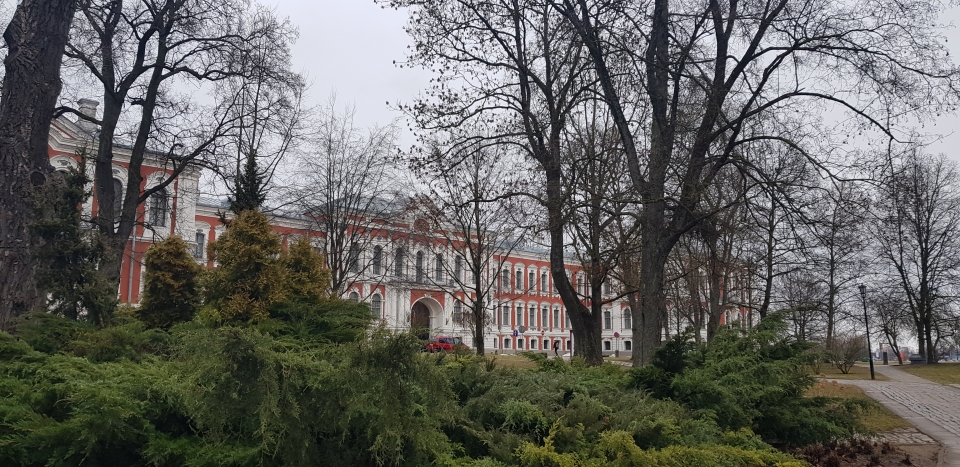
I feel that cooperation so far has been feeble. We have begun talks on various ways of developing and strengthening it; for example, the city's schools could use the university's laboratories in their teaching. Not much time has passed yet, but the plans are big... The current vice-rector, Prof. Linards Sisenis, former dean of the Faculty of Forest and Environmental Sciences, is one of the most active negotiators on the LBTU side and, if the interest is mutual, I see no obstacles to finding a common language.
Not about the city's public transport, but about intercity transport. As a fairly frequent train traveller, I feel we are slightly short-changed – there are fewer services to Riga, the trains still run on a single track...
That is a national-level question, where a local government can wish and demand, but... We would need more frequent train services – not once an hour, but every 30 minutes, and in the morning hours even more often – in short, a meaningful connection with Riga. Jelgava's task is to create the infrastructure so that it is convenient to reach the station on foot, by bicycle and by car. We need more “park your car and take public transport (the train)” = Park&Ride solutions, so that the primary situation is this – if you have to travel to Riga, let your first choice be the train, not the car. It is cheaper, friendlier to nature and so on. My experience of working in Riga shows that the journey from home to work takes the same amount of time as it would by car, but on a train, as everyone knows, you can sleep, or work on a computer, or read a book, none of which you can do behind the wheel of a car.
Around Jelgava, Cukurfabrika, Ozolnieki and Cena stations there are quite a lot of cars parked, which shows that the train is a good choice.
At Cukurfabrika the car and bicycle parking needs to be extended; at Jelgava station, in my view, the market and the car park should have been swapped round. The current idea is that a person coming off the train walks through the market to the car park. I understand the developers, but... if the market and what it offers are not of good quality, people will give it a wide berth anyway. Everything will be decided by the content.
When will the newly built market start trading?
I do not know! We have already been misled quite enough times. The latest word was 1 September; I make no secret of the fact that I do not believe it. The building was recently accepted for use and, judged by business logic, if money has been invested and a market has been built, it would be time to open it and start earning. If that does not happen, it would be very suspicious.
What would need to be done to make people want to live in Jelgava?
A better urban environment has to be created. While everything is fine with the districts of private houses on the outskirts, it must be remembered that, conceptually, the city's basic environment is blocks of flats, where people live at a fairly high density and all services are available nearby. Focusing on this idea, we have to ensure a whole range of important things: that there is a school and a kindergarten nearby, that the street up to every building is in good order, that there is good infrastructure not only for cars but also for pedestrians and cyclists. We have to deal with the question of multi-storey car parks and, in the end, get to work on the courtyards, which we have already talked about. We have to create an environment that city dwellers find pleasant.