
Until the moment you took up the duties of dean, your career seems to have had little contact with the forestry sector.
Up to that point my work was more closely connected with real estate, its valuation, land use, surveying and, of course, with technologies, which we are learning and getting to know more of with every passing day. I have supervised and continue to supervise a number of scientific studies, including doctoral theses.
Ever since my student years I have taken part in the earliest stages of the land reform process, in connection with putting the legal side of these matters in order. It was a time when many people wanted to recover family properties or to privatise land. As for land use, I have been involved in several studies analysing both land use and types of use. If we link all of the above with surveying work, it is worth remembering that determining the type of land use is a surveyor's bread and butter; in the cadastral surveying process the surveyor is legally the only person who can determine it.
For several years now the cadastral value has sounded like something of a bogeyman to landowners, because from time to time there are promises to review these values, which could result in high land taxes.
There are regulations setting out how these processes are organised. Cadastral valuation is an automated process based on the property data registered in the State Real Estate Cadastre Information System. Of course, a review of the cadastral value can also be initiated by the owner, since instrumental cadastral surveying may not have been carried out since the land reform, that is to say for around 30 years. In order to allocate land to everyone at the same time, the so-called allocation method was used back then, and if no further activity has taken place on the property since, the documents are exactly as they were drawn up and produced at that time. Of course, the owner and only the owner is responsible for ensuring that the data on the property correspond to the actual situation, because the real estate tax derives from the cadastral value of that particular property.
I recently interviewed Sniedze Sproģe, adviser to the Latvian Association of Local and Regional Governments. Back when she was head of a rural municipality, she used to say that in Latvia there are still plots of land in inaccessible places that have counted as ownerless property for years.
I have taken part in several discussions on these matters. I would like to stress that the Institute of Land Management and Geodesy organises regular scientific and practical conferences (the most recent was relatively recently – on 14 March), which are also attended by sector representatives. We discussed these questions in 2024, and in that connection an important point should be added: there is a set regulatory procedure and a limit on financial resources for sorting out this situation and registering ownerless properties.
Have you had occasion in your work or research to assess the mistakes of the 1990s (the land reform)?
Things were chaotic in the 1990s; we did not know how to manage, private property was something new and unfamiliar to many, there was no experience, very few advisers and so on. We have assessed the relevant problems in student projects too, and we have found mistakes out in the field as well. For example, we now carry out boundary measurements instrumentally, and we have come across cases where a particular boundary "wanders" by as much as 30 m, which is a considerable distance on the ground. In practice this means that up to now one neighbour has been managing the other neighbour's land, or vice versa.
In the early 2000s these questions were brought to the fore and, for the most part, sorted out. For example, large, extensive fields and arable land are managed by farmers who have an interest in receiving subsidies, and consequently the areas they declare are duly and consistently checked. I think more problems may have "survived" on small properties, where there has been no need to update the data. But, as you mentioned in your question, there are still unresolved situations left over from the land reform period.
Selling land and forest. People say all sorts of things about the market – now it is stagnating, now a moment later it is quite lively, then it goes quiet again.
In recent years there has been a marked trend towards drawing up land management projects, as a result of which agricultural land is separated from forest land. At the same time the question of access and how to provide it for the newly created land units becomes topical. I would stress that it is very important here to put the legal side of the situation clearly in order, because a mutual agreement with a neighbour or a prospective owner is not enough: at some point the agreement may "disappear", and if there is no such legal safeguard in place... Every owner needs to understand that "legal safeguard" means the road easement must be registered in the Land Register, because the question of access to a given property can unexpectedly become very pressing.
To put it more briefly: 30 years ago we agreed with a neighbour about using a road, the neighbours changed, and the new neighbour knows nothing about the old agreement or does not take it into account
Precisely; you have described the very simplest situation.
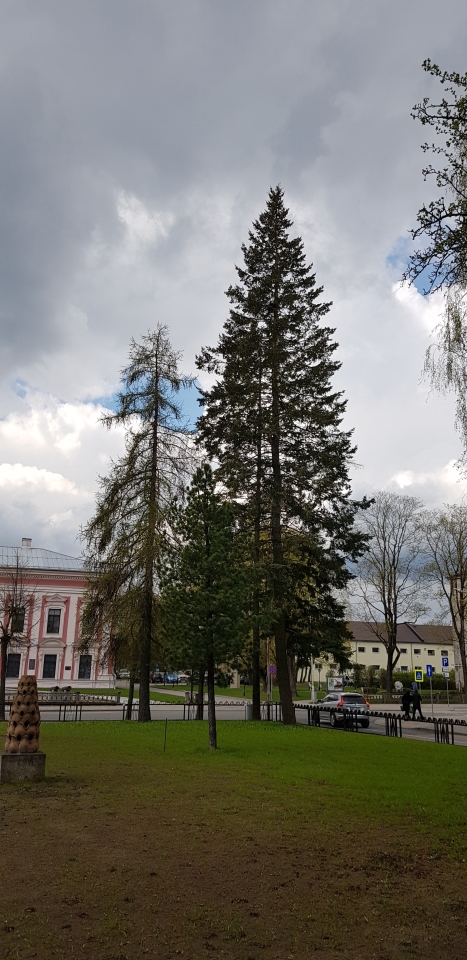
Returning to your work at the faculty, your office is now in the building of the former Faculty of Forestry (now the Faculty of Forest and Environmental Sciences) at 11 Akadēmijas Street. How have you settled into a place where the talk is overwhelmingly about forests and forestry?
I have been at 11 Akadēmijas Street for more than six months now; to make things clearer, let me take a few steps back.
I am a graduate of the Faculty of Land Management and Hydraulic Engineering at the Latvia University of Agriculture (LLU), where I gained an engineering qualification in land management; I subsequently also obtained a master's degree in economics (Mg. oec.) and a doctoral degree in economics (Dr. oec.) at LLU. During my undergraduate studies I also acquired a basic knowledge of forestry as part of the study courses.
At the point when changes began at LBTU (hereinafter also referred to as the university) and the university's management set about merging faculties, the period during which I headed the Department of Land Management and Geodesy (now the Institute of Land Management and Geodesy) came to an end. I had thought I would sit out the coming changes quietly, working with students and setting aside more time for scientific matters, but...
In the summer of 2023 I received an unexpected offer to become director of the Institute of Civil Engineering and Wood Processing. While colleagues from the construction field worked alongside me every day and it was clear what they did and how, the wood processing field was unfamiliar to me. Of course, colleagues from the wood processing sector showed and explained a great deal to me; I had the chance to visit factories and to meet and get to know sector representatives, which opened up a broader view towards wood and forests.
As the changes continued, I received an invitation from LBTU Rector Irina Arhipova to become acting Dean of the Faculty of Forest and Environmental Sciences (hereinafter also referred to as the faculty). The offer was both a surprise and a challenge for me, since this is, after all, the largest faculty at the university. After careful thought, and given that I care about the future development of LBTU and of the faculty, I accepted this challenge and this invitation.
Now that some time has passed, I can see and feel that all sorts of activities are buzzing around me; the faculty has built up and consolidated excellent cooperation with the forestry sector, which is continuing successfully and helping me understand its structure, its activities and particular events that matter to the forestry and wood industries. This is new knowledge for me too. But it should be noted that the talk at the faculty is now also about construction, land drainage, surveying, landscape architecture and geoinformatics.
Have you previously taught students of the Faculty of Forestry as a lecturer?
I have taught the elective study courses "Real Estate Transactions" and "Real Estate Market Valuation", which were also taken by students of what was then the Faculty of Forestry.
You mentioned that you had already got to know colleagues from the wood industry earlier on.
That was just under a year – from September 2023 to June 2024 – when I gained at least some idea of this sector.
I know that, continuing what Professor Linards Sisenis began, you are very supportive of the cooperation with the sector that the faculty has started, in terms of informing and educating students.
That is the shared position of the whole team at the Faculty of Forest and Environmental Sciences – to base studies on practical knowledge. Students, too, find it interesting to understand where the theory taught at university can be applied in practice. If sector representatives come and talk about what is already important or will be very soon, students will pay more attention to those questions in class as well. To develop knowledge there has to be a certain foundation – as we know, you do not build a house starting from the roof.
Speaking of the merging of faculties, there was discussion at one point about the tower block at 19 Akadēmijas Street and its future. What is planned there?
There has been a lot of discussion about that within the faculty. Clearly we are not rich enough to let premises stand empty; we have to make sure they are used rationally and to the full. The vision going forward is this – the faculty will gradually give up (vacate) the building at 19 Akadēmijas Street and move into other premises that have already been adapted for the study process. At one of the faculty's Council meetings I put this plan to colleagues – the construction and wood processing block will be located at 41 Dobeles Street, also making use of the Interdisciplinary Laboratory building, and fully fitting out the teaching block, where refurbishment is due to be completed this spring.
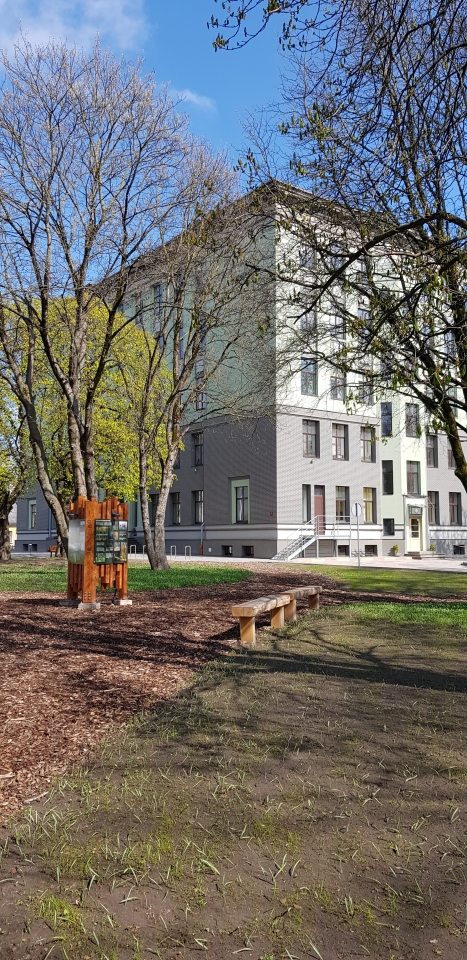
What happens at 19 Akadēmijas Street from now on, and how, is definitely a matter for the LBTU management to decide. As is known, the university has an approved real estate development plan.
In a conversation with Laimdota Straujuma, Chair of the LBTU Council, we touched on the university's many and varied properties and the Council's initiative to sort this question out. It was about a practical optimisation of properties – keeping those that are needed for the core work.
In line with the LBTU Council and management's position on the rational use of premises, the Faculty of Forest and Environmental Sciences will henceforth be located and work in four buildings – 11 Akadēmijas Street, which houses the Dean's Office and the Institute of Forestry, will be the main block; the Institute of Civil Engineering and Wood Processing will operate at 41 Dobeles Street; the landscape architects will continue to work at 11 Rīgas Street, at Valdeka Manor (at the moment we are working there on putting the outdoor area in order); and at 5 J. Čakste Boulevard the Institute of Land Management and Geodesy and the environmental engineering block of the Institute of Landscape Architecture and Environmental Engineering are already setting up their workplaces, the premises for this purpose being ready and in order. These four will be our "sites" from now on.
Have you given thought to what you would definitely want from the faculty's cooperation with the ministry, the sector and the sector's non-governmental organisations? A topical subject at present is bureaucracy; we have talked a lot in our conversation about what needs doing – have you also given thought to what could be left undone?
What could be left undone is a good question, but it would deserve a broader discussion. As I am an LBTU patriot, it is important to me that the activities undertaken are directed towards the development of the university, the study process and science, not always putting the money we will receive to the fore, but thinking about worthy goals.
Cooperation in improving the study process is important for the university. Professional programmes cannot exist without an occupational standard, for which the relevant sector is responsible, so that it is up to date and fits the sector; only then can we improve our study programmes. Discussions are taking place and it is largely clear to us what is expected of us. Our experience and cooperation with the sector so far can be judged positively; the sector is very responsive. That cannot be measured in any way, but it is extremely valuable for the faculty's further development.