




China's carbon dioxide (CO2) emissions rose by 4% in the first quarter of 2023, reaching a record high, and are projected to reach an all-time peak this year. However, the continuous expansion of low-carbon energy use will eventually reduce the country's emissions.
New analysis from Carbon Brief shows that the rapid expansion of low-carbon energy could cause emissions to peak and decline, provided the post-C19 recovery plan is successfully implemented.
With China focusing on economic growth, the impact of the world's largest CO2 emitter is likely to reach a historic high in 2023. In 2020, the country emitted more than 10,000 million tonnes of CO2, accounting for approximately 30% of global carbon emissions.
China's quarterly carbon emissions
China's carbon emissions rose by 4% in the first quarter of this year. This exceeded the previous peak emission level seen in the same quarter of 2021.
Emission estimates were calculated using data from China's National Bureau of Statistics on fossil fuel and cement production, Chinese customs data on imports and exports, and WIND Information data on changes in inventories.

As shown in the chart, the red bar represents China's carbon emissions in the first quarter of each year. The increase was driven by rising demand for fossil fuels, with consumption of oil (up more than 5%), coal (up more than 3%), gas (up more than 4%), and cement production (4%) all increasing.
What is causing the rise in emissions in China?
The main reasons for the rise in carbon emissions in China are as follows:
- economic recovery after C19
- financial stimulus measures
- weak hydropower generation
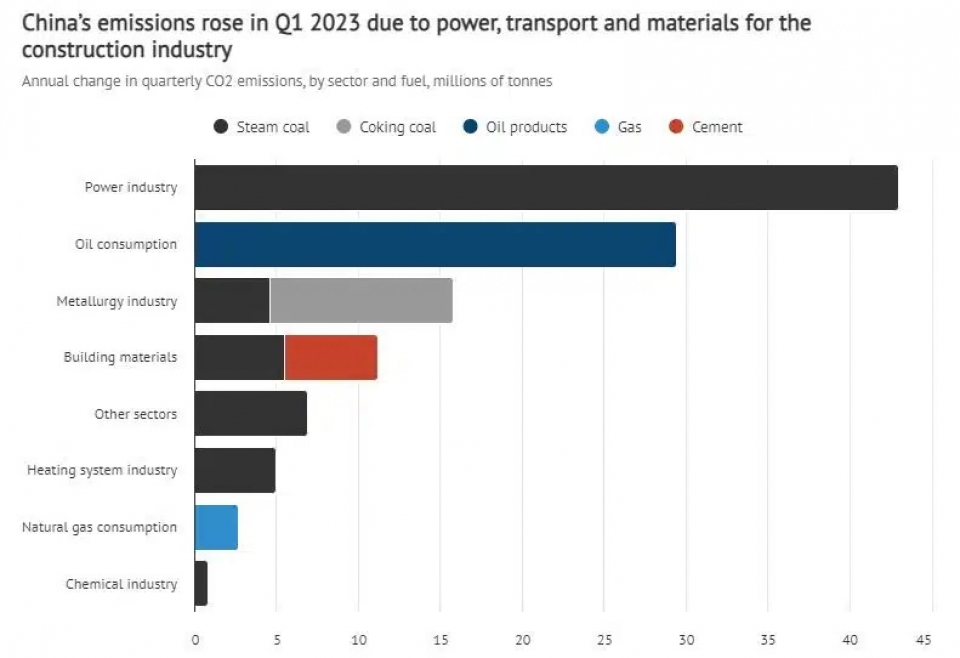
Breaking emissions down by sector, the largest increase occurred in power generation, where the volume of coal-fired electricity rose by 2%. Compared to the previous quarter, coal-fired power generation increased by 3.6%.
Due to low hydropower generation, China increased its reliance on coal-fired power. Low rainfall and drought led to low levels of hydropower production.
The world's second-largest economy by GDP has been increasing domestic coal power production since 2021 to ensure energy security. It grew by 11% in 2022, but despite higher domestic supply, coal imports nearly doubled in Q1 2023. The reason for this is the lower quality of domestically produced coal – each tonne contains less energy.
Regarding electricity, demand grew by more than 4%, accounting for approximately 80% of China's total increase in carbon emissions. This was largely due to the end of the country's zero-C19 policy, meaning that business and commercial activities resumed. For the same reason, transport activity returned to normal, increasing fossil fuel consumption by more than 6%. Air transport consumption increased particularly intensely.
China reaches a significant energy milestone
Despite the increase in CO2 emissions, China managed to reach a significant turning point in energy production from clean or non-fossil sources. These include renewables and nuclear energy, which historically exceeded 50% of the country's installed power capacity. They overtook coal-fired capacity and other polluting energy sources.
In particular, the installation of solar and wind energy increased significantly, reaching a record high.
The growth in solar energy installations was almost three times higher than the previous record of 13 GW in the same quarter of 2022, reaching 34 GW. New wind energy installations of 10.4 GW increased by 32%, setting another record in Q1 2023. The country exceeded its 2022 target of 120 GW of new wind and solar capacity, reaching 125 GW.
A key element in China's strategy to increase wind and solar energy production is the creation of massive clean energy bases in its deserts, abandoned coal mines, and other unused land.
These bases are being built in phases, with the first two, boasting capacities of 97 GW and 200 GW, to be completed by 2025. If 2023 installations reach the national target of 160 GW, 240 GW of capacity will be added annually over the next two years.
China's nuclear capacity is also growing
Based on its current nuclear capacity (57 GW) and ongoing construction (27 GW), the superpower is on track to meet its targets. This means that by 2025, 30 GW will be under construction and 70 GW will be in operation. Two nuclear reactors have already begun construction, and one began producing electricity this year.
Demand for electricity in China is likely to increase this year, which will also contribute to the rise in coal-fired power production. However, the growing supply of low-carbon energy, or energy delivery from clean sources, will attempt to balance the increase in coal demand.
Eventually, when clean energy exceeds the annual growth in electricity demand, the energy sector's carbon emissions will peak.
What will China's emissions be in 2023?
Current Q1 trends and industry estimates suggest that the emissions of the world's largest emitter will increase this year. They will likely reach the previous peak seen in 2021, as shown in the graph.

The main reason for these projections is the financial stimulus measures implemented by the Chinese government to boost manufacturing capacity, energy production, and transport infrastructure.
Although the increase in emissions varies by sector, total energy demand will increase by 3% in 2023. Given the projected growth in low-carbon energy production, China's CO2 emissions will increase by 1-4%, as the difference will be offset by fossil fuels.
A World Bank report states that China will need investments of 17 trillion US dollars to reach its climate goals. These investments are intended solely for the energy and transport sectors.
Early this year, the superpower revived its carbon emission reduction scheme – the China Certified Emission Reduction programme – which aims to reduce carbon emissions. If the post-C19 recovery proceeds as planned, the sustainable expansion of clean energy production will drive emissions to peak, after which they will decline in the following years.