



AS “Latvijas valsts meži” (LVM) was founded on 28 October 1999. Over these years, the company has grown into one of the largest in Latvia, with a turnover exceeding half a billion euros. The core of LVM’s operations is the sustainable management of state forests, ensuring a balance between economic, environmental, and public interests.
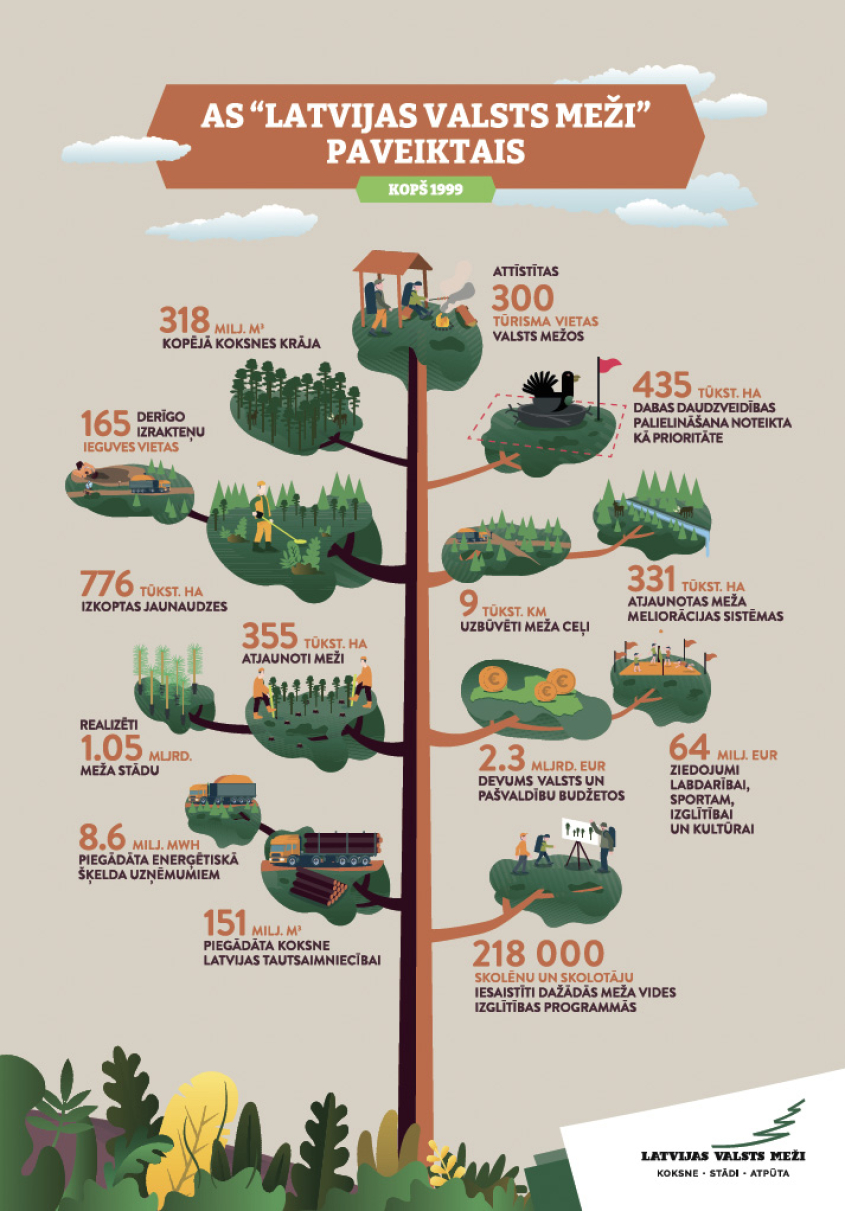
As a result of LVM’s economic activities since its inception, the company has contributed 2.3 billion euros to the state budget in the form of taxes and dividends. At the same time, the timber stock in Latvia's state forests continues to rise, having reached 318 million cubic metres. Each year, forests accumulate an average of an additional 11.3 million cubic metres of timber, providing a significant contribution to carbon sequestration and the mitigation of climate change. In the forests managed by LVM, the stock of timber available for harvesting is ten times greater than the annual felling volume. The timber stock in Latvia’s state forests continues to grow and currently stands at 318 million cubic metres. Timber grown in Latvia and used in the production of wooden structures and goods promotes carbon storage and helps to mitigate climate change. Each year, as the forest grows, the timber stock increases by 11.3 million cubic metres, while the volume of timber available for harvesting in LVM-managed forests is ten times the annual felling amount.
LVM’s operations are based on a long-term approach to forest regeneration and the cultivation of future forests. Since the company’s founding, forests have been regenerated and planted across an area of 355 thousand hectares. To ensure high-quality seedlings for future forests, LVM nurseries offer high-quality, Latvian-grown spruce, pine, birch, oak, and black alder saplings. Over these years, LVM has grown and sold 1.05 billion forest tree seedlings, which is more than 569 saplings for every resident of Latvia!
Alongside forestry, LVM is also developing several other areas of activity. The company produces selected seeds and grows forest seedlings, manages subterranean resources, develops forest infrastructure, provides recreational services, and creates innovative geospatial data solutions.
LVM manages 165 mineral extraction sites, where high-quality subterranean resources—peat, sand, and sand-gravel—are extracted for the needs of the national economy and the company's construction projects. The extracted mineral materials have been used in the construction of both significant public infrastructure objects and private projects. LVM clients highly value the quality of the materials, which meet building product requirements, as the production process for mineral materials and their mixtures complies with internationally recognised standards. Since the company’s founding, 9 thousand kilometres of forest roads have been put into operation, and forest drainage systems have been renovated across a total area of 331 thousand hectares.
Technology also plays a vital role in LVM's development. The LVM GEO geospatial information technology platform, developed by LVM, is used for their own business needs by more than 45 clients across various industries, not only in Latvia but also abroad. The number of active LVM GEO users has grown to 140 thousand, making the application developed by LVM the most popular map app in Latvia. In 2025, revenue from external business system developments and services reached 1.2 million euros.
In today’s world, sustainable forest management is unimaginable without data-driven decision-making. In its daily work, LVM makes extensive use of unmanned aerial vehicles, or drones, which ensure precise data acquisition and more efficient process management. Currently, drones are used in all of LVM’s operational areas, promoting work quality and efficiency.
Over 27 years, there has been a significant increase in the area that the company manages with the primary goal of increasing biodiversity. While in 2001, territories where the main management objective was nature conservation made up 5% of the areas managed by LVM, by 2026 this figure reached 27%. LVM is responsible for 23 different types of forest, marsh, grassland, dune, and aquatic habitats. As LVM environmental experts survey planned economic activity sites each year—such as planned forest road construction sites and mineral extraction sites—new European Union significance habitats and locations of specially protected species are identified within state forest territories. This allows for the improvement of LVM’s voluntary nature conservation area planning and can also serve to enhance state-designated specially protected nature areas. At the same time, LVM carries out monitoring of both large bird species that inhabit nests (golden eagle, lesser spotted eagle, black stork, etc.) and the western capercaillie, as well as several specially protected plant, lichen, and fungi species. In addition to annual habitat and species management work, the company has also been actively working on externally co-funded environmental projects since 2021.
LVM also cares for public access to recreational opportunities in state forests. The company carries out forest management specifically suited for recreation on nearly 5% of the area it manages, and more than 300 free recreation sites have been established throughout Latvia.
The company carries out forest maintenance on nearly 5% of its territory that ensures these recreational opportunities; over 300 free recreation sites have also been established for Latvian residents and visitors.
Meanwhile, nearly 218 thousand pupils and teachers have taken part in annual forest environmental education programmes over the years.
LVM’s operations encompass forest regeneration and maintenance, seedling cultivation, infrastructure development, geospatial data solutions, nature conservation, and recreation, forming a unified management model that creates long-term value for the Latvian state and society.