




Ants, which are about one centimetre long, mainly live in coniferous forests. There are six species of ants in Europe, five of which are also found in Finland. According to Jouni Sorvari (Jouni Sorvari), a researcher at the Finnish Natural Resources Institute (Luke), ants have a positive impact on both forest biodiversity and carbon sequestration in forests, and they are also natural enemies of forest pests. Everyone who has spent some time in the great outdoors has probably noticed ants, ant trails or anthills, but not everyone knows that they can help prevent damage caused by other insects.
“Recent research shows that ants reduce (limit) damage caused by the European spruce bark beetle. We have not yet determined exactly how this happens,” explains Jouni Sorvari, a researcher in the Luke project Kekometsä [Antill Forest].
The European spruce bark beetle is, as is well known, a dark brown beetle about five millimetres long. Together with other pests, it has become a significant threat to forests, nature, and carbon sinks in the forest. According to J. Sorvari, it is known that ants also “disturb” pine pests. It has been observed that trees near anthills suffer less from damage. “There are some older studies on the benefits of ants in combating insect damage in birch trees as well,” points out J. Sorvari.
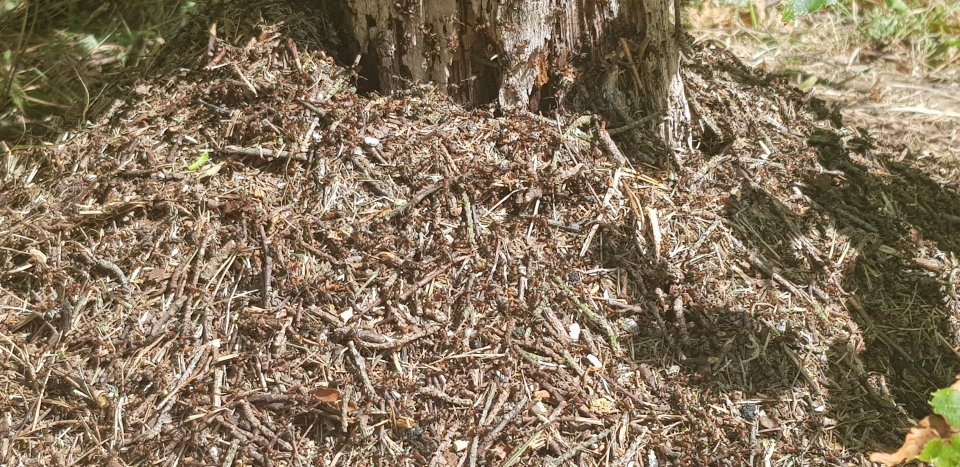
According to data from the Finnish Forest Centre, more than 6,000 hectares of forest were felled in Finland in 2022 due to insect damage. It is expected that with global warming, the volume of insect damage will increase and its harmful effects will start to spread even further north. The number of logging cases that need to be carried out due to insect damage continues to rise. For example, in Germany and the Czech Republic, the bark beetle has destroyed large areas of forest in recent years and caused serious disruption to the timber market. The spread of the insects has been facilitated by both drought and prolonged periods of heat.
Ants are useful for the forest environment
Ants are a component of the natural forest environment; their presence keeps the forest healthier, improves forest biodiversity, resilience against harmful insects, and carbon sequestration.
The Kekometsä project, in which J. Sorvari works, is studying the impact of tree groups of different sizes and compositions on anthills and the survival of other forest species associated with ants. Another task of the research is to identify the types of commercial forests where ants are most likely to be found, so that the existence of anthills can be taken into account when carrying out and planning logging. Some of the research objects also include the density of the tree canopy, the total area occupied by trees, and the range of species that influence the presence of ant colonies (anthills).
There is a hypothesis that tree groups and thickets (densely growing forest) can help ants survive after logging. This has not been studied until now. Currently, research is underway in Finland and Sweden, and the results will be applicable throughout Europe.
Jouni Sorvari believes it is useful to value trees near anthills. “Often, trees near anthills are more resilient compared to those growing further away,” he says. Why? Ants usually carry pine needles and small twigs into their homes; as these decompose, trees and other plants can absorb nutrients more easily.
Anthills are carbon stores
J. Sorvari points out that ants also “serve” as carbon accumulators in the forest. “Relatively speaking, the amount of carbon stored in anthills is less than in trees, but large anthills can store a surprising amount of carbon. One large mound can contain more than 20 cubic metres of organic material.” He explains that usually, the largest part of an ant's home is above ground, but ants can also burrow to a depth of almost half a metre.
“In dry and sandy soils with plenty of light, anthills can be lower, but their underground parts are sometimes just as large as the visible ones,” assesses J. Sorvari.
Biomass stacked in piles decomposes more slowly than pine needles and small twigs that have fallen evenly on the ground. In well-maintained anthills, about 50-80% of the material is drier than the surrounding soil, contains less fungal biomass and fewer decomposition-promoting organisms, which is why anthills act as carbon sequesters.
Ants do not like open areas
According to J. Sorvari, if a mound has been abandoned due to logging or another reason, it decomposes fairly quickly, with the accumulated carbon being released into the atmosphere.
“If trees are felled around an anthill, it is abandoned within a few years. Usually, by the time the forest stand is 'mature' for its first thinning, all anthills except those located on the edges of older stands have been abandoned and have collapsed,” informs J. Sorvari.
Logging, of course, does not cause the mass extinction of anthills, but those left in open areas become uninhabitable because the “food” previously provided by the trees now has to be sought by the ants at a much greater distance. The temperature or humidity inside the mound can also change.
“Inside an anthill, the temperature is almost +30 °C, which is optimal for the ants' breeding process. If the surrounding trees are logged, the internal microclimate of the mound changes, and the previous temperature regulation no longer 'works',” explains J. Sorvari. Earlier studies suggest that a change in microclimate is harmful to anthills.
Jouni Sorvari believes that ants are most likely to survive after logging if trees are left near the anthill, especially spruces, for which birches, pines, and also oaks will be a good “addition”.
Depending on the species, ants can inhabit one or several anthills
“Large anthills quickly become too dry under the influence of sun and wind; in short, they dry out. In the study, we are trying to position tree groups for 'anthill conservation' so that they cast enough shade, especially on the south side of the anthill.
Species that have only one mound are mostly found at the edges of forest stands or in places where there is a lot of light in the forest. Species with multiple mounds build larger ones; they can also live in shadier places deeper in the forest, because large mounds generate enough heat for the ants to be less dependent on direct sunlight,” assesses J. Sorvari. Species that form multiple mounds also readily build new homes at forest edges or alongside forest roads.
Ants do not like open terrain
In Finnish forests dominated by conifers, the average number of ant “homes” is 3-4 per hectare. The largest anthills are found deeper in the forest, where there is plenty of food, for example, insects, dead animals, seeds, and, especially, honeydew secreted by aphids. A lack of food, naturally, can affect ants. J. Sorvari says that worker ants found in clearings are usually smaller in size. “In the course of the study, we concluded another surprising fact – the mortality rate of ants living in clearings is higher in winter than for those living in forests.”
Anthills are home to dozens of other species
J. Sorvari explains that in commercial forests, ants help maintain species diversity. “Dozens of insect and spider species live in anthills, all of which need the ant home to live in at some stage of their lives. Furthermore, many other species live right next to them that are not directly dependent on the ants themselves,” says J. Sorvari.
Admittedly, we do not think about it, but studying or looking at ant homes in the forest provides a serious and complete experience. The forest... it is much more than just trees, berries, and mushrooms. “Without anthills, the range of species in forests would be much smaller,” says J. Sorvari.
Anthills can be several decades old
“In Finland, there are still anthills that were created during the Second World War that have been preserved and remain inhabited. Sometimes they have been abandoned for several years, but the ants have returned to them,” says J. Sorvari; he plans to continue studying the value and aesthetic significance of anthills.