




Most of the news we hear about Hungary these days is negative — for instance, about Prime Minister Viktor Orban's foreign policy and the wrangling over his disregard for Brussels' instructions. Not everything is bad, however: Hungary is developing its forestry sector, and lately in particular it has been running state programmes for forest regeneration and for strengthening the national forest industry, because Hungarians understand the value of forests — they are an investment in the country's future.
If the Hungarian Ministry of Agriculture's programmes meet their target, forests will cover 27% of the country's territory by 2030, reports Magyar Nemzet. Over the past 100 years, Hungary's forest area has doubled, reaching two million hectares. In recent years, the scale of tree planting has increased substantially.
Hungary is currently carrying out the largest tree-planting programme in its modern history. The government's aim is to increase the country's forest area from the present 2 million hectares to 2.5 million hectares by 2030. One measure helping to achieve this is a dedicated Afforestation of Settlements programme, the fourth stage of which the Ministry of Agriculture announced at the start of 2024 in order to help green settlements with fewer than 10,000 inhabitants. Following pre-registration on 1 February 2024, every municipality that met the criteria was able to apply for a further 10,000 tree seedlings. Interest was so great that the entire quantity on offer was taken up within a single day.
In the fourth stage of the programme, the total number of trees planted reached the pre-set target by the end of 2024. The programme is coordinated by the National Forestry Association (OEE), which also runs the Országfásítás.hu portal. The site also offers an interesting historical retrospective.
Forest area in Hungary from 2000 to 2022
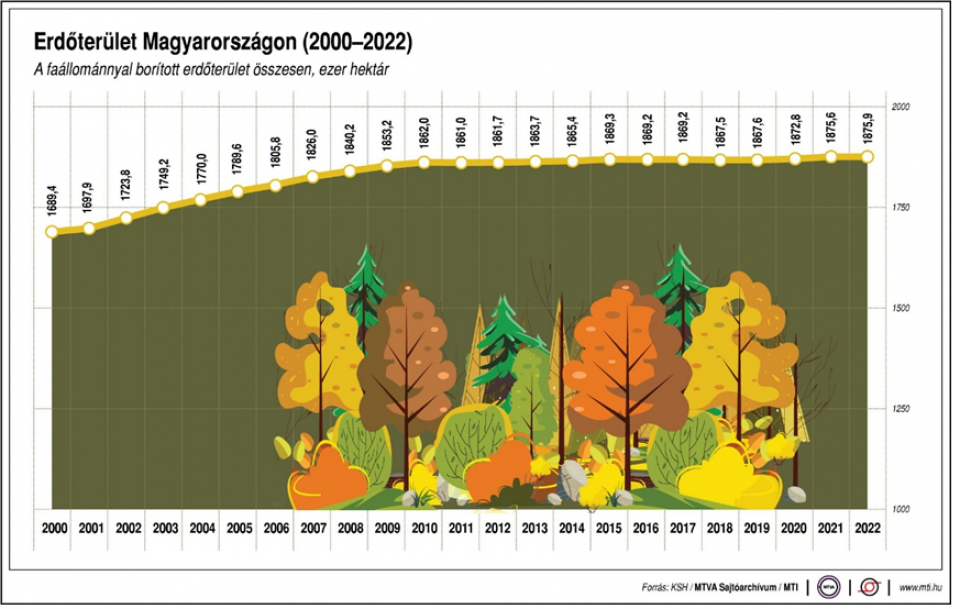
Before the First World War, Hungary's forests covered 7.3 million hectares, or 26% of the country's territory.
After the Treaty of Trianon (the peace treaty signed in 1920 under which roughly two thirds of Hungary's land and a third of its population were "handed over" to neighbouring countries), the forest area fell by 85% — to one million hectares, which amounted to less than 12% of the country's remaining land area.
For more than a century now, the need to expand Hungary's forest area has been a constant, from economic, environmental and public health perspectives alike. In response, considerable work on forest restoration was begun and continues to this day as a matter of national importance. The most significant step in expanding the forest area was the afforestation of the Great Hungarian Plain and of mountainous and hilly regions. This was the life's work of Károly Kaán, the outstanding Hungarian forester of the 20th century, as was the drafting of Hungary's 1935 Act on Forests and Nature Conservation.
This first positive impetus in forestry was halted by the Great Depression and then by the Second World War. Following the professional principles introduced by Károly Kaán, the afforestation process — by then largely entrusted to the state — resumed in the 1950s and 1960s and was given particularly close attention. Moreover, after the change of regime (the collapse of communist rule in 1989) and the restoration of private property, various afforestation programmes continued. Since 1990, private forest owners have thus established some 200,000 hectares of new forest, amounting to 10% of the current forest area.
If the targets set in the Ministry of Agriculture's programmes are met, forests will cover 27% of Hungary's territory by 2030.
Afforestation is proceeding in several areas at once: both the Rural Development Programme and the Common Agricultural Policy support afforestation on private and municipal land.
The Hungarian Forestry Association points out that forests created through afforestation enjoy strong legal protection. Under Hungary's Forest Act, the owner has a duty to maintain the forest, which means it may not be converted into arable land, pasture or built-up areas.
According to the World Conservation Monitoring Centre, Hungary has around 490 known species of amphibians, birds, mammals and reptiles. Of these, 0.4% are endemic, i.e. found in no other country, and 3.5% are threatened. Hungary is home to at least 2,214 vascular plant species, of which 1.7% are endemic. Some 8.8% of Hungary's territory is protected under IUCN categories I–V.