



Buying a log cabin is a serious decision that requires careful consideration and reflection. It is important to be aware of all the necessary information to make the best choice. Before and after purchasing a log cabin, many factors must be taken into account; there are also several important terms and facts that may need clarification first in order to fully understand what constitutes a log cabin.
Log cabins are a bright and interesting addition to any outdoor space. They provide extra room for work, relaxation, or entertainment, and act as a tasteful feature for any garden. Garden buildings, for example, can offer the same usage possibilities as a house extension, but at a significantly lower cost compared to a potential home renovation. Log cabins are suitable for entertainment rooms, games rooms, crafts, bars, home gyms, home offices, and outdoor living rooms. They are a great opportunity for young people to start their own independent lives or to create a space to run a business. The value of a log cabin lies in its attractive design and practicality.
What are log cabins made from?
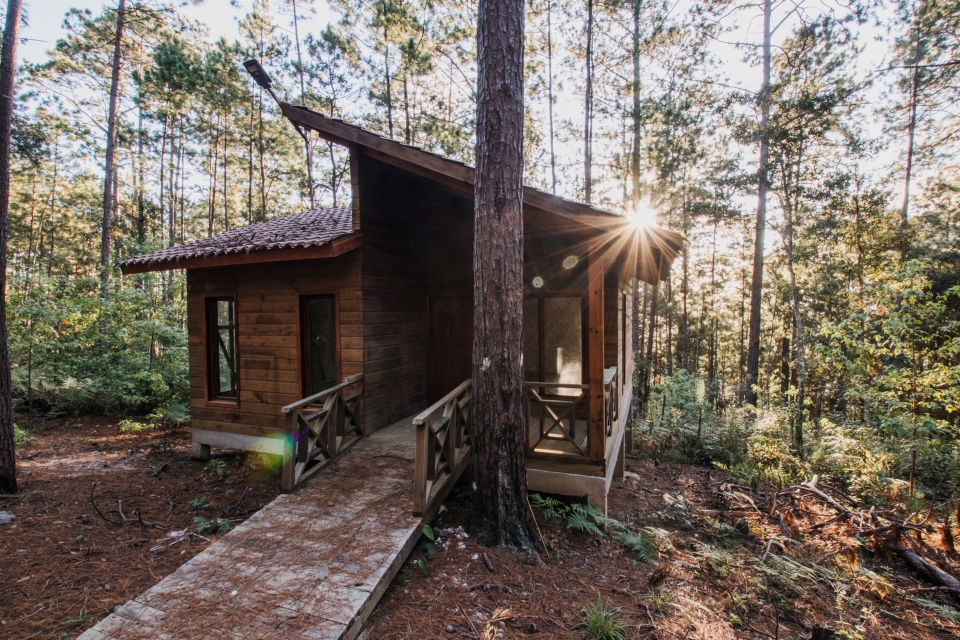
Log cabins are manufactured from logs. The most important component of any wooden building is, of course, the timber itself. The quality of the wood will affect both the appearance of the building and its longevity. For garden buildings, the best timber is that with increased density and improved durability, which is less prone to deformation or splitting. Log cabins are made from interlocking logs, creating a sturdy structure with no visible gaps. As the logs fit tightly together, the building is more resistant to moisture and wind, thus extending the structure's service life. If you plan to use the building all year round, it may be beneficial to choose a log cabin made from thicker logs – especially if you live in a region with a colder climate, which is part of the Latvian winter. Log cabins are available in various thicknesses: 19 mm, 28 mm, 44 mm, and even thicker logs. Wooden houses can fit in well in many places; it is not for nothing that they are built all over Europe according to the owner's needs and wishes. The logs are easy to adapt, for example, by extending the terrace if you want extra space outside the building.
19 mm log cabins are generally smaller in area, making them ideal for more compact gardens. The walls are thicker than a shed, and if you want to use your log cabin as a summer house on warmer days, 19 mm may be suitable for your needs. These buildings are effectively "in between" shed-style summer houses and more solid buildings. High-quality 19 mm houses are the most budget-friendly and are sufficiently durable.
28 mm log cabins are the next step up from 19 mm buildings. Increased log thickness provides greater strength and improved heat retention, which is especially important if you want to use the house for most of the year. Although 28 mm log cabins can be used year-round in milder climates, they are best suited for spring, summer, and autumn. These log cabins are usually available in a wider range of sizes and types compared to 19 mm buildings, offering greater customisation options.
44 mm log cabins are suitable for year-round living, even during the harsh Latvian winters. The wood is thick enough to protect against heat loss and provide insulation in winter, while also providing outdoor space for relaxation in summer. 44 mm wooden houses are factory-made with increased durability and are available in a wide range of designs to suit any outdoor space. 28 mm and 44 mm log cabins can use a four-way chamfered notch method to ensure a secure and tight fit of the logs at the connection points.
Nowadays, the production of these types of structures is highly efficient thanks to modern industrial solutions, such as the use of modified CNC machining equipment. Qualified specialists are always striving to find new solutions to build various houses in a timely and high-quality manner, which are primarily tailored to the individual rather than just found in catalogue sizes.
Dimensions
Once you have determined the necessary area for your log cabin, you should consider what size building you want. It is good to think about the future – perhaps you will need more space, so choose a size that meets your changing needs or a growing family. The use of the log cabin will be an important factor in choosing the size. If you are planning a home gym, for example, ensure that the chosen equipment will fit inside. Furniture will also be an important element of the space, so allow enough room for chairs, sofas, and tables. While a home office may only require space to comfortably accommodate a desk and chair, increased area improves your ability to vary the use. During the day, the log cabin's primary function might be a home office, and at night, a lounge. The additional space is also ideal for storage. You must consider the height requirements of your chosen equipment or furniture, as well as the necessary floor area. Of course, you should then also think about security if you intend to store anything of value in the house.
Log cabins are available in all sorts of sizes. Size can refer to the base size, internal measurement, external measurement, or external measurement including roof overhang. The difference between external and internal dimensions can be significant, so be sure to check the specific technical dimensions and ask for a detailed construction diagram or floor (foundation) plan showing all measurements.
A log cabin often has a roof overhang; this must be taken into account. Check whether the provided overhang dimension is from the front of the wall or the end of the interlocking log. If garden space is very limited, corner log cabins are a great way to maximise the possibilities.
Can a log cabin be heated?
If you are not satisfied with the warmth of the room in winter even after insulation, there is a solution, but it is best to think about it in advance—for example, if you know from the start that you will want to use the log cabin in winter. You have several options: use a portable gas heater, heating with a solar energy hub and a 12V heater, or connect the garden room to the mains electricity grid so you can use an electric heater. For more complex solutions, you should seek the help of professionals, such as electricians. If you add a heater, be sure to follow all manufacturer-recommended safety instructions, including those relating to the room and ventilation. Never leave heat sources unattended!
Is the timber treated?
Unlike sheds and summer houses, most log cabins are not treated. The wood will need to be treated during construction and then every year thereafter. This is a great opportunity to add colour to your log cabin to match your style and garden. It can also help reduce the cost of the house.
Before choosing a specific log cabin, it is worth reading the installation section of the chosen product to see full information about any available assembly services. It contains detailed specifications and descriptions to help you find the best solution.
Photographs by Esteban Benites and Eric Mclean used