


A fall in logging volumes would reduce revenue from timber sales, income to the state budget and the wages that companies pay their employees.
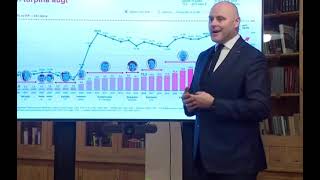
What would happen if Finland's annual logging volume were cut from the current level of roughly 70 million cubic metres to 55 million cubic metres in 2035? Between 2026 and 2035, revenue from timber sales would fall by 6 billion euros, state revenue by 5.5 billion euros and the wages paid out by companies by 7.5 billion euros, according to a study commissioned by forestry companies.
Restricting logging is often presented as a way of meeting climate targets. The main task of the study was to assess what restricting logging would mean in practice. The results of the study were presented this month at an event held in Helsinki by the Finnish Forest Industries Federation.
According to the study's figures, cutting logging from 70 to 55 million cubic metres would be equivalent to 10-15 industrial-scale sawmills, the volume of timber supplied by roughly 800 harvesters, and 250 timber lorry journeys a year.
The study also assessed a scenario in which logging volumes rose to around 80 million cubic metres in 2035, which would mean an increase in timber sales revenue of 6 billion euros, an increase in state revenue of 5.5 billion euros and an increase in wages paid out by companies of 7.5 billion euros over the period from 2026 to 2035.
Too short a timeframe
Finland's goal is to become carbon neutral by 2035. Speaking at the event held this month, the executive director of the Finnish Forest Industries Federation, Tino Aalto, judged that this target is not realistically achievable. The executive director stressed that it could be met if forestry and the timber industry gradually wound down their operations, but that this would have a very negative impact on the country's economy and employment. This view was shared by Simo Jaakkola, vice-president of Koneyrittäjien: “We have been set fairly good targets, we can meet them, but that requires a little more time. Right now we are slowing down too sharply.”
Tino Aalto believes that attention should currently be focused on so-called technical sources of pollution: “Attention needs to be paid to heating and the use of biochar. Using wood in construction is also a concrete, clean and green transition.”
An appreciation of the forest sector
Speaking at the event, Finland's transport minister Lulu Ranne said that Finland needs broad growth across all sectors, rather than shutting down or squeezing out some traditional branch of industry: “Alongside the traditional sectors, we also need a renewed ancient sector, namely the forest sector. It is important to understand the bigger picture. Finland must not get this wrong now — must not give up something that has brought us growth for decades, for centuries.”
Lulu Ranne believes there is currently too much confidence that data centres, the hydrogen industry and the green transition will deliver rapid economic growth. She urges people to value the sectors that already exist, such as forestry. Climate and energy policy can be implemented in a way that supports the existing forestry sector: “The Finnish government's programme on forests is excellent. It states that the use of forests in Finland will not be restricted.”
Greenpeace, of course, is critical
The study was carried out by the Finnish consultancy group FCG on the commission of Bioenergia ry, Koneyrittäjät ry, MTK, Metsäalan Kuljetusyrittäjät ry, Meto Metsäalan Yrittäjät ry, Metsähallitus Metsätalous Oy, Sawmill Industry ry and SLC rf.
It is no surprise that the report was also recently criticised by Greenpeace. That organisation takes the view that forestry entrepreneurs should stop spreading fear in society that climate and nature protection targets will spell the end of Finland's forest sector.
Any argument made by foresters that the extreme wing of the environmental organisations does not wish to accept is criticised and dismissed. This trend can be seen here in Latvia too, where for years environmental organisations have been stoking unfounded hysteria, persistently and deliberately trying to turn the public against the forest sector and significantly hampering the country's development and the sustainable use of natural resources.