



It often happens that an entrepreneur has not even had time to fully formulate their thoughts and plans for developing a business in a particular parish or district, but someone else has already organised a protest rally against their idea and their desire to provide work, finances, and a sense of self-worth to local residents. When reading descriptions of situations that are difficult for the country, it becomes clear – money is needed – if not by everyone, then by many. People talk a lot about the need for it, but... Have nearly 33 years of independence somehow strengthened the opposite – a desire to forget where and how to earn money?
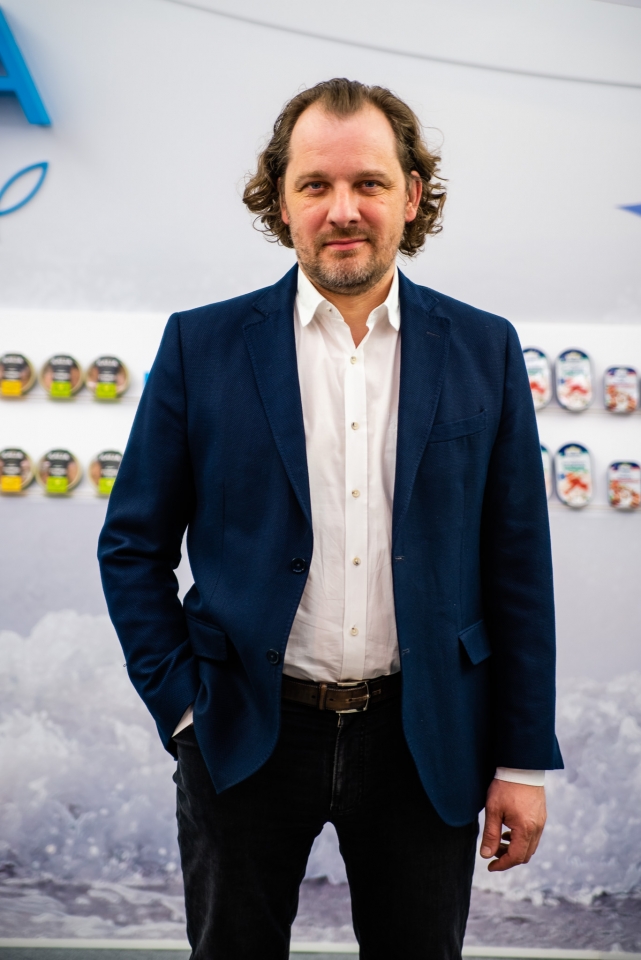
Andris Bite is interviewed by Māris Liopa, Chairman of the Forest Certification Council of Latvia, and Pauls Rēvelis, editor of zemeunvalsts.lv
In March, you were elected President of the Employers' Confederation of Latvia (LDDK). For the head of a serious company, this is an important public duty in an economically difficult situation for the country.
Even before agreeing to work for the Employers' Confederation of Latvia (LDDK), I have been quite actively involved in the public life of entrepreneurs, both in the Latvian Fish Industry Union, the Latvian Food Companies Federation, and the LTRK. We saw that cooperation between state administration and entrepreneurs (state administration and business) can in some cases be built quite well. Here, I am talking about situations where both sides – the public sector and entrepreneurs – work as a single team with a common goal. In the cases of successful cooperation I mentioned, we have always reached a 'conditional ceiling' where we hit a wall – whether it be a ministry or another institution – and if it is a question of ministries or institutions under the control of different political forces – bang! – even successful cooperation comes to a halt.
In my sector – the fishing industry – and also in my own company, everything is currently fine; there is development, there is work, and the paths ahead are clear. However, I am generally concerned about the country's situation, realizing that we who work in the productive manufacturing business in Latvia are unfortunately quite few in number and weak; a clear and understandable increase in the total number of companies and the overall economic capacity of the country is necessary. It is objectively necessary, and what is more, it must be many, many times greater to sustain our country. At the moment, it is difficult to achieve this with the current generation of resources. I am convinced and I believe that the system can be changed and grown larger.
I chose a simple fact as a benchmark for this assessment – from time to time, serious publications that focus on business compile and publish various lists of companies. If my company is in 30th to 32nd place in the list of national capital companies in Latvia, it means that the sector and the economy are doing badly, not that I am an exceptional entrepreneur. Objectively evaluating, my company should be around 300th place.
I am not disappointed; the system is changeable, both by strengthening the entrepreneurs' own ambitions to achieve more and better, and by changing and strengthening cooperation with the state. Enabling, training, and motivating – these are important things. I do not want to emphasize only one-sided problems, shifting the responsibility entirely to the public sector. We entrepreneurs are all different.
Often, when listening to comparisons, when talking about our Estonian neighbours, there is almost a wailing sound: 'They are so far ahead of us...' What is the problem? Why are we lagging behind?
If I knew the answer, I think the problems could be solved step by step, or they would have been solved already. I cannot answer. I suppose one has to set aside the genetically historical problems, starting with the fact that the Lithuanians had dukes and kings, which we do not have, as well as the undoubtedly important national composition.
I see weak and irresponsible management of national capital as a serious problem in Latvia; in fact, at one time it was 'plundered', and the 'plunderers' are still operating quite close to our politics. Those people who had the ability and the opportunity to accumulate national capital either did not invest it anywhere, for example, in export-oriented and capital-generating industry, or chose the path of political business in connection with monopolies, public procurement, etc. Namely, certain business was dependent on creating the environment for the future of that business – so-called political business.
Business that is based on political decisions – if those decisions did not exist, the business would not exist.
Exactly! I do not consider political business to be practical entrepreneurship; it is more of a parasitic business, and moreover, it is mostly related only to the state's internal consumption. If some sector of political business were related to political decisions to, for example, take over or conquer a market in a neighbouring country, that is a different – export – story. In Latvia, the thinking was how to get just one euro more from citizens, for example, for waste management.
So it all started with privatization.
Privatization as a process should be evaluated in different ways. For example, the fact that Andris Šķēle privatized the Avelat group is not considered a bad option, because someone had to do it. In turn, looking at the mistakes of entrepreneurs at that time (the 90s and later), I used what I saw as experience in my own work. The first stage of privatization was successful because, as I mentioned, 'someone had to collect everything'. Why? Otherwise, many sectors would have met the fate of VEF – the end, full stop, and that’s it. The next – second – step did not follow... The plans were good, but they did not materialize. I have not studied the situation at that time in too much detail, but, for example, in our neighbour Lithuania, national capital strengthened; it was not sold off, but invested in the producing and productive sphere.

Estonia, in turn, was helped by Finnish experience.
Of course, in Latvia, a sufficiently large amount of money was generated locally for a long time, which, unfortunately, did more harm than good. We had a sufficiently large banking sector, including the servicing of money flows of various origins. For quite some time, a great many smart and active people worked precisely in the banking sector, which at the time earned 'easy' money without investing it further. I think that in terms of knowledge and 'people's heads' (critical thinking) in this sphere, everything was fine, but – if instead of various fund acquisition schemes, these same 'thinkers' and 'schemers' had invested their thoughts and ideas into production and productivity, our achievements would be much, much better. Of course, that is neither simple nor is it the easiest path.
For example, I have talked with a few politicians about the choice – what to do – to sell 100,000 passports or to invest in a manufacturing company. The second path – manufacturing – is undoubtedly more necessary and useful for Latvia, but it is also much harder. Selling passports is easier. There you have it!
Entrepreneurs are often not satisfied with the stalling of various very important issues in state institutions.
We need to talk about the level of cooperation between the state or local government and entrepreneurs. Liepāja and Valmiera are good examples; looking at the country as a whole, there is no such connection; officials are afraid to make decisions because in the event of errors, they face political problems. I know myself that during the time of Minister Jānis Dūklavs, the fishing industry developed good cooperation with the relevant departments of the Ministry of Agriculture, which is now continuing under the leadership of Kaspars Gerhards – nothing has been spoiled. I will add that this also creates a sense of stability in the state administration, because in the event of possible errors, the sector will not let you be beaten; the 'taste' of cooperation is felt, and it is important. It is necessary to build or create such a situation on a wider scale – first of all – definitely between ministries, which is where we should start, but there are obvious political problems here.
The long road in the dunes – every ministry is like a separate republic. People have been talking about this for years too...
That is how it is, but that is why it requires skilled leadership. If in my company every department or workshop lived its own life, the company would not exist. The government is already in a bad situation, and Prime Minister K. Kariņš does not lead this government. He can complain long and hard about how difficult it is to lead a government consisting of several parties and ministers from several parties; he complains more than we do, but he does not lead the government himself. Quite a lot is sacrificed to achieve political peace, good results included. Political comfort, if there is no work and no results, is hardly needed by anyone.
For this Saeima and this government, cooperation as a process is a very big problem, because if there is at least some kind of interaction between ministries represented by one political force, as soon as ministries are managed by different political forces and short, quick coordination from the prime minister is required, everything stops.
People talk about this a lot, nothing happens.
I think it is a matter of the general operating style set by the head of government.
Some things may also be objects of political bargaining. If you recall, at the beginning of this year, the prime minister let slip the phrase: 'The state maintains entrepreneurs,' and later seriously reproached the Minister of Economics for successful cooperation with the sector. What kind of nonsense is that?
That is the mindset.
Could it be that the prime minister really thinks that, or was it a clumsy statement?
I know that K. Kariņš himself has been an entrepreneur. If he thinks so (that the state maintains entrepreneurs), that is very sad. I allow that he expressed himself not very sensibly and without thinking, but – the fact remains – the nonsense that the state maintains entrepreneurs is sufficiently dominant among state and municipal officials. I have argued and spoken with such people very many times, concluding that, unfortunately, they do think so. If I say and explain – 'as the entrepreneur fares, so will the official fare' – the overwhelming majority of officials believe that they pay taxes themselves and receive a salary from a mystical state budget that is created and filled from who knows where. How money gets into the budget is not clear to them, and they are not interested.
That is fundamentally bad! (To put it mildly.)
If a member of parliament who participates in the preparation and creation of laws thinks like this, that is very bad. Here we must start with education, and not just talking about schools and universities, but starting right with the state administration and the civil service. If someone working in state administration does not know where and how money is created, there is no need to hope for the country's development.
Who will tackle this issue, knowing that there are many civil servants and that is a large number of voter votes?
Ideally, this issue should be tackled! If we participate in elections using classical arithmetic, it is unlikely that anyone will start. If the voters are the civil service, which is not small, if the voters are pensioners, of whom we also have many... We will be and will remain where we are!
Parallel to Latvia's internal problems, a steamroller is running over Europe, on which someone has crossed out the words 'green course', correcting them to – 'green madness'.
It is not good to say that, but the war will definitely bring its own adjustments.
Political decision-makers watch the public in the centre of Riga very carefully, and the thoughts that arise from watching the asphalt and reading advice on 'correct thinking' on the web.
It has been heard that in politics, a lot is determined by Old Riga and the four blocks around it, namely, the people who live and work and circulate in this territory.
We must be reminded of the old and perhaps forgotten story – good times create weak people, weak people create 'sad' (bad) times, etc. Currently, there are more and more voices and sway for the so-called 'progressive communists', which can result in a big crisis. I would not want to experience that, but... If people who go to the countryside or the forest on an excursion once a year decide on the future and use of forest or agricultural land, it bodes no good.
It is repetitive, but Latvia has a sadly classic story about a bear, which is and is not a cute furry animal (read a book – it is, meet it in the forest – it is not).
We have no other resources – there is forest and there is land; there is still no oil. One must take from what is available; no owner in Latvia thinks in categories – I sowed once, I mowed once – full stop, I harvested the forest – it is finished. An entrepreneur does not think that way! An entrepreneur thinks about the future, and no one else but the owner and the master will treat the property more economically and sustainably.
In the less than four months since the Cabinet of Ministers' decision on forests, have you not happened to see giant queues formed by those wishing to cut?
One fact is the thoughts of city dwellers or pseudo-city dwellers, which are often directed in this way. Another big problem lies in the circumstance – a city dweller who has a sufficiently secure life buys property in the suburbs or the countryside and, understanding little, believes that nothing should happen around his property because he enjoys life here on Sundays.
I was schooled on forest issues by my father, who said that trees grow faster than a human lifetime ends; other trees grow within one human lifetime.
So, if a person saw one forest landscape in childhood, it will definitely change during their lifetime. This applies to every person. 'I have been driving here my whole life and suddenly the forest is gone...' That is not a shock, but an acute lack of knowledge.
The forest in Latvia is a quite aggressive environment that regenerates rapidly.
Whatever we listen to and hear, for example, 'everything is depleted and finished', there are actually no such large forest areas and low-intensity agriculture elsewhere in the world, and even more so – in Europe. Agriculture here can be even more intensive. Where there is no forest, there is land, there are fields; in every square meter of Latvia, something must grow or someone must graze. If in Ireland one can obtain 10 times more from agriculture, we have a clear answer and a goal to strive for.
If only the Irish did not have their idiotic decision about peat...
Both veganism and modern communism will 'be in the saddle' until the first famine, when people will truly eat everything. Strange ideas form from too good a life, when it becomes necessary to divide and take everything away.
In 1991, the Baltic states waited a long time for recognition of independence from European countries. At the time, the thought often sounded that 'fat and fed Europe' did not want to understand anything at all.
Of course, in Latvian society too, there are people whose 'fatness' of thought and action is acutely felt and clearly visible. That is a big problem. My company's ability to survive and enter a wider market happened thanks to the fact that Western Europe is self-satisfied, obese, and sedentary. We were ready to work, work more, longer hours, earn less, be hungrier, and that is how we entered the European market. If we have imagined that now we need such a standard of living as in Sweden, which has not fought in the last 200 years, not experienced communism... moreover, the Swedes have not experienced nationalization of property, nor has anyone robbed them in any other way. If we in Latvia imagine that we have the right to live at such a (Swedish) level today, we will very quickly be in a ditch. Two or even three generations must work diligently at least six days a week, only then can such a level be reached or approached. That requires time and work, work and once again work.
Many, by repeating it often enough, still blame Latvia's problems on the Soviet legacy.
There is a certain amount of truth in such statements. The Russian market, even though it was close and seemed very profitable and large, ultimately brought minuses, not pluses, in the total balance. Pluses can be brought by a market with long-term thinking – namely – where everything depends on your abilities, successes, and volume of work, not on external factors. In Russia, the market has always depended on something – will they allow it or not, will they open it or close it, will they control it or not, etc. Through various business structures, such as banks, this attitude and style of our neighbour also 'came' to us. For example, there are opportunities to compare – how Jūrmala is managed and how Valmiera is. The difference is very noticeable.
One cannot justify everything with old times, but the influence of both the Soviet Union and Russia in various spheres is, unfortunately, very noticeable.
What is happening now in Russia makes a logically thinking person build a high wall or fence on the border, because one does not want to experience anything like that here. I try not to maintain my former contacts in Russia; I once had five quite serious cooperation partners, quite well-off, seemingly western-oriented, their children studied in Great Britain, etc. The attitude towards the war and aggression among these five is different – there are the understanding ones who will say nothing because they are afraid; there are those who understand that things are not good, but for them, 'Russia is fighting for its independence'; and there are the supporters of state policy.
Actor Ivars Kalniņš described the situation, saying that he does not communicate with colleagues in Russia, because he does not want to be disappointed in people he knows well and with whom he once collaborated.
Exactly! But I allow that many in Russia are very afraid. If you can get 12 years in prison just for your stance...
Is our situation in Latvia stable in this regard?
My company is located in Vecmīlgrāvis, which is quite a peculiar district of Riga, judging by the national composition. At the state level, it is currently too late to try to cosmetically fix any interpersonal relations – if they have not been formed, the opportunity has been missed. One must have one's own position and attitude – accept – accept, don't want to – don't want to. I have never been on the side of those who want to tear something down, but currently, a different reality prevails, in which the monument in Victory Park was a symbol.
In my company, there is a normal atmosphere in the work environment; the approximate national composition is 50% Russian, 30% Ukrainian, and the rest Latvian. I will not say that I am well-oriented in the personal thoughts of the employees; from the management side of the company, we expressed our position quite clearly; what the people themselves think, I cannot say exactly. I will add that there is also no very clear and unequivocal attitude from some Latvians; for example, a person can be covered in 'auseklis' tattoos, yet still argue smartly that the situation in Ukraine is not clear enough...
The most important issue at the state level – how our special services work and how strong they are to catch and neutralize all potential provocateurs. That is current. We hear less about such things, arguing that the good work of special services is invisible. Let it be so! In Estonia, such people end up in the hands of special services quite quickly. The attitude of society is also very important. For example, were there many people in Latvia who did not know who Juris Savickis was and what the 'project' ice hockey team Dinamo Riga meant? Where was or is the problem? Exactly the same as with corrupt politicians, namely, to grumble and grouse about how bad something is, but at banquets and gatherings to go up to those same people being criticized behind their backs, shake hands, and smilingly ask about their health. Public shunning does not happen. Of course, we each have people with whom, for certain reasons, we do not speak; for example, I try to educate myself – I do not have to greet someone I do not respect.
What, in your opinion, should be the work done in the near future on a state scale?
Winter. Availability of gas – not so much talking about price, but about availability. Of course, many will have big financial problems; they must be helped, and this issue will be important. The current approach – to help everyone – is not correct. In principle, the situation is not problematic, but it is problematic in Latvia. As can be understood, the Ministry of Welfare cannot calculate income per household member.
Can they not practically or...
...it is a matter of thinking. The State Revenue Service (VID) has such data, but whether you are maintaining only yourself, or whether you have parents or relatives, is not visible in the database. This situation 'forces' the government to give money to everyone. The necessary preparatory work has not been done. In my opinion, there are no secrets here; it remains to borrow a good example from other countries and implement it in Latvia.
The restructuring of the education system should be 'taken' (copied) from Finland or Estonia.
Large-scale things, such as changes in education or law enforcement structures, or anywhere else, are not possible without serious and sufficiently painful reforms. Who wants to implement such reforms now, and who will be ready to agree to them? If education reform gives us a result where, for example, 1/3 of teachers lose their jobs, who will agree to such reform? If it means 1/3 fewer schools, which will definitely be of higher quality, who will decide that? Municipalities usually choose convenience, not quality – the school is close to home, there is work in it, etc. As long as the ministry does not understand that quality will be provided by those reforms that will not be 'good' for everyone, then one should not expect anything significant and high-quality. Of course, one can shout 'for more money', which will change nothing, because we spend more per student than in our neighbours, but teachers' salaries in Latvia are lower.
The craziest thing is that one has to think more and more about how to turn the situation for the better. If we compare ourselves with our neighbours – the direction is right for us too, but while our neighbours are driving on the road, we are moving in the ditch. The country can be organized; we do lack people, they are definitely needed more. Looking at the data, about 400,000 productive (working-age) people have left and now work in other countries. In this regard, I want to emphasize an important fact – currently to talk that Europe is financing us with fund money is a big nonsense. Looking at the balance, yes, every year we receive a certain amount of funding from these funds, but – how much funding do our 400,000 departed residents give to their current countries of residence? Can that be compared? Has that been done? We are financing the rest of Europe with our workforce, moreover, if we compare work capacity and work culture, our people are rated very highly.
How to change this situation? That, in the words used a lot lately, 'requires stepping out of the comfort zone'.
There is another problem – how society treats entrepreneurs and what it thinks about them. Recently, I gave a lecture at the Riga School of Economics, and when I asked the audience at the end who sees themselves as entrepreneurs in the future, 5-10% of those present signed up. That is not a good indicator; that is very, very little. Yes, historically we have been very good performers; that is our difference from the Lithuanians! This is where we should start teaching the young generation – from the basics of entrepreneurship, for example, it is acceptable to make mistakes, it is acceptable to go bankrupt, it changes nothing, etc.
At what speed should everything we have talked about and mentioned be developed?
If currently we have lagged behind the Estonians by ~25%, we in Latvia must work much harder, because – catching up with a standing person is one thing, but one must catch up with someone who is not standing in place. Setting very ambitious goals is important – but without losing what we are already successfully selling. In export and production, we must support everything we can create, produce, manufacture, and export right here, except for drugs and radioactive waste. We cannot and must not start sorting, saying 'this is low-productivity' or 'this is different'. If we hear anyone say that this or that is not needed, we call: 'Be quiet!'
Comments