
Weekly review
Poll
In recent weeks, both in the Saeima and the Cabinet of Ministers, the thesis has been heard once again: “We must act this way, otherwise there will be penalties, infringement procedures, etc.” Often, such a pseudo-argument completely excludes reasonable disputes, discussions, or alternatives, forcing those responsible to make decisions hastily and not always in the interests of Latvia. Why is that?
Old habits are hardening - someone somewhere knows better, let us rely on them
Lack of sufficient capacity or laziness to defend a different point of view
A generation of cabinet officials has been created who are accustomed to accepting rather than delving into matters
This is a serious problem for Latvia for which no solution is being sought. It will probably be all right somehow...



20-26 April

From 11 April to 2 June, the environmental campaign “Dod riepām otru dzīvi” (Give Tyres a Second Life)
On 26 and 30 April, parts I and II of the seminar “Ilgtspēja kūdras nozarē” (Sustainability in the Peat Industry)
The 20th Latvian Plant Parade on 4 and 5 May in Sigulda
zemeunvalsts.lv · 20 latvijas stadu parade sogad notiks 4 un 5 maija
Until 12 May candidates may be nominated for the European Commission's “EU Organic Awards” competition, which is open to organic producers who have developed outstanding, innovative, sustainable and inspiring projects that create real added value for organic production and consumption.
zm.gov.lv · zm aicina latvijas lauksaimniekus un partikas razotajus lidz…
Latvian Forest Science Day on 16 May – “Stāsti par Latvijas Nacionālo meža monitoringu” (Stories of Latvia's National Forest Monitoring)
silava.lv · 16 maija latvijas mezzinatnes diena stasti par latvijas naci…
Latvian Forest Days – 24 and 25 May
lvm.lv · 7345 latvijas meza dienas aicina pieteikties sadarbibas part…
Latvian Forest Days – 24 and 25 May
lvm.lv · 7345 latvijas meza dienas aicina pieteikties sadarbibas part…
Official matters
On 9 April 2024 the Cabinet of Ministers reviewed the informative report “On state and local government capital companies to be put forward for an initial public offering” and decided to allow LVM to end its shareholding in LVP. Accordingly, on 23 April 2024 LVM and AS “Latvenergo” concluded an agreement on the disposal to AS “Latvenergo” of all LVP shares held by LVM (20%).
The government has adopted amendments to the regulations on angling, crayfishing and underwater hunting, changing the size of the catch that may be kept for certain fish species and refining the list of waters open to underwater hunting as well as the list of waters in which an autumn ban on catching salmonids applies. At the same time, local governments have been given the right to designate, in addition to the existing list, waters in which invasive crayfish may be caught.
As of 11 April this year, licensed angling is no longer being organised at Lake Lielauce, which is managed by AS “Latvijas valsts meži”. From now on the lake will be freely available for angling like any other water body with public status.
On industry issues
This year too, the forest came to Jelgava
With an investment of more than two million euros, a new metalworking workshop building equipped with modern technology has been built at “Iekārtu rūpnīca”, the machine-building and technical services centre of “Latvijas Finieris”. Its 1300 m² of space is intended for the storage and initial processing of metal raw materials – cutting, sawing and bending. An impressively large, purpose-built shot-blasting chamber for treating steel surfaces has also been installed.
One of the priorities of the European Green Deal and the EU biodiversity strategy is to promote the restoration of biodiversity, including in forests. The strategy highlights sustainable forest management as one of the important nature-based tools in the fight against climate change.
The Guidelines
AS “Latvijas valsts meži” invites interested parties to take part in developing the concept for “Laimīgā zeme” (Happy Land), a new themed section of the Latvian State Forests nature park in Tērvete, by preparing outline design proposals for a modern, active recreation and discovery area that will be one of the park's central features. Clarifying questions may be submitted until 17 May 2024 and proposals until 17 July 2024.
About the Forest Development Fund
In order to promote the priority scientific research needed for the development of the forest sector, as well as to inform those working in the sector and society as a whole about the sector's development, on Tuesday, 23 April, the government approved amendments prepared by the Ministry of Agriculture to the procedure for granting state support for forest sector development, setting out the funding for these purposes from the Forest Development Fund in 2024.
Officially.
What is that? Firewood! A nice bit of firewood...
(quoting the film “Pie bagātās kundzes”)
(quoting the film “Pie bagātās kundzes”)
On 25 April the Saeima will consider in second reading the amendments to the draft “Energy Law” prepared by the Ministry of Climate and Energy (KEM). The Cabinet of Ministers (MK) approved these amendments in mid-January this year. With them, Latvia is transposing the requirements of a European Union directive and developing national regulation to strengthen security of supply, make administrative processes more efficient and encourage the production of heat from efficient and affordable sources.
We offer the following explanation from the Ministry of Climate and Energy (KEM): the proposal put forward in the draft “Energy Law” does not prohibit the use of biomass fuel (firewood, pellets, briquettes) for heating, which is an efficient renewable energy resource. There is no reason for public concern. When organising heat supply in their territory, local governments assess which heat supply solution is the most suitable – renewable energy resources, which include biomass fuel, or zero-emission technology.
One of the most popular forms of heating in private houses is wood heating. However, particularly during the winter season, it increases air pollution. Under the 2021-2027 European Union funds programming period, residents are to be offered the opportunity to receive co-funding for replacing their heating equipment.
On environmental issues
The Agricultural Organisations Cooperation Council and the Employers' Confederation of Latvia are calling on the country's most senior officials to review immediately the commitments Latvia has taken on in the field of climate, given the geopolitical and economic situation.
lsm.lv · 21.04.2024 ano eksperte mani biede ka musu berni pieredzes d…
Should Latvia be allowed higher emissions because it has been occupied? Or perhaps Africa, because it was colonised and could not develop? These are very difficult and, at the same time, very interesting questions. And I always hope that I will be able to influence them in Latvia's favour.
A popular topic in the rhetoric ahead of the European Parliament elections is the European Green Deal. What misleading claims are Latvian politicians spreading about what this strand of European Union policy actually involves?
The Zemgale District Court in Tukums has imposed a hefty fine payable to the state and 120 hours of community service on a pensioner from Engure parish for felling an old pine on their property without permission. The penalty is so heavy because the tree was a protected veteran pine and stood in a specially protected nature area.
On 9 April, in the case Verein KlimaSeniorinnen Schweiz v Switzerland, the Grand Chamber of the European Court of Human Rights found that Switzerland had breached the European Convention on Human Rights by failing to fulfil properly its positive obligation to combat climate change. The applicants before the court were the association “Climate Seniors” (KlimaSeniorinnen), which is made up of more than 2000 women of pensionable age, together with four members of the association who are over 80 and complain of health problems that worsen during the annual heatwaves.
“Either we do not understand one another, or we do not want to,” commented the chair of the district council, Andis Caunītis, stressing that VARAM gives the local government little scope to write into its own regulations solutions to the problems it identifies in its administrative territory.
Nothing more than unrest painted green?
In a direct and open conversation, Ilma Čepāne explained why the Constitutional Court's ruling will be a lesson for the government, and for the Ministry of Agriculture in particular, and why environmental protection has so far not been going well in Latvia.
Ending up at the Latvian Fund for Nature was more of an accident. It was not a professional goal of mine. But it did matter that I have a country house in Latvia, and that I often travelled there even when I was living abroad. My rural property is in Vidzeme, and there is a large tract of forest close by.
The mapping of habitats of European importance – or, as it is popularly known, the nature census – took seven years in Latvia, with experts literally walking one third of Latvia's territory on foot. In habitats, conditions are little affected by people. Put simply, everything there happens naturally, and that allows animals, birds, plants and insects to live and grow relatively undisturbed.
The number of days with very heavy rainfall will also increase considerably. And there will be more cases like last year's notorious August... On the whole, not every year and not every summer month, but the trend is upwards.
What is going on around Ķemeri?
As the programme notes, the situation has given rise to disputes over whether these are wild animals or animals kept by humans, and accordingly whether they must be cared for in the way that animal welfare legislation requires.
Wild animals, or animals kept by humans? The several hundred Heck cattle and Konik Polski horses kept in Ķemeri National Park are not being cared for as all the legislation requires. The owner considers them to be wild and therefore takes the view that natural processes should not be interfered with.
About science and our scientists
As the observations of our study's authors in European academia and in higher education and science policy frameworks confirm, mobility – researcher mobility – is one of the cornerstones of excellent science. This is borne out, for example, by the various grants available that involve moving somewhere for a longer or shorter period.
Drawing on the experience of European colleagues, a group of specialists bringing together representatives of several countries of the continent was set up in Africa in 2022. Two representatives of the European Helicobacter and Microbiota Study Group were involved in the working group. One of them was Mārcis Leja, director of the Institute of Clinical and Preventive Medicine of the University of Latvia (LU KPMI).
About buildings
During the repair work, in accordance with the work plan and methodological instructions drawn up by master roofers and in compliance with the requirements of the National Heritage Board, the entire roof covering was replaced, with particular attention paid to a historically appropriate size of the sheet metal panels and to the way they were arranged.
Current affairs in cartoons
 |
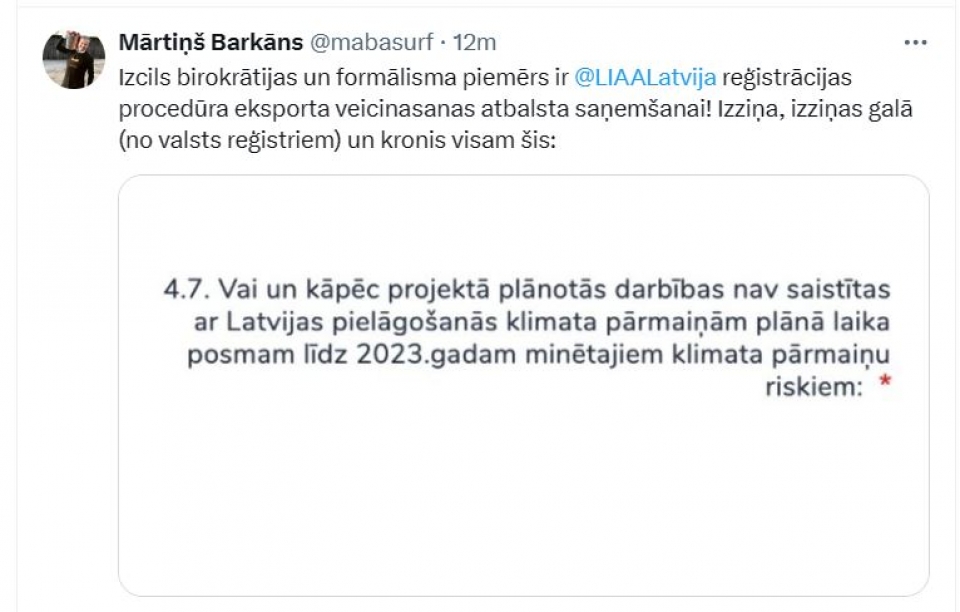 |
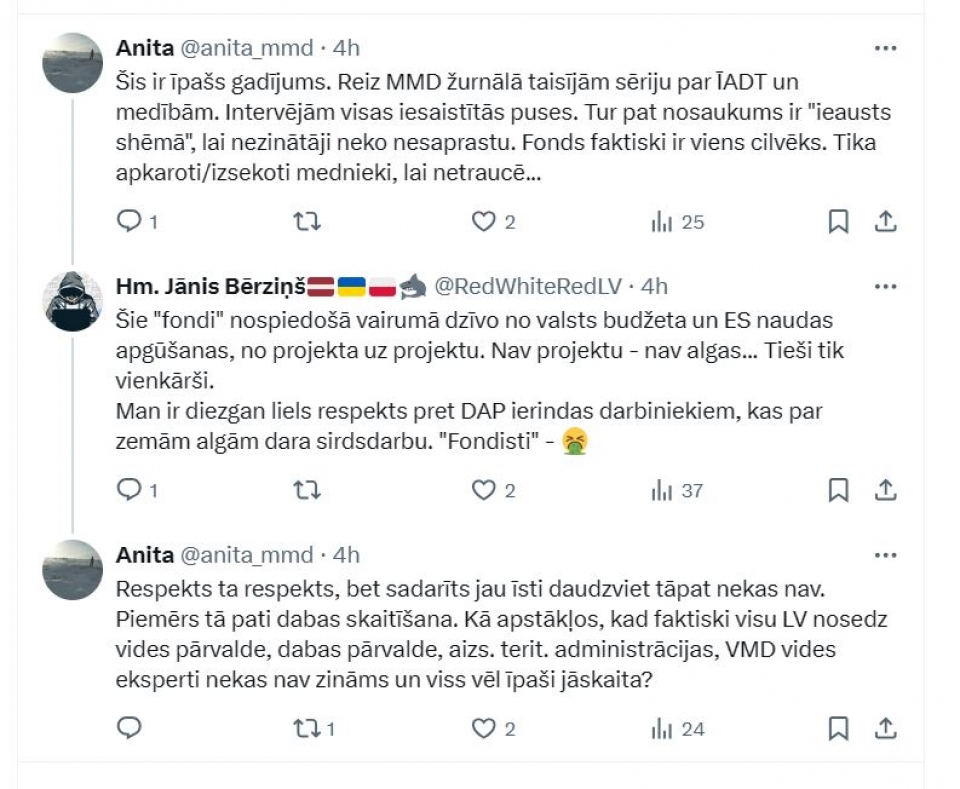 |
 |