


The idea of becoming an animal first occurred to Thomas Thwaites one spring day in 2013. He was walking his goddaughter’s Irish terrier, Kobe, along the Thames, and found himself pondering his life. He was 33. A few years earlier, he had begun a career as an artist and designer with an ingenious project: building a toaster from scratch, personally sourcing the iron and manufacturing the plastic. Along the way, he catalogued the environmental damage caused by humanity’s mass craving for toast – a huge crime against nature committed for the sake of breakfast. Thwaites’s toaster was acquired for the permanent collection of the Victoria and Albert Museum. Aside from the fact that not a single slice of toast was ever made with it (it turned out that some essential parts were too difficult to manufacture), it was a successful project in all other respects.
Three years had passed since the completion of the toaster. Now, Thwaites was beginning to worry about the future. He had irregular work and was living with his father. Would he be a scruffy, over-the-hill person forever? How would he earn enough to build a family? Was building toasters or other things that bleakly confirmed the absurdity of modern life really a good way to spend his time on earth? Busy people flowed past, but Thwaites asked himself these questions and watched Kobe. He thought: how wonderful it would be to live in Kobe’s eternal present – sniffing the grass, the wind, and the water without worrying about the future, the past, the meaning of life, and the inevitability of death. How much simpler it is to be an animal!
A few days later, Thwaites sent a funding request to the Wellcome Trust’s medical humanities office in London. Once the funds for the project were secured (“The committee thinks this is a wonderfully exciting idea,” the trust replied), Thwaites began to wonder what animal he would like to be. At first, he wanted to become an elephant. Elephants are big, he thought, and if he could build an elephantine exoskeleton, he could climb into it and plod around, eating grass and living in the moment. However, after going to South Africa and seeing elephants, he realized that an adult elephant is strong enough to knock over a tree. To make himself equally strong, he would need a massive, bulldozer-like exoskeleton; the noise of the motor and the smell of petrol would interfere with experiencing animal bliss. Furthermore, it is believed that elephants mourn their departed and cover their dead friends with leaves and branches. Since one of the goals of the project was to escape the existential worries of being human, Thwaites needed an animal that was not only smaller but also less rational – one whose mental life would be simpler and more carefree than his own.
Soon after, a Scandinavian shaman suggested that Thwaites should focus on an “animal that is closer to you and with which you share a common environment.” An Englishman has no reason to be an elephant, she said; he should be a sheep or a goat. Childhood memories surfaced: Thwaites remembered that once, when he was small, he tried to eat a houseplant using only his mouth. A goat matches my level to a much greater extent, he thought. The shaman introduced Thwaites to the history of animism and totemism. She pointed out that for most of human existence, people have created works of art and performed rituals to cross the border between human and animal. The Chauvet Cave in France has a 30,000-year-old drawing depicting a cross between a human and a bison. “Wanting to become a goat is, in fact, quite typical,” Thwaites concludes in the book “GoatMan: How I Took a Holiday from Being Human”1. “From a historical point of view, it is almost strange *not* to want to become a goat.”
Thwaites is an artist with the soul of an engineer, so he approached the realization of his project through the lens of problem-solving. He saw three problems. The first was the goat’s mind. To understand it, he began spending time at a farm in Kent – the Buttercups Sanctuary for Goats. From goat behavior expert Alan McElligott, he learned that goats are relatively calm and robust creatures, with a strict hierarchy reigning in their society: this was both good and bad news for his upcoming life as a goat. At the same time, to understand what it might mean to “be” a goat (or, for that matter, to “be” anything), Thwaites began reading the works of the philosopher Martin Heidegger, who argued that a person’s self is formed not by their thinking, which is based in language, but by their skills, habits, and states of soul, which interact. What we are is determined more by our way of interacting with the world than by our beliefs. Reading Heidegger convinced Thwaites that accessing the goat’s psychic life would require treating the surroundings in a goat-like way. “I need to change the context,” he decided, “so that when looking at a chair, I don’t automatically associate it with sitting.” He would have achieved goat-ness when he could look at a word but not read it or, even more importantly, “look at (another) goat and think of it as another person who is like me.”
Then Thwaites turned to the goat’s body. To learn to move like a goat, he began meeting with prosthetist Glyn Heath from the University of Salford, located near Manchester. He told Heath that he would like to obtain a set of goat leg prosthetics and go galloping on them through the Swiss Alps. Heath, who also holds a doctorate in zoology, pointed out that the anatomical structure of goats and humans is different. Without the goat’s strong forelimbs and elastic musculature, a human performing movements characteristic of goats, such as galloping or jumping from a higher place to a lower one head-first, would severely injure themselves. In response, Thwaites stepped onto four sawn-off crutches and began trotting around the lab. Heath, against his will, was impressed by the naturalness of Thwaites’s movements. He agreed to create goat limb prosthetics and suggested some stretching exercises.
The last problem was food. Goats eat grass, which humans are unable to digest. Thwaites participated in a goat dissection at the Royal Veterinary College. He admired the four compartments of the goat’s stomach and learned that the largest – the rumen – contains bacteria that turn grass into a fermented and digestible mash. At first, Thwaites wanted to add the goat’s microbiome, which promotes grass digestion, to his own by using goat feces, but when he realized how dangerous that was – one could contract parasites from a goat that way – he came up with a new idea: he would create an artificial rumen, chew the grass, spit it into a plastic bag with goat gut bacteria, and then drink the fermented contents.
Thwaites explained his plan to Alison Kingston-Smith, head of the Ruminant Gut Ecosystems lab at Aberystwyth University. “I wouldn’t do that if I were you,” she said. She explained that not all goat gut microorganisms are benign. Thwaites decided to abandon the microbiome. Instead, he bought a bottle of cellulase online – an enzyme that allows rumen bacteria to break down grass. He would use cellulase in his artificial goat rumen. Satisfied with this elegant solution, he bought a plane ticket to Switzerland and arranged a meeting with a goat herder.
Thwaites did not know that he had a rival, but he did. It is hard to say when Charles Foster first considered becoming an animal, but it is very likely that it was on a warm October evening in the 1980s. Foster was walking home from dinner at an East End pub when he noticed two foxes in the park. Flattened against the grass, they were turning their heads from side to side like sphinxes denying something. Foster crept closer and, dressed in a suit, lay down to look at the park from the fox’s level. The foxes were picking daddy longlegs off the dew-covered grass with their tongues. Foster stuck out his tongue. He found that the mosquitoes were fuzzy and then slimy, and tasted like vanilla.
Foster had been a veterinarian, a lawyer, a newspaper columnist, a lecturer in medical ethics at Oxford University, and an adventurer. Now, at the age of 53, he was the author, co-author, or editor of 34 books. Among them are a philosophical treatise on human dignity and bioethics, as well as a travelogue about the search for the Ark of the Covenant. In the book “Being a Beast”2, Foster chooses a more direct approach than Thwaites. Instead of building an exoskeleton or an artificial stomach, he immediately starts acting like an animal.
For six weeks, Foster lived in the forest as a badger. He dug a den, or sett, where he slept during the day and from where he crawled out on all fours at night. Badgers eat earthworms. “When you put a worm into your mouth,” Foster says, “it feels the heat as something threatening” and searches for the gaps between your teeth until you bite it and feel the taste of slime and earth. Foster describes the terroirs of earthworms: worms from Chablis “have a long mineral aftertaste,” while “worms from the High Weald of Kent are fresh and uncomplicated; they could be included in the list of recommended sides for grilled sole.” In his opinion, these flavors are part of being a badger.
At the badger’s level – 15 centimeters above (or below) the ground – a lot is not visible, so badgers have to rely on other senses; for example, it is believed that they can hear the bristles of earthworms loosening the soil. Foster could not amplify his hearing, but he trained his sense of smell. Before moving into the sett, he bought various types of cheese, asked his wife to hide them around the house, and tried to find Stilton blindfolded. As a badger, he turned to the world of smell. He discovered that, over time and depending on the weather, smells expand or contract. On crisp, dry mornings, smells cling to their source and the world of smell is small and compact. As the day warms up, smells expand and drift. (“Smell up to the chest,” as hunters say.) When it is damp, the world of smell becomes three-dimensional. Foster thinks that for a badger, smells form spatial structures with volume, boundaries, and an interior. On a warm day, a tree is a “spiral of scent eddies that pulls dust up into the canopy,” while on a cold day it becomes a “sharp hummock of lichen with a blurred chimney.” Approaching a dead animal is like walking deeper into a building.
A dead hedgehog has the shape of a hedgehog, then the shape of a green smell, then the shape of entrails, then a sweet shape, then the shape of pork scratching, then the shape of a beetle.
Foster took his eight-year-old son, Tom, to the sett, and since badgers are social creatures, they explored the forest together. “If I had to describe my badger life in one word, it would be ‘intimate’,” claims Foster, because “when a badger goes out, its goal is to stumble upon food.”
We bustled, grunted, jostled, pushed, and pressed our noses into the ground. And *we* even smelled something: the citrusy urine of voles in their paths in the grass; the sharp, sea-like smell of a distant snail’s trail, which resembles low-tide pools in winter; the crushed laurels of a frog; the dustiness of a toad; the sharp musk of a weasel; the duller musk of an otter.
Foster enjoyed his underground home – especially “the place at the end, which was squeezed into the shape of my body.” On rainy days, he smelled the surrounding and barely perceptible scents of damp earth. During a severe storm, he writes, our sett was clenched in the gnarled fingers of tree roots – beech on both sides, oak from above. The whole forest swayed with the wind. We rocked in our cradle, the roots around us tensed and creaked like ship timbers in a stormy sea. A field mouse, driven out of a flooded or collapsed burrow, crawled in and crouched shivering in the crook of Tom’s knee.
Foster and his little one managed to get some sleep – they found a way to feel at home in the forest. However, over the six weeks, they did not meet a single badger. (They heard them and tried to approach them, but without success.) After six months, they returned to their sett. In winter, it was frozen and odorless. The walls, Foster writes, were like “jaws”; the earthworms, attracted by their body heat, wriggled out of the soil “like hairy tongues.” Having lost courage, Foster fled back to civilization, taking with him this image of absolute mystery and inaccessibility that characterizes the life of a badger.
For various reasons – out of curiosity, difficulty, alienation – writers have long been happy to imagine the world from an animal’s perspective. When Achilles in the “Iliad” learns that his best friend Patroclus has been killed, Homer compares him to a lion that has realized that a hunter has taken its cubs:
But now I will go, for I want to meet the murderer of my friend,
Hector! I shall wait only for the death fated by destiny
At the moment when Zeus and the other eternal gods wish it.
One is accustomed to human emotions, whereas an animal’s emotions can seem fresh, strange, powerful, and unmediated.
Generally speaking, there are two approaches to writing about animals. In 1886, Leo Tolstoy published the story “Kholstomer”, written from the perspective of a horse. Tolstoy’s approach is pastoral. He imagined that horses, not restricted by human vanity, might see the world more clearly, calmly, and honestly. Listening to people’s conversations, Kholstomer wonders about their strange notions. “The words ‘my horse,’ applied to me, a living horse, seemed to me as strange as the words ‘my land,’ ‘my air,’ ‘my water’,” it thinks. People “try in life not to do what they consider right, but to call as many things as possible *theirs*.” How much simpler – much better – it is to be an animal!
James Joyce, in writing “Ulysses”, used a more sensual approach. When Leopold Bloom visits the Dublin cemetery at the beginning of the book, he watches a rat squeezing through a crack in a tomb wall. Always curious and sensitive, Bloom imagines what a corpse tastes like:
The smell is nothing to them. Salt-white, crumbly mash of a corpse: smells, tastes like green white turnip.
In the pastoral and sensual representation of the animal self, being human is criticized in various ways. Tolstoy believes that the problem with humans is the egoism in which they are trapped. The clear-headed directness of animals is a remedy for this self-obsession. Joyce believes that the problem with humans is lethargy, insensitivity, and indifference. He thinks we could learn from the eager sensuality of animals. Tolstoy’s animals teach us to be good, Joyce’s – to be alive.
The way Thwaites and Foster have arrived at goat-man and badger-man confirms the approaches of Tolstoy and Joyce, respectively. Thwaites believes that a person lives in constant stress, their life is absurd, but worst of all, they themselves are overcome with narcissism: “Even the Queen has worries,” he writes, although “she was born into the most privileged and prestigious class.” By becoming a goat, Thwaites hopes to escape his own egoistic anxiety, from his thoughts about it, because, as Thwaites has formulated it, “to be human is to worry.”
Foster has the opposite problem. Believing that a human is a form of voluntary dullness, he strives for the openness that he believes characterizes the rich animal kingdom. After Foster had tried being a badger, he began spending nights as an urban fox.
I lay in the yard in Bow without food or drink, urinating and defecating right where I was, perceiving the people in the terraced houses all around as hostile, which was not hard.
One evening, while rummaging through trash, he noticed that a television was flickering in almost every house; he counted (counting, of course, is not particularly fox-like behavior) that 64 out of 73 families watching television were watching the same show. From Foster’s perspective, the people in these houses, watching “EastEnders” over their pleasantly globalized pizza, pad thai, and aloo gobi dinners, are not living anywhere in particular. Foxes are the “true East Enders” because they “know that under the doorstep of number 17A is a mouse nest and bumblebees behind the cedar cladding at number 29B,” and explore and hunt in these specific streets. An urban fox “will continue to be fox-like, whereas completely urbanized people risk not being optimally human,” writes Foster. With a fervor worthy of George Eliot, he concludes:
We have very sensitive hands, but we handle the world in thick gloves and then, bored, blame it for having no shape.
It is probably natural to consider animals as our supplements – to imagine that they are what we are not, but it would be quite solipsistic to see our own reflection in other beings. Primatologist Frans de Waal, in the book “Are We Smart Enough to Know How Smart Animals Are?”3, tries to constrain our egocentrism. “I am even annoyed by the term *non-human*,” he writes, “because it lumps together millions of species just because they are somehow lacking.” He argues that we should not compare animals with ourselves, but rather recognize that every animal is an animal in its own way.
De Waal is an admirer of the biologist Jakob von Uexküll. Jakob von Uexküll, to denote the unique way of life of each animal, introduced the term *Umwelt* at the beginning of the 20th century. In direct translation, Umwelt means “surrounding world” or “environment,” but this environment can be cognitive and existential or physical.
Umwelt emphasizes an organism’s egocentric, subjective world, which is only a small part of all available worlds, explains de Waal. A reindeer’s Umwelt includes forests illuminated by ultraviolet rays. For eyeless ticks, it means not only the smell of butyric acid evaporating from mammal skin but also a juicy opportunity awaited for years.
In a classic 1974 article titled “What Is It Like to Be a Bat?”, philosopher Thomas Nagel concludes: since the experience of echolocation differs “from anything we can experience or imagine,” we will never understand the bat’s states of consciousness; the best we can do is imagine them by analogy, imprecisely comparing echolocation with hearing or sight. De Waal agrees with Nagel: he believes that no animal can fully understand another animal’s Umwelt. However, he thinks it is still worth trying to imagine another animal’s perspective, even if those efforts will be unsuccessful. In his view, we know about echolocation only because “scientists tried to imagine what it is like to be a bat, and they succeeded to some extent.” One cannot cross the species barrier, but by colliding with it, one can learn something.
There are also moral reasons to try to expand the boundaries of the knowable. J.M. Coetzee’s character Elizabeth Costello in the novel of the same name gives a lecture on “What Is It Like to Be a Bat?”. She argues that Nagel’s article commits a typical philosophical error by overestimating the differences and underestimating what is shared. Bats and humans almost certainly share something – at least the joyful feeling of being awake and moving, or, as she puts it, being alive as “body and soul.” Isn’t that enough to give us a meaningful insight into a bat’s life?
In our efforts to imagine the animal mind, there will always be a tension between benevolent imagination and rational skepticism. Perhaps we should lean in the direction of benevolence. That has already been done in the aforementioned book “Being a Beast”, a kind of penance for a life spent in positions of “ontological snobbery,” assuming that “existence is hierarchical.” That is exactly what, writes Foster, “made me an unbearable little prig for years.”
In one of his many previous lives, Foster was a hunter who used the hard-earned money from his law work to board a train to Northern England and hunt deer. Even then, he wanted to be a beast. He thought that by hunting deer, he could learn something about them. Many years were wasted, he writes, in search of “epiphanic, word-perfect blood feasts,” until he finally realized his mistake. It was not benevolence toward animals per se that led Foster to end the hunt; rather, it was politics. When the crimes of corporate executives began to arouse his indignation, he realized that he wanted to be on the side of the hunted, not the hunters – the sheep, not the wolf.
In perhaps the book’s best chapter, on the red deer, Foster describes an attempt to learn this animal’s slow, timid, and watchful peace. Foster crawled naked through the forest: “For six hours, I watched the movement of a single stalk of cleavers.” While he was trying to understand the life of a hunted animal, he himself was being hunted by a tracking dog named Monty. Panicked, helpless, and vulnerable, while fleeing, he managed for a few moments to cross the essential boundary between predator and prey, yet he spent most of his time trapped in his predatory nature. Foster writes: “I cannot be the prey. Imagination and inventiveness can help me find and see everything within myself, except continuous, clear vulnerability.”
Foster arrives at the boundary of benevolence – partly because it is also the boundary of autonomy. If he could, he would be benevolent toward every animal, yet he cannot just take and expand his imagination. For physical reasons, he could not be what he admired most – a swift.
(“Might as well try to be God,” he concludes.) Due to his temperament, he could not become an otter: this animal’s unquenchable and intense foraging for food seemed depressing to him.
A few years ago, when I was swimming with otters (that is a long story), I was also disheartened by their manic, muscular curiosity: they poke their paws and noses into every corner, investigating every possible hiding place in hopes of a tasty morsel. (If I had to choose one word to describe this experience, it would be “intimate.”) Otters were definitely alive as “body and soul,” yet I would not want to be an otter, even so.
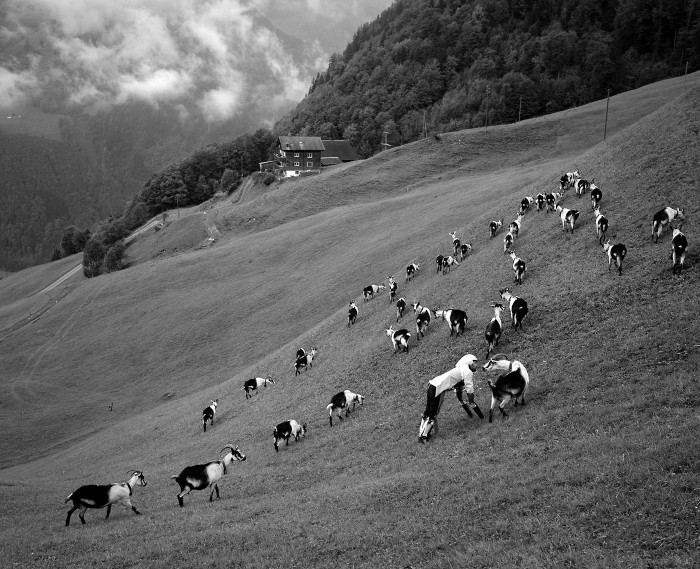
About a year after the moment of inspiration by the Thames, Thwaites was standing on all fours on a Swiss hillside. On his arms and legs, he had goat prosthetics, on his back – a Gore-Tex jacket in the color of goat hide, on his head – a helmet intended to give him a goat’s face at first glance. (For safety, he was forced to give up on cellulase; he planned to replace it by chewing grass during the day and stewing it in a pressure cooker on a campfire at night.) A few hours earlier, he had been running as hard as he could down a rocky mountainside with a herd of goats. It was exhausting and at times frightening. But now, in the green pastures, he was surrounded only by goats and mountain slopes. He mused:
Finally, I am living a goat’s life, which consists of approaching a tuft of grass and eating it for some five minutes. Approaching another tuft of grass and eating it. And so on and so forth.
Thwaites began to get to know “the subtleties of different types of grass: the bluish-green tufts of grass are bitter, but the greener green grass is sweet and much better.” As the day went on, he got into a rhythm: “Chomp, chomp, chomp.” In the end, he began to forget about himself. Other goats sniffed him; he sniffed back. One particular goat – goat no. 18 – became his friend. Goat friendship is “quite nice,” Thwaites informs.
I wander after her when she goes to another tuft of grass, and she does the same when I move to the next, not far behind me.
In the middle of the day, Thwaites made a mistake. He accidentally stepped higher up the mountain, above the rest of the herd – into the position of the leader. He writes that it was “like a moment in a Western when the whole saloon suddenly goes silent.” Panicked, he began to wonder if he could defeat a billy goat in a fight, but his new goat friend defused the tension by “simply walking through the group and starting to wander around.” Ultimately, Thwaites spent three days grazing with the goats. Later, the goat owner said that he thought Thwaites had been “accepted into the herd.” Thwaites took this probability sentimentally, even romantically, considering it a sign that the project was successful, yet he ended “GoatMan” on an uncertain note. On the last pages of the book, a grim photo report shows Thwaites in a goat costume alone, climbing toward the peak of a Swiss mountain. The photographs testify that, despite reading Heidegger, Thwaites has not managed to change the way he moves through the world. He is still a loner who uses opportunities and tools to reach the top.
Goats, of course, are domesticated; foxes are not, yet Foster managed to connect with them. As a fox, he made an enemy of a local house cat; one day the cat peed – Foster thought, quite contemptuously – on his fox hideout. Foster decided to take revenge. He hid behind a newspaper on which he had placed a chicken drumstick; when the cat grabbed the drumstick in its teeth, Foster “shot into the air with a Vesuvian roar.” Leaping over boards and a flower pot, he chased the cat to the end of the garden. The cat balanced along the fence, and Foster followed until the cat slipped behind the shed and from there into a side street. When Foster turned the corner, the tomcat was gone. Instead, however, he writes, “I looked up into vertical pupils in an elegant, red head two meters away.” The fox was sitting high on a wall, with the chicken drumstick in the corner of its mouth, gesturing to the whole world as if with a cigar. She held me with her gaze: most definitely she held me with her gaze, not I her. When she wanted to, she let me go.
These books are ironic: the more Thwaites and Foster try to turn into animals, the more they become Thwaites and Foster. That does not mean they haven’t changed themselves. The human *Umwelt* is expandable and extendable. Foster writes:
Real and lasting changes in our desires, fears, and beliefs are possible, but, in spite of these changes, the self remains. This ability to endure change is a miracle and mystery of personality. To ponder one’s existence, to dream of new ways of life, to take oneself apart and put oneself back together – these are natural human activities. They are our endless hunt.
© The New Yorker, May 30, 2016
Translated by Sandra Kuple
1 GoatMan: How I Took a Holiday from Being Human. New York: Princeton Architectural Press, 2016.
2 Being a Beast. New York: Metropolitan Books, 2016.
3 Are We Smart Enough to Know How Smart Animals Are? New York, London: W.W. Norton, 2016.
Article from the February 2018 issue of Rīgas Laiks magazine