


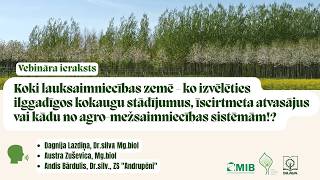
On 8 May, as part of the project "Support for the revitalisation of historic peat extraction sites", the Vidzeme Planning Region held the first of four planned field seminars, bringing together landowners, industry specialists and other interested parties at Rāķu Bog and Maitiņu Bog. The seminar looked at practical examples of how land can be put to a variety of uses once peat extraction ends – growing moss, growing large-fruited cranberries and growing organic highbush blueberries.
At Rāķu Bog, participants learned about the experience of SIA "Klasmann-Deilmann Latvia", presented by company representative Ieva Auniņa. The company continues to extract peat in part of the area while implementing various revitalisation solutions elsewhere on the site. The seminar included a demonstration of moss fields and large-fruited cranberry plantings, along with an explanation of how wet farming, or paludiculture, can help reduce peat decomposition and CO₂ emissions. Ilze Ozola, an expert at the Lake and Peatland Research Centre, stressed that raising the water level in peat areas does not simply mean flooding them – the aim is to keep the peat wet so that it retains its carbon while biomass can still be grown.
Rāķu Bog was presented to participants as currently one of the most significant examples of artificially created moss fields in Latvia. The company representative also explained that the site was never originally designed for industrial moss harvesting, so it serves more as a practical demonstration and research site. During the field visit, participants also discussed the growing interest across Europe in alternative substrates that could in future partly replace peat in horticulture. Experts noted that global demand for substrates will continue to rise, which is why sustainable solutions and alternative materials are increasingly being sought – and moss is one such solution.
At Maitiņu Bog, meanwhile, seminar participants learned about the experience of the "Dižoga" farm in growing organic highbush blueberries on a former peat extraction site. The farm's owner, Viktors Strāders, spoke frankly about the difficult early years of the business, the mistakes made and the practical challenges of growing berries on a peat bog. The farm grows berries and also propagates planting stock. The farm's representative stressed that organic growing certainly does not mean "doing nothing" – it demands very precise knowledge of plant health, soil, the water regime and the prevention of problems before they arise.
Highbush blueberries are one of the crops that need acidic soil, which makes peat bogs particularly well suited to growing them. The seminar highlighted that a peat environment offers blueberries clear advantages while also creating significant challenges. In the grower's experience, berries grown in peat are tastier, sweeter and keep better, but the work is made harder by the complex water regime, frost, drought and the difficulty of moving machinery around. Practical knowledge and experience have been key to the farm's development, including cooperation with growers in Poland. In Latvia, blueberry growers are paying ever closer attention to the winter hardiness of varieties, as some large-fruited varieties cope poorly with sharp swings in temperature.
Participants at the seminar discussed a range of solutions for mitigating climate risks in blueberry growing, including drip irrigation, irrigation against frost, hail protection options, shading solutions and other techniques that help reduce the risks posed by drought, frost, hail and overheating. The examples put forward for discussion also demonstrated the participants' broad knowledge and practical experience – those present actively shared the various solutions and technologies growers use to reduce weather-related risks and adapt to changing climatic conditions.
The economics were also discussed during the seminar. The grower acknowledged that selling fresh berries is the most profitable option, while processing is better suited to damaged or overripe fruit. Labour was another topic, since a large number of workers are needed to pick the berries during the peak season, though when the harvest is especially heavy, members of the public are also offered the chance to pick their own.
Experts at the seminar repeatedly stressed that there is no single revitalisation solution that suits every historic peat extraction site. The most appropriate future use depends on the type of peat, the water regime, the condition of the site and the surrounding environmental conditions. At the same time, the information gathered during the project also helps to assess which areas have already regenerated naturally and which no longer warrant the status of degraded land given the situation on the ground.
The field seminars are being organised as part of the Just Transition Fund project "Support for the revitalisation of historic peat extraction sites", implemented by the Vidzeme Planning Region in cooperation with the Kurzeme, Latgale and Zemgale Planning Regions. Further seminars will be held in the other planning regions throughout May.
The aim of the project "Support for the revitalisation of historic peat extraction sites" is to survey the historic peat extraction sites recorded to date that are in private or municipal ownership, in order to assess their current condition, including identifying areas that have already regenerated naturally or through deliberate intervention. Revitalisation strategies will be drawn up for those sites identified during the survey as suitable for revitalisation and whose owners have agreed to take part in the project. Landowners will be able to use these strategies in future to apply for European Union funding to carry out revitalisation work on their property.
More about the conditions for receiving support will be available at information seminars across Latvia. In Vidzeme, the seminar will take place on 27 May 2026 in Cēsis. Information: www.vidzeme.lv