



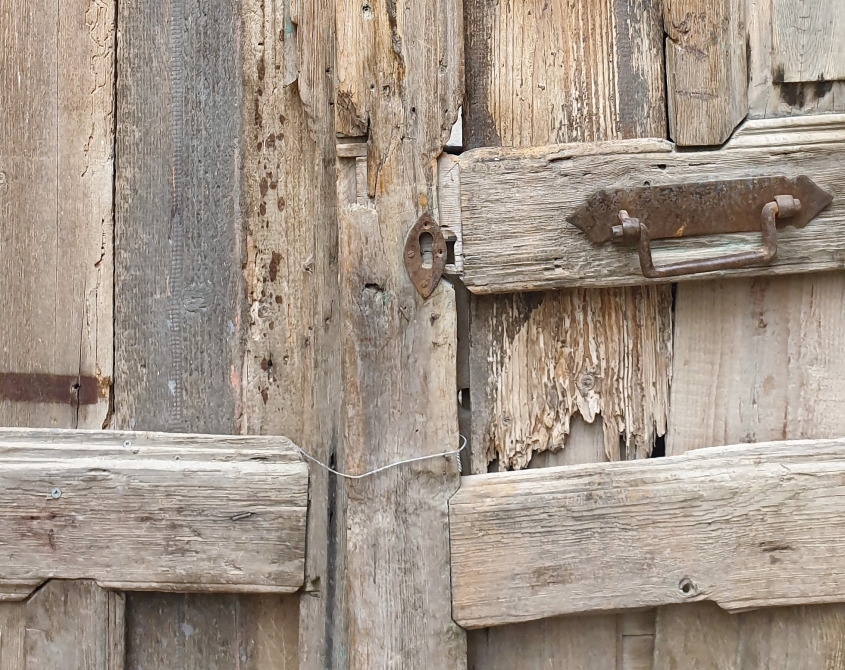
Planks and beams from old barns and buildings are finding a new lease of life as raw materials for the antique-look doors, wall panels, and light fixtures produced by SIA AW Latvia, with the company planning to build a new production facility.
“Approximately 95% of our net turnover is generated by the export of the wood products we manufacture ourselves,” explains Aivars Eglītis, a board member of SIA AW Latvia. He emphasises that the antique-look and oak doors are sold under the Wooden Door Design brand, wall panels and three-layer carpentry boards under the Wooden Wall Design brand, and various light fixtures – the company’s newest line of business – under Wooden Light Design.
“We are focusing on exporting our products because they are high-value and their appearance is highly appreciated in Alpine countries, where the lion’s share of our total production is sold,” says Inita Bendzule, sales director at SIA AW Latvia, when asked about their largest markets. She notes that customers primarily purchase the company’s products under the Wooden Wall Design brand through major sales platforms such as Amazon (amounting to approximately one million euros last year), though in recent years the company has been selling more of its products through its own website.
“E-commerce works well for us, but for long-term growth in Europe, that alone is not enough – the development of a strong network of dealers and partners is also essential. Nowadays, a manufacturer must be able not only to create a quality product but also to actively work with the market, customers, and partners, especially in the interior design segment where AW Latvia operates. Doors under the Wooden Door Design brand are primarily sold through distributors, although they can also be purchased and configured online,” says I. Bendzule in response to a question about the manufacturer’s ability to successfully sell goods under its own brands. She notes that, in practice, e-commerce means the company must keep the volume of wall panels ordered by customers in stock.
“Currently, the company warehouse holds approximately 12,000 m² of various types of wall panel products, which reach customers in Central Europe within three to five days, and within five to seven days in Southern Europe,” says I. Bendzule when asked about warehouse capacity and delivery times, explaining that it is more economically advantageous for the company to sell what it produces via its own website than to rely on large e-commerce platforms.
“Customers can assemble the wall panels themselves, just like a Lego (or furniture) kit,” says I. Bendzule when asked about assembly, noting that the company’s products can also be purchased in building supply stores in Latvia.
Giving a second life
The company mostly sources the planks, beams, and wooden structural elements from buildings at least 50 years old needed for the production of its items within Latvia.
“Latvia accounts for about 75% of the supply of this essential raw material, with the remainder being supplied from Lithuania and, to a lesser extent, Estonia and Poland,” A. Eglītis notes regarding the raw material sourcing area. He admits that they have partners in Lithuania who know exactly what kind of old planks, beams, and materials from old wooden buildings – such as barns – are needed, while in Latvia, the company buys elements from old,-derelict barns itself or offers building owners the chance to replace their old cladding boards with new ones.
“That is how old planks are given a second chance, or a second life, as otherwise they would simply be burnt or perish in the open air,” emphasises A. Eglītis. He points out that all old wooden planks, beams, and rafters at the facility are cleared of nails and other metal inclusions, the texture is cleaned of moss, and then the top layer is sawn off so it can be glued as a surface layer for doors and furniture boards.
“First, we take the longest, widest, and most textured old planks, which are used in the production of doors and three-layer carpentry boards – these are our products with the highest value-added and price. The shorter, narrower old planks serve as raw material for wall panel production, and all remaining small offcuts are used for lighting fixtures. This essentially creates a zero-waste technology that allows us to use old planks very sparingly,” explains A. Eglītis. He admits that the company needs about 500 old buildings per year to produce its output.
“There is enough, and there will be enough for many years to come,” A. Eglītis says when asked whether the amount of available old wood products will decrease in the coming years. In recent years, the company has also developed the production of oak products, diversifying business risks and expanding its product range with oak doors, three-layer carpentry boards, and wall panels.
Avoiding competitors
Although there is no shortage of competitors in the antique wood products segment, A. Eglītis notes that the company has managed to strengthen its market position and avoid direct competitive pressure.
“Products from Indonesia are available on the European market, and they are significantly cheaper than those manufactured by AW Latvia; a similar picture can be seen with products made in China. However, in Smiltene, we produce wall panels with various patterns that other manufacturers do not make, as they are complex and require a great deal of manual labour due to the lack of appropriate technology,” A. Eglītis reveals as his method for avoiding competitive pressure. He supports this by pointing to the sales volumes of products manufactured in Smiltene and sold under their own brands on the Amazon e-commerce platform, as well as the customer reviews posted there.
“Yes, there are manufacturers of similar products in Poland, but they focus more on the industrial sector, whereas AW Latvia operates in the premium product segment,” says A. Eglītis in response to a question about competitors in Poland. At the same time, he admits that turning old planks into expensive design elements and selling them successfully is by no means an easy task, as the market for such products is not vast, and the buyers are wealthy individuals who want very high-quality products. “As time passes, the preferences of potential buyers change, and we follow them very carefully,” says A. Eglītis.
The epic saga of the new factory
Several years ago, AW Latvia developed a development plan that envisages expansion and the construction of a new 800 m² factory for doors and three-layer carpentry boards.
“The plan was to start construction of this approximately €1.2 million facility as early as 2027, next to the existing plant, but a significant obstacle has arisen. Sadales tīkls, which had previously promised in writing to remove the overhead power line, changed its plans in 2026 and now promises to do so sometime within the next five years, even though the cables that duplicate this overhead line were buried in the ground several years ago,” A. Eglītis explains. He is surprised by the situation but hopes that a solution can be found so that the planned AW Latvia facility does not have to be located elsewhere. There was reason for hope following a remote meeting on 29 September with the management of Sadales tīkls, which was also attended by the executive director of the Smiltene municipality, Andris Lapiņš.
“We agreed that within the next two months, Sadales tīkls will inform us about the possibility of dismantling the overhead line next year – tentatively, this could happen in mid-2027. I am grateful to the municipal executive director, who actively defended and supported the company’s interests during the meeting,” says A. Eglītis.
“There is an option to locate the factory elsewhere – in Cēsis or the Valmiera industrial park – but that would result in a loss of efficiency, as we would need to duplicate the production manager and several staff members, such as forklift operators, which would increase production costs,” A. Eglītis says when asked what the company’s decision might be if the power line is not removed. He admits that he has tried to buy the real estate bordering the current facility, but none of the current owners wish to sell their land.
At least 20 additional jobs
By building the new facility, AW Latvia would increase its current staff of 47 by another 20-25 – bringing the total to around 70.
“There are many wood processing and food processing companies in the Smiltene area that need a large number of employees, and a labour shortage is felt throughout the region, but we will gradually attract the necessary staff for the new plant,” A. Eglītis says in response to a question about staff availability. He points out that it should be noted that in addition to the 47 people involved in production, about 15-20 people work in the dismantling of old barns – the procurement of raw materials.
“In total, the net turnover of all the group’s companies in 2025 was €5.5 million, of which €2.2 million was from the manufacturing company AW Latvia,” A. Eglītis says when asked about the total turnover.