




Brussels is known for its “strong winds”. Where policy is concerned, it seems clear that the wind from the European Commission's (EC or the Commission) Berlaymont headquarters will soon turn gusty.
The current Commission is paying more attention than its predecessors to improving European competitiveness and to the practical measures needed to meet climate targets, particularly with regard to the outlook for the industrial sector. Major changes in the geopolitical situation have also brought the goal of improving Europe's self-sufficiency and resilience to the fore.
The bioeconomy is an integral part of all these goals, and it enjoys strong momentum in the European Union. A year ago the previous Commission published a communication on promoting biotechnology and biomass production, which gave a good account of the challenges and opportunities facing the bio-based sectors.
One concrete step the Commission took in January to promote the bioeconomy was the launch of a new website. The site brings together information and links useful to companies in the biotechnology sector, especially start-ups — for example on the availability of EU funding instruments, patenting and obtaining official approval for new products. It is to be hoped that the current update of the EU bioeconomy strategy and the preparation of the Biotech Act will provide substantial support to the sector.
The forest sector is a significant part of the European bioeconomy. Wood is a European raw material, processed in Europe using European skills and knowledge. Thanks to innovation in the forest sector, Europe has access to renewable, recyclable and climate-friendly wood-based products and solutions that replace fossil materials and advance the circular economy. It is important to keep in mind the role of wood in Europe's strategic independence.
What exactly can wood and forestry offer Europe?
Answers to this question were provided by a recent study from the consultancy AFRY, which examined forest bioeconomy innovation and the ecosystem in Finland.
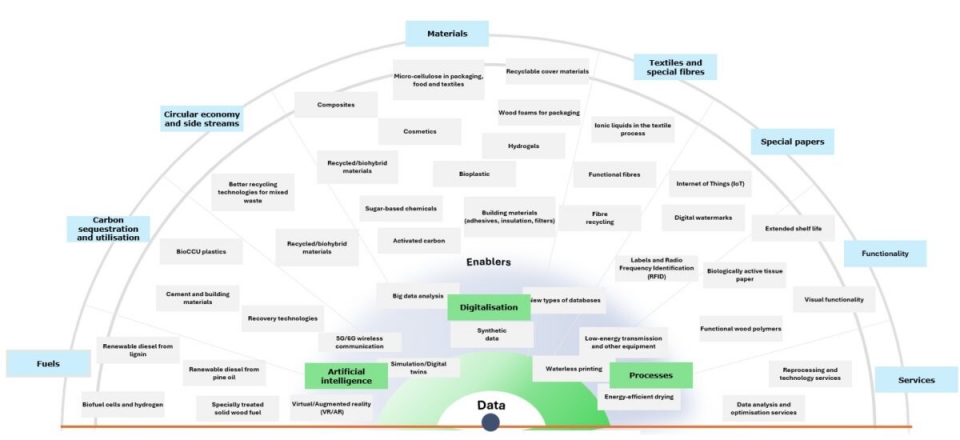 The forest sector innovation fan. Source: AFRY
It is interesting, and at the same time slightly surprising, that the central element in the image is not “wood” but “data”. The forest sector is of course a processor of wood and will remain so, but it is increasingly also a user and processor of data. One example is the sector's processing companies using the so-called internet of things and machine learning to automate processes, thereby reducing energy and water consumption and improving productivity. Data and artificial intelligence are also used at the start of the value chain, in forest management. This can improve forest productivity, for instance, and detect forest damage in good time.
The “Materials” section describes a number of innovations that make it possible to replace fossil materials with wood-based ones, including fuels, construction materials, cosmetics, and the use of wood foam and microcellulose in packaging.
It is easy to overlook the importance of stickers and labels on various kinds of packaging; yet they can improve food safety or prevent the counterfeiting of pharmaceutical products, for example. This is an area in which Finnish businesses have a great deal to offer the rest of Europe.
Finland leads Europe and ranks third in the world (behind the United States and Japan) in the number of patents relating to stickers and labels.
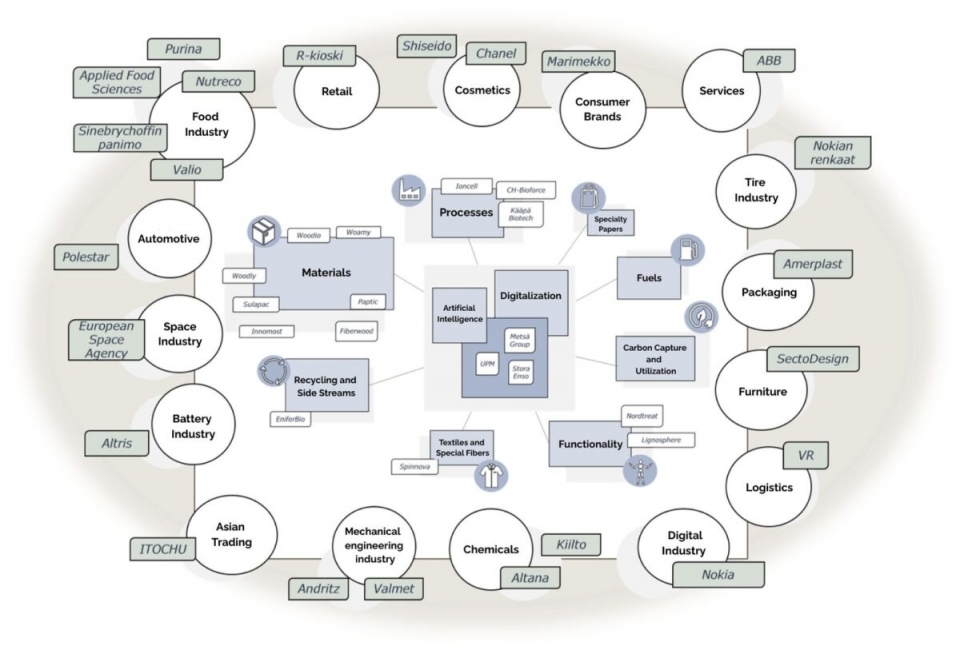
The forest sector ecosystem. Source: AFRY
What makes a successful forest sector ecosystem? Two aspects of the image depicting the Finnish ecosystem are especially important. First, it shows an obvious core made up of the sector's large companies. Second, many smaller companies branch out from this core. Large forest sector companies act as the driving force of the innovation ecosystem, for example by offering smaller companies access to research collaboration, funding, production platforms and international markets.
Widening the view and following the forest sector's branching links with other sectors, we see a broad network of interconnections of many different kinds. Some links with other sectors are well known, such as those with manufacturers of forestry or production machinery. Some may come as a surprise, such as the connection with retail. Picking up a sandwich wrapped in a transparent, breathable material made from wood is an everyday example of how the forest sector is replacing plastic and helping other fields meet their sustainability targets.
The forest economy and the forest sector have a great deal to offer Europe. Sustainable wood-based solutions help many other sectors meet their sustainability targets too, and they improve Europe's self-sufficiency and resilience. We are glad and happy to share our expertise, new materials and products for the benefit of Europe.
https://forest.fi/blog/opinion-competitive-edge-and-strategic-autonomy-for-all-of-europe-from-forest-bioeconomy/