
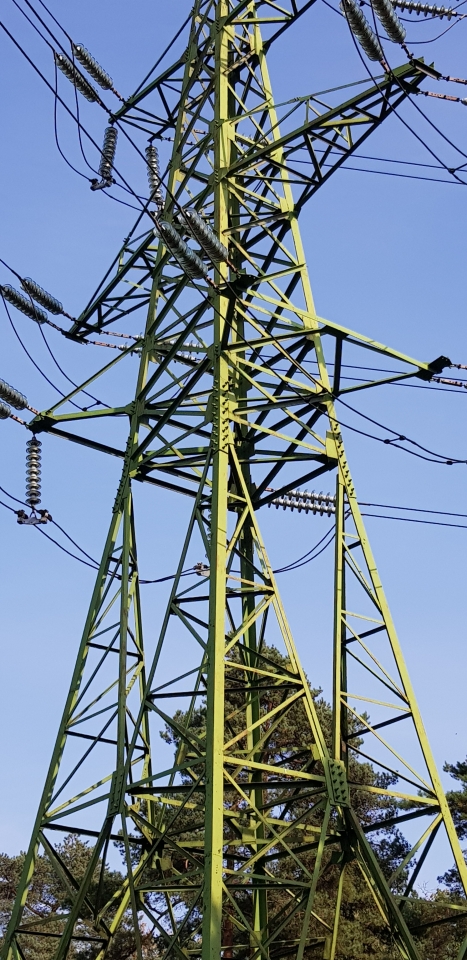
It seems this news has not yet reached Latvia's national media with sufficient prominence, but in Kuldīga municipality it has been discussed for some time already: the construction of a new 330 kV power transmission line Ventspils – Brocēni – Varduva/Telsi, specifically the section of the route planned to bypass Kuldīga. There is a great deal of uncertainty in the situation, starting with the fact that the project plan changed during the preparation of the Environmental Impact Assessment (EIA), two similar assessments of the local landscape were carried out in parallel, and, unfortunately, as is customary in Latvia, there has been no clear, understandable and mutually beneficial cooperation and coordination.
Is it clear why a new high-voltage power line loop around Kuldīga is needed at all, and why discussion of precisely this loop began so late?
The new power line bypass around Kuldīga is linked solely and exclusively to Kuldīga's UNESCO status. The point is that the structures planned for construction should not obscure or damage the classic view from Kuldīga's bridge. It so happened that while Augstsprieguma tīkli was having the Environmental Impact Assessment for the power line prepared (Basis for carrying out the environmental impact assessment procedure: Decision No. 5-02-1/49/2024 of the State Environmental Bureau of 20 September 2024 “On the application of the environmental impact assessment procedure and the transboundary environmental impact assessment”), the town of Kuldīga, in cooperation with the UNESCO institute (IHM, Institute for Heritage Management GmbH/Heritage Management Institute), commissioned a thorough study (Viewpoint analysis for the UNESCO World Heritage Site “Kuldīga Old Town”), so that the plans could indicate how far within Kuldīga's visibility zone, as seen by a person standing at the main viewpoints, wind parks would be permitted. (So that wind turbines would not spoil the landscape.)
The areas where they are planned are already known (both NW and SE of the town); for this purpose, both a thorough study and a visualisation have been carried out – showing how far away and how tall wind turbine towers could be possible or permissible. If the current landscape is damaged by industrial structures, everything associated with the town's image is damaged, and that is not acceptable.
I was surprised by the fact that in 2025 both the UNESCO study and the Environmental Impact Assessment relating to the power line were carried out in parallel, yet there was no communication between them. In my view, the researchers who carried out the meticulous work of assessing how the landscape would be affected by the wind turbine rotors could also have paid attention to one fact – if the new high-voltage line is planned to be taller (on higher pylons) and two or three pylons will be visible in the main view (from the old brick bridge, looking downstream on the Venta), the specialists dealing with the UNESCO heritage would immediately have explained that this should not be the case. With timely consultation, the environmental impact assessment would have been prepared taking this important circumstance into account.
At present it looks as though the many specialists involved in this literally monumental piece of work were guided by Augstsprieguma tīkli's original statement, namely that the existing route would be retained with only minor adjustments.
What is the biggest concern? Sub-variant 5, which includes a route loop through the forest, “appears” in the annexes to the EIA text; it must be said that this variant is rather clumsily worked into an already-finished report, and so, it appears, was added at the last minute. It is difficult to rework an already-finished report so that a later addition fits into it organically.
I cannot fault the work of the landscape specialist, who did an excellent job assessing Kuldīga on its own. The EIA assessment shows the same thing as the UNESCO work. I do not doubt the results, but what is it that we, the non-specialists, doubt? I will not speak for those people who are now confronted with the fact that a potential new power line, with a 54 m wide corridor cleared through the forest, will suddenly be right next to their homesteads. There are houses from which the new line will “appear” at a distance of around 150 m. These people's perspective and emotions are different, and I cannot represent them precisely.
I am speaking as a Kurzeme resident of Kuldīga municipality who drives across the bridge every day, glances left and right, checks the water level at the Venta rapids, and so on. What happens to the scales of judgment in this situation at that moment?
As a forester, I find the area (volume) of forest potentially to be cleared much more tangible and direct, compared with a situation in which I would have to look at two taller power line pylons for two or three seconds. I would add that we can also see the pylons of the “old (current) power line” from the bridge today; they are lower, but – I would stress – visible even today. It matters to me to gain clarity on whether I am assessing this situation objectively. In my view, someone is needed who could calculate, as precisely as possible, the benefit or loss involved if the high-voltage line were rebuilt from scratch, crossing forests and adding 7 km of construction (the existing route is around 13 km long, or around 20 km – with the bends; that is 7 km of conductors, poles and work), compared with another possible technical solution – whether a different pylon design, a different height, or a cable. Publicly available information shows that Latvia has a state energy standard describing cable lines with a voltage of 110/330 kV. The standard's conditions are available to anyone.
When we asked for the justification for why the route is planned through the forest, we heard: “Away (out) from the town, so it can't be seen! ...and a cable is supposedly expensive.” Please, give us the figures! In cost terms, how much forest will be lost compared with the expense of a cable? It must be remembered that the planned route touches on a Natura 2000 area, which is a separate story altogether. The current route does not touch the forest.
The specialists asked to mark the alternative route on the plan have done professional work, trying to avoid habitats as far as it is possible to bend such a wide corridor. In the end, around 0.5 ha of habitat will still have to be felled.
To raise another nuance – the new route is supposedly being shifted outside Kuldīga, “out of sight”, but a great many Kuldīga residents go to that very forest for walks, cycle there, run there, or walk their dogs there...
Listening to your account, I was reminded of a phrase heard at various times and in various places, and unfortunately still heard today, about the felling of Latvia's forests. This is a case where the forest will genuinely be cut down and will no longer exist; it will not regenerate, and no one will replant it.
Exactly – this is felling! It is a permanent reduction in Latvia's forest area. The total maximum area that may have to be cleared for the 330 kV route is 296.1 ha.
What else confused me? I am not a habitat expert, although more than 10 years ago I studied alongside people who went on to become experts able to “count nature”. The knowledge I gained lets me recognise that I know a good deal well enough. Reading the EIA findings, in the ornithology section I see – “there will be no impact”. In principle, there will be no impact on a single bird species. Really? A white stork certainly won't deliberately run into the wires, that's clear. On the black woodpecker – “there will be no impact”. The black woodpecker lives in that particular area, and old forest may also be felled there. How can that be? Will there really be no impact?
Here I encounter professional relativism. If this were private forest and the owner planned logging, they would certainly “get their knuckles rapped” – you're affecting the environment, you're shrinking the woodpecker's habitat, and so on. In the case of a high-voltage power line, human impact suddenly does not exist, because it is a large state project. I understand that, and so the bird has to give way. But! In my view, it would be honest to say that there will be an impact on the environment (and on the black woodpecker), but that we have to accept it, because the overall benefit outweighs the interests of one, five, or however many birds. It is not clear why the expert was compelled to write that there would be no impact.
That's a question for the expert. What does Kuldīga municipal council say about this, and have the councillors considered a cable as an alternative?
The council has not yet expressed a view. I should say that in our conversation we have gone in a loop and returned to the question – where is the problem. The problem lies in the fact that the municipality has not paid proper attention to this project, without assessing how people would react. You have to talk to people!
It is clear that the vast majority of Kuldīga residents and residents of the municipality will not search for or read the EIA documents online. You have to know how to find them...
...and be able to understand them, because they are not written in language everyone can understand...
I assume that, during the developer's public pre-consultation survey in 2025, the “ordinary Kuldīga resident” saw posters or read announcements in the press. What did they say? About plans to rebuild the 110 kV line as a 330 kV line. Fine – if the decision-makers judged it was needed, so be it! A total of 84 respondents took part in the public consultation across Kuldīga, Saldus and Ventspils municipalities, 22 of them in person in Kuldīga. I myself often take part in public consultations, and my experience shows that two or three people turn up from the public, while the rest are specialists from the municipality and representatives of the developer.
During the 2024 public consultation, the fact of the planned loop or bypass around Kuldīga did not appear. It appeared suddenly, becoming known on 12 February, when people who had unexpectedly received letters about the redesign of the high-voltage line affecting their properties took part in the public consultation. The rest of Kuldīga's residents, it seems, still think the new line will follow the old route. Why would I go to a consultation if it all concerns the old route?
So during the environmental impact assessment, is there no talking to local residents and no discussion of the situation with them?
The EIA annexes state – the instruction to mark and examine the new route came late and out of season... This is emphasised several times – certain actions have no point, because the new idea came so late that... for example, you cannot study bats or migratory birds in winter, because they are not there. It is recorded that clarifications must be made this year.
As for local residents, as far as I know, there has been no conversation with the owners of the two houses located right next to the potential route.
In the 21st century, that is neither understandable nor acceptable...
In short, dismantling the current power line reduces the impact on the residents of houses near the existing route, which is undoubtedly a benefit. The number of these residents is significantly larger than the number living in the two houses affected by the new route. What are two houses? ...
I may be wrong, but I have the impression that in Kuldīga municipality serious attention is paid to public consultation and residents' opinions. Wouldn't it truly be worth delving into the project as it takes shape and assessing the possibilities of using a cable? If you recall, our colleague Arvīds Ozols touched on this topic relatively recently, noting that it would not be enough to say “the number has fallen” or “something is disappearing”, but that specific figures need to be given. These days, “expensive” means nothing unless it is clear what it is being compared to.
Yes, absolutely! My request to everyone involved in this project: “Please find someone who can calculate – how much a cable would cost, how much – an alternative line with all its problems would cost.” After all – building a 7-kilometre route will in no way be cheap, and maintenance costs must also be borne in mind.
What, in your view, should be done next?
The public consultation has now concluded for the time being; in-person discussions are expected.
A very important nuance affecting our sector – the project's planners have not officially spoken with “Latvijas valsts meži”, whose land the new route will directly affect.
As I mentioned earlier, the idea came relatively late. The person who prepared the cultural-historical report genuinely walked the entire route from Ventspils to the Lithuanian border, conscientiously recording hillforts and other archaeological monuments on the ground, but, importantly, this serious work was carried out along the “old plan's” route. For example, the alternative variant affects ancient burial sites; they are mentioned in the EIA review, but were not surveyed on the ground (this can be concluded, since an archive photograph was used for this site alone).
The landscape architect has prepared excellent visualisations. Those cataloguing natural values have mentioned the need for further work. For example, people living on the right bank of the Venta know of several ancient oaks that somehow “slipped past” the assessors of the Venta valley; local residents themselves measured and photographed them and sent the information to the Nature Conservation Agency to have them registered.
To sum up, I have mixed feelings – if someone were to convince me that the cost of a cable would be disproportionately high compared with the 7 km loop, then let the loop be built. I am not preparing to strike a pose – insisting it must be this way and no other. People get used to changes in the landscape; after three or four years we will have forgotten what the forest looked like in that spot.
Incidentally, I cross the site of the new route every day, should it come to be built there. Having lived in this area for 40 years, I see how the forest has changed. At present it alternates between clear-cuts and young stands, which, as a forester, feels natural to me, because I know how everything will look over time.
In my view, the municipality needs to take the current situation into account and, so that nothing similar happens again, work out a way to communicate better with people. I do not think this was deliberate. I can only say good things about the municipality's leadership team.
It would be important to explain, look into things properly and reassess, by publishing and analysing specific figures.
How much will this cost Latvia and all of us? The extra route will be at our expense, on top of the forest that will neither grow nor produce timber. In a situation where we currently see an idle pier standing in the Daugava, the problems compound, because the long-standing inaction over, for example, AirBaltic and Rail Baltica, now takes on a different light. A discussion with competent specialists is very important – how many wind parks we need, what we gain, what we lose, who benefits, and so on.
The EIA text mentions – that once the power line route is completed (in the early 2030s), new wind parks will be able to connect to it; there is a direct link. You cannot connect large wind parks to a 110 kV line, the capacity is too small.
You are touching on a serious issue that the forest sector actively debates with others who pretend not to see the problem – how much and what we need. For some reason many people find this question uncomfortable, yet almost every matter, problem or situation has a certain capacity or volume. To quote Prof. Ilgu Kreitusi – “there are many things that have not been explained in plain language to the aunt in Bauska.”
Objective truth and the amount of money involved must be taken into account. If very large sums of money get involved...
...the truth can change.
Since I understand Swedish, I read the Swedish press and take an interest in what they write about wind parks. Sweden once shut down its nuclear power plants and built wind parks; the Germans did something similar. And – suddenly – it turned out that during winter anticyclones there is little wind, and electricity can run short. Today the Swedes are complaining loudly that electricity has become horribly expensive, with bills doubling or tripling, which, understandably, has been affected by the cold winter. Of course, that is Sweden's own problem, given how much everyday life and how many processes there rely solely on electricity, but... aluminium producers have fled from Germany to France (AES operates in France). Those in the know say there is a shortage of baseload capacity to even things out. These are complicated matters, but the many people involved in these processes, for whom persuasion is a profession and a livelihood, will do everything to convince everyone else that things must be done one way, and only one way is right. Because that is how they earn their living.