In Latvia, the majority of historical peat extraction areas have already regenerated naturally or been revitalised, while degraded areas require targeted restoration. The assessment shows that revitalisation is recommended for approximately one third of the analysed areas in municipal ownership, and for approximately one quarter of those in private ownership.
These conclusions are set out in two summary reports – “On the assessment of peat extraction sites in municipal ownership” and “On the assessment of peat extraction sites in private ownership”. The reports were prepared by the association “Baltijas krasti” on the commission of the Vidzeme Planning Region. They analyse the ecological condition of historical peat extraction sites, natural regeneration processes and the options for future use of these areas.
The aim of the assessment was to analyse desk-based data sets (i.e. by analysing already available data) on historical peat extraction sites, to identify areas where revitalisation activities should be carried out, and to establish which sites have already undergone natural regeneration or renaturalisation. The analysis drew on a range of geospatial data and information layers, and field surveys of the areas were also carried out.
Both summaries were prepared as part of the project of national significance “Support for the revitalisation of historical peat extraction sites”, which is being implemented with co-financing from the Just Transition Fund in the Vidzeme, Kurzeme, Latgale and Zemgale planning regions.
Areas in municipal ownership
In total, municipally owned historical peat extraction areas were analysed across 42 deposits with a combined area of 1417 hectares. Most of these areas are located in the Vidzeme statistical region – 938 hectares – followed by the Latgale region (219 ha), the Kurzeme region (193 ha) and the Zemgale region (67 ha).
The assessment shows that 916 hectares, or 65% of the analysed area, have already regenerated naturally or been revitalised as a result of targeted economic activity. Revitalisation is recommended for approximately one third of the areas – a total of 467 hectares, which makes up 33% of the areas analysed. Around 34 hectares, meanwhile, were classified as land unsuitable for revitalisation, for example roads, built-up land or areas with very little historical bog cover.
The largest area recommended for revitalisation is in the Vidzeme Planning Region – 269 hectares – while in percentage terms the highest proportion of areas requiring revitalisation was found in the Kurzeme region.
During the assessment, six potentially applicable types of revitalisation were identified for the degraded areas: renaturalisation, afforestation, creation of water bodies, paludiculture, and the cultivation of large-fruited cranberries or highbush blueberries. The most frequently recommended solutions are renaturalisation and afforestation, followed by paludiculture. The choice of the most suitable type of revitalisation took into account the hydrological condition of the area, the character of the vegetation, the thickness of the peat layer, the peat type and pH value, as well as the terrain.
The reports also note that in areas where subsoil use licences were issued after 1996 and which overlap with municipally owned land parcels, the “polluter pays” principle applies (responsibility for restoring the area rests with the operator). Such areas are not to be included in the list of publicly funded revitalisation measures. In total, municipally owned land parcels covering 227 hectares were identified to which this principle could apply.
The analysis found that in several deposits currently included in Annex 3 to the Guidelines for the Sustainable Use of Peat 2020–2030, the actual land use no longer corresponds to the characteristics of historical peat extraction sites. The report therefore proposes removing 82 hectares from that annex.
Areas in private ownership
The report analyses only those areas belonging to private parties – natural or legal persons. In privately owned historical peat extraction sites, most areas have already regenerated naturally or been revitalised. The analysis covers areas across 90 historical peat extraction deposits with a combined area of 8158 hectares.
The assessment shows that 76% of the areas have regenerated naturally or been revitalised, while revitalisation is recommended for 23% of the areas. The total area recommended for revitalisation amounts to 1892 hectares.
The largest analysed areas were found in the Latgale statistical region – 3798 hectares – followed by the Vidzeme region (2190 ha), the Zemgale region (1184 ha) and the Kurzeme region (986 ha). The areas recommended for revitalisation are distributed similarly: 823 hectares in Latgale, 508 hectares in Vidzeme, 335 hectares in Kurzeme and 226 hectares in Zemgale.
Six potentially applicable types of revitalisation were also identified for degraded areas in private ownership – renaturalisation, afforestation, creation of water bodies, paludiculture, and the cultivation of large-fruited cranberries or highbush blueberries. Several solutions may be recommended for a single land parcel.
The authors of the report also stress that the decision on the most suitable type of revitalisation must be taken individually for each area, taking into account the hydrological conditions, ecological condition and terrain of the particular site, as well as the interests of the landowners.
The report also assesses the “polluter pays” principle. In total, the areas to which this principle could theoretically apply amount to 1108 hectares.
At the same time, the assessment shows that in a large proportion of the areas, natural regeneration or targeted revitalisation has already taken place in place of the degraded peatlands. Such areas cover a total of 6198 hectares, which is 76% of all the privately owned land parcel areas analysed. Most often, natural bog vegetation has regenerated in these areas, or forest areas or water bodies have formed.
The assessment also found that some areas do not in fact correspond to historical peat extraction sites. The report therefore proposes removing from Annex 3 to the Guidelines for the Sustainable Use of Peat 2020-2030 a total of 477 land parcels located across 86 deposits with a combined area of 2285 hectares.
The reports provide the most detailed picture to date of the condition of historical peat extraction sites in Latvia. The information they bring together makes it possible to identify areas in need of revitalisation, as well as places where the bog environment has already regenerated naturally. The resulting data will be useful both for further research and for decision-making at national level, including in developing the Guidelines for the Sustainable Use of Peat for the next planning period.
Materials
In municipal ownership
Summary report on the assessment of peat extraction sites in municipal ownership (.pdf)
Data set: peat extraction sites in municipalities (.xls)
In private ownership
Summary report on the assessment of peat extraction sites in private ownership (.pdf)
Data set: privately owned historical peat extraction sites (.xls)
For further information
The summaries were prepared under the project “Support for the revitalisation of historical peat extraction sites”, co-financed by the Just Transition Fund. The project is being implemented under the European Union cohesion policy programme for 2021-2027, specific support objective 6.1.1 “Mitigating the economic, social and environmental consequences of the transition to climate neutrality in the most affected regions”, measure 6.1.1.1 “Phasing out the use of peat in energy production”.
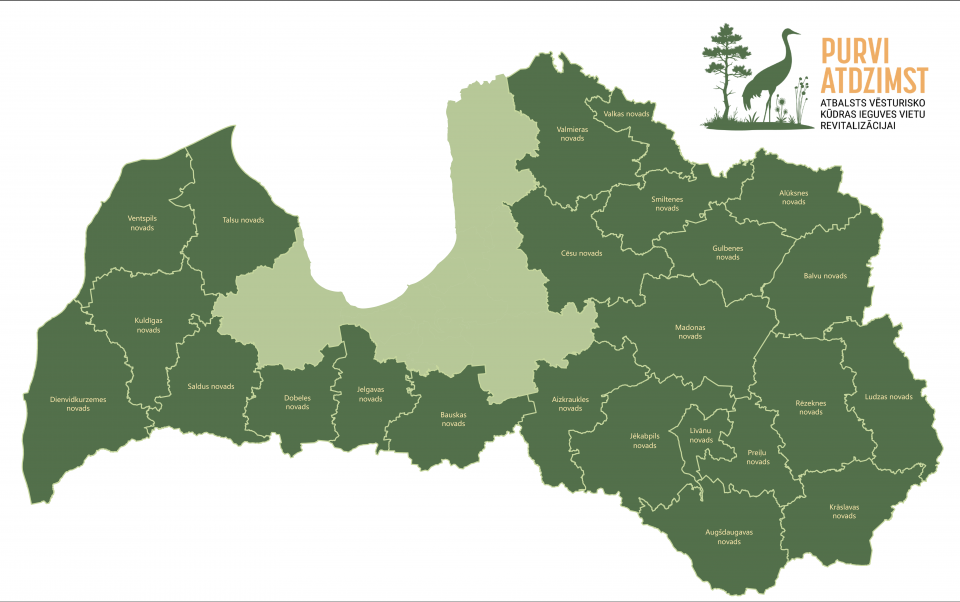
The project implementation areas correspond to the scope of the Territorial Just Transition Plan, which sets out the availability of Just Transition Fund funding for the Kurzeme, Latgale, Vidzeme and Zemgale statistical regions in accordance with the nomenclature of territorial units for statistics at NUTS level 3 in force on 25 November 2022.
The project does not include areas located in the state cities of Rīga and Jūrmala, or in the municipalities of Ādaži, Limbaži, Ogre, Ropaži, Ķekava, Mārupe, Olaine, Salaspils, Saulkrasti, Sigulda and Tukums.
 |
 |