


Representatives of Latvian municipalities and planning regions have been exploring various solutions in Ireland for restoring historic peat extraction sites and their future use. The Irish experience shows that there is no single solution for all areas. When choosing the most appropriate approach, one must consider the condition of the site and its restoration potential, as well as its future use, opportunities for the local economy, and the interests of the residents.
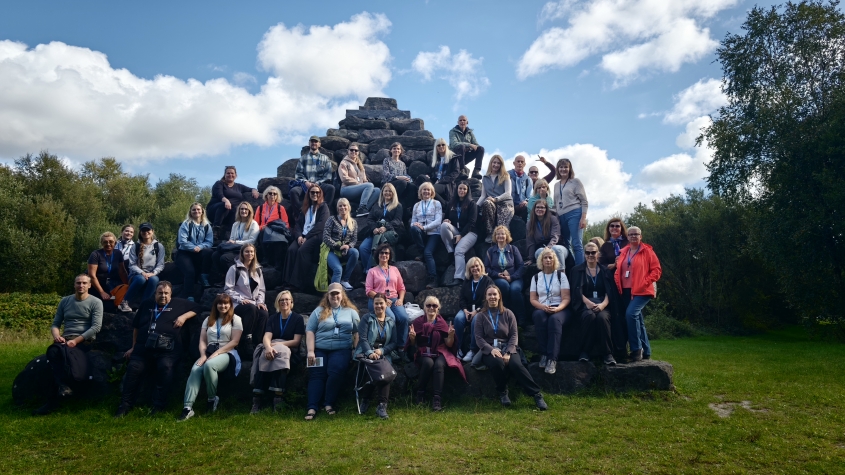
From 21 to 24 September, 40 experts from Latvia visited the Midlands region of Ireland for a study tour. The delegation included municipal representatives from the Vidzeme, Kurzeme, Zemgale, and Latgale planning regions, specialists from these regions, as well as representatives from the Ministry of Smart Administration and Regional Development and JSC “Latvijas valsts meži”. The visit was organised by the Vidzeme Planning Region as part of the project “Support for the Revitalisation of Historic Peat Extraction Sites”.
The Midlands region was selected for the exchange of experience with a specific purpose. For decades, peat extraction and its use in energy production provided jobs here and was a significant part of the local economy. After peat extraction ceased, the region had to address several interconnected issues – how to restore former extraction sites and how to use them in the future, while simultaneously finding new employment and business opportunities for people whose livelihoods were previously tied to the peat industry.
The project “Support for the Revitalisation of Historic Peat Extraction Sites” in Latvia is assessing the condition of these territories and their restoration potential. Therefore, it is essential for municipal specialists to see not only plans but also solutions that have already been implemented and their results several years after completion. The Irish experience also provided insight into solutions that did not yield the expected results in practice. For example, coniferous trees were planted in previously drained bogs, but this approach only dried the bogs out further. Meanwhile, attempts to restore raised bogs in areas where peat had been deeply extracted showed that after significant changes to soil and water regimes, this is no longer always possible.
“The Irish experience shows that the development of a territory does not end after peat extraction ceases. Depending on the site’s condition, both bog restoration and other types of use are possible. It is valuable for Latvian municipalities to see these solutions in practice and how they perform several years after implementation. This helps make more informed decisions about the future of our historic peat extraction sites,” notes project manager Maija Rieksta.
The sites visited demonstrated how diverse restoration solutions can be. In the former peat extraction site of Derrybrat, intensive extraction resulted in 6-10 metres of peat being removed right down to the limestone bedrock, significantly altering hydrological conditions. Therefore, it is no longer possible to restore the original acidic raised bog there; instead, an alkaline fen with reed beds is forming. After extraction ceased, drainage ditches were blocked and the water level was raised. Over approximately ten years, a rich mosaic of wetlands, grasslands, and birch stands has developed, where rare bird species have returned, including the common crane, which had been extinct in Ireland for over 400 years. The territory is also accessible to visitors – a walking and cycling path has been created along the route of a former narrow-gauge railway, and a bird-watching spot has been installed at the edge of the wetland. Alongside the restored area, a wind farm is in operation.
Meanwhile, in the Milltownpass and Cloncrow bogs, conditions suitable for raised bog restoration have been preserved. There, drainage ditches are being blocked and peat barriers created to raise and stabilise water levels. In the Cloncrow bog, the delegation was shown how restoration results are monitored by regularly tracking water levels and assessing vegetation changes. Mapping data clearly showed that within three years, the area of active raised bog increased by one hectare, with sphagnum moss and cottongrass returning rapidly. The restoration process is also complemented by the involvement of the local community – QR codes with stories from residents have been placed along the route, and school children are involved in studying the bog’s rarest butterflies and plants.
In Ireland, the delegation also learned about different bog management models. In the Tóchar project, the restoration of fens is based on voluntary cooperation with private landowners and farmers. In contrast, the raised bogs of Milltownpass and Cloncrow are managed by the National Parks and Wildlife Service of Ireland, in cooperation with local communities.
Special attention is paid to residents who historically had the rights to extract peat in these territories. To stop peat extraction in protected bogs, residents are offered compensation and other solutions, including the opportunity to extract peat in a different area. Local communities are also involved in maintaining the restored bogs and educating the public. This experience shows that in bog restoration, not only are technical solutions important, but so is timely agreement with the people whose interests are affected by the changes.
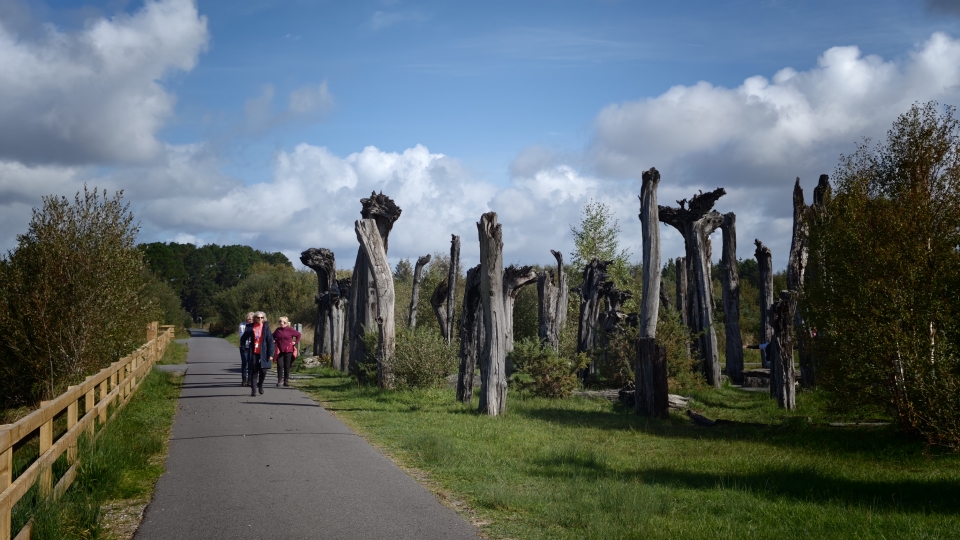
In Ireland, new ways of using restored peat extraction sites are also being sought. One of the most prominent examples is Lough Boora. It is a former industrial peat extraction site covering approximately 2000 hectares, which has been transformed into a nature and recreation area with a network of approximately 50 kilometres of walking and cycling routes. The site’s industrial past has not been erased – old rails, railway sleepers, and other peat extraction infrastructure elements have been used in outdoor artworks.
Lough Boora is not an isolated tourist attraction, but part of a broader development approach for the Midlands region. The Irish tourism development agency Fáilte Ireland, with the support of the EU Just Transition Fund, is implementing a 68 million euro programme for the development of sustainable tourism. From this, 30 million euros are earmarked for the development of interconnected walking and cycling routes in former industrial peat extraction sites. For this purpose, the infrastructure of the former narrow-gauge railway is also being used. The routes connect former extraction sites with towns, villages, and other attractions. This approach shows that a former peat extraction site does not have to be developed as an isolated tourist site – it is possible to include it in a wider network of routes and services, creating benefits for local businesses as well.
At the Technological University of the Shannon, the delegation became acquainted with the work of the Just Transition Academy and research related to the cessation of peat extraction and new development opportunities in the region. The academy was established with the support of the EU Just Transition Fund to provide training and retraining opportunities for residents in territories that have long been dependent on peat and fossil fuel extraction.
The university is also researching new economic activity opportunities in former peat extraction sites. In the Mount Lucas territory, where a wind farm is now also located, fish and aquatic plant farming is being tested in an integrated circular system. Nutrients generated from fish farming enter the water, which is then channelled to aquatic plant cultivation fields. The plants absorb these substances, purifying the water, which then returns to the fish farming system. The harvested biomass can be used, for example, in animal feed and for the production of other goods. The demonstration project is testing whether such a management model can be used in former peat extraction sites.
The delegation also became acquainted with the ReShape skills platform. Within it, a person can assess their existing skills, while the system compares them with the skills required in various professions, helps identify which knowledge and skills are lacking, and finds suitable training. Such an approach is particularly significant in a region where, following changes in the peat industry, some residents need to find opportunities to apply their previous experience in other work.
Some former “Bord na Móna” employees are using their existing skills in bog restoration work. Workers who operated tractors and excavators in peat extraction now use this machinery to carry out the work necessary for rewetting bogs. This is a concrete example of how skills accumulated in the industry can be used even after peat extraction has ceased.
A just transition affects not only the territory and local economy but also the people whose work and daily lives have been tied to the peat industry for decades. This is particularly vividly shown by the Cloontuskert village, which was established in the 1950s by the state company “Bord na Móna” for peat extraction workers and their families. Over several generations, peat extraction provided work here and became a significant part of community life.
Local residents acknowledged that after industrial peat extraction ceased, some former employees initially perceived the rewetting of the bogs as the loss of the result of their previous work. Therefore, alongside bog restoration, attention has also been paid to dialogue with the local community and the preservation of industrial heritage.
One way to involve residents in the transition process is the “Bog Bothy” project. At its heart is a mobile wooden cabin that travels through the bog communities of the Midlands in 2026 and becomes a place for conversations and events about the past and future of the bogs. Stories of former peat extraction workers and their families are also being collected, documenting the history of the site and the people’s connection to the peat industry.
The Cloontuskert experience shows that in places where peat extraction has long been a part of people’s work and community life, bog restoration work alone is not enough. It is equally important to involve local residents in a conversation about the changes and the future development of the territory.
The experience gained in Ireland allows Latvian municipalities to compare various solutions before decisions are made about the future of historic peat extraction sites. The visit showed that there is no single solution for all territories. Depending on the site’s condition, the restoration of a bog or wetland is possible, while in other places, the territory can be used for recreation or new economic activity. When choosing the most appropriate solution, cooperation with landowners and local residents is also essential. After the work is carried out, it is necessary to track the results and evaluate whether the chosen solution is working.
The project “Support for the Revitalisation of Historic Peat Extraction Sites” is being implemented within the framework of the European Union Cohesion Policy Programme 2021-2027, specifically under support objective 6.1.1 “Mitigation of the economic, social, and environmental consequences of the transition to climate neutrality in the most affected regions”, measure 6.1.1.1 “Phase-out of peat use in energy production”.
The project’s implementation territories are consistent with the scope of the Territorial Just Transition Plan, which determines the availability of Just Transition Fund financing for the Kurzeme, Latgale, Vidzeme, and Zemgale statistical regions in accordance with the NUTS level 3 statistical territorial unit nomenclature in force on 25 November 2022.
The project does not include territories located in the state cities of Riga and Jurmala, or in the municipalities of Ādaži, Limbaži, Ogre, Ropaži, Ķekava, Mārupe, Olaine, Salaspils, Saulkrasti, Sigulda, and Tukums.