



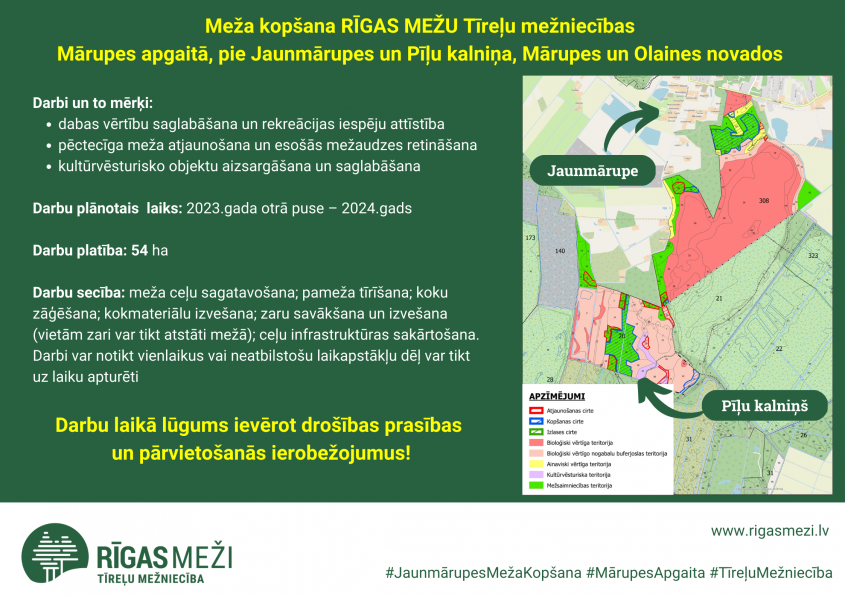
In the second half of this year, forestry management and harvesting work will begin in the Tīreļi Forest District of “Rīgas meži”, near Jaunmārupe. The work will be carried out in accordance with an environmentally friendly method – the landscape design plan – as well as the company’s “Forest Management Plan” (FMP), which places greater emphasis on preserving biologically valuable, natural and recreational areas, while reducing the areas used for intensive forestry.
Logging operations will take place in the Mārupe circuit of the Tīreļi Forest District – in the forest stands near Loka road in Jaunmārupe, Mārupe Municipality, and near the “Pīļu kalniņš” recreation area in Olaine Municipality.
Regarding forest landscape design plans
This is a new and more nature-friendly approach to forestry in Latvia, which contributes to more sustainable forest development and the preservation of natural values. “Rīgas meži” is a pioneer in its application. Specifically, before work begins, the forest is surveyed, assessed and divided into zones. Subsequently, a specific harvesting and forest management method is determined for each zone to ensure it remains aesthetic in the long term, to promote regeneration, and to ensure that existing natural values are preserved.
To date, forestry work in this manner has been carried out in the company’s Rīga Forest District, for example, in the Jugla forest in 2021/2022, as well as in the Gauja Forest District, near Ādaži and Ropaži.
Regarding forest management in Tīreļi Forest District
The Tīreļi Forest District is the largest forest district of “Rīgas meži” – over 23,000 hectares. It is rich in bogs, the largest and most well-known being Cenas tīrelis. It is part of the Natura 2000 network of specially protected nature areas and is one of the most unique bogs in Latvia.
The forest district includes the “Melnā ezera purvs” nature reserve and “Beberbeķi” nature park, which are also part of the Natura 2000 network of specially protected nature areas. The Tīreļi Forest District also contains many other various bogs not included in the lists of specially protected nature areas, such as Rāvājs, Medema and Ēbeļmuiža bogs.
Logging work in the Tīreļi Forest District will be carried out in accordance with the established landscape design plan and is special in that previous landscape design plans in other “Rīgas meži” forest districts did not feature cultural-historical territory zones, which are characteristic specifically of the Tīreļi Forest District. For instance, it is home to such cultural-historical values as Christmas Battle sites, the fortification system including Pluģi redoubt, the Ostvalds memorial stone and other cultural-historical objects.
-
Aim of the work: preservation of natural values, development of recreational opportunities, successive forest regeneration and thinning of existing stands.
-
Planned work period: Second half of 2023 – 2024.
-
Area of work: 54 ha.
-
Sequence of work: preparation of forest roads for transport requirements; clearing of undergrowth; felling of trees; extraction of timber; collection and removal of branches (as necessary, in some places branches may be left in the forest); maintenance of forest road infrastructure. Work may take place simultaneously or may be temporarily suspended due to unsuitable weather conditions.
Before logging operations, in order to promote the sustainable development of the areas, a functional zoning of the forest stands has been created – biologically valuable areas, buffer zones for biologically valuable blocks, forestry areas, and cultural-historical areas. These zones highlight landscape elements and take into account forest values and recreational opportunities. When carrying out the work, the principles of responsible and sustainable forest management, as determined by the international certificates awarded to “Rīgas meži”, will be observed.
The forest stands where the work will take place are unique in that they have a relatively high concentration of biologically valuable sections. Therefore, extra attention will be paid during logging, and the work will be carried out particularly carefully. These forest stands also contain the Enduro moto trail created by “Rīgas meži”, which is available free of charge.
Before the commencement of logging, “Rīgas meži” provides information about the planned work and the functional zoning of the forest stands.
Biologically valuable area:
-
Aim of the work: to protect and preserve the area, which has high biological value and natural habitats – active raised bogs, degraded raised bogs, swampy forests and other biologically valuable areas.
-
Planned work: in accordance with the FMP and the findings of habitat experts, management restrictions and prohibitions have been set here. Tree felling in this area will only be carried out in cases where it is necessary for infrastructure maintenance, having been coordinated in advance with nature conservation specialists.
Buffer zone for biologically valuable blocks:
-
Aim of the work: to maintain a protective belt around the blocks of biologically valuable areas. This zone is created in areas of concentrated natural forest habitats, where felling plans are assessed and recommendations for the preservation of natural values are provided by a “Rīgas meži” nature and environmental protection specialist.
-
Planned work: taking into account the necessary spatial and seasonal restrictions, regeneration felling may also be planned here. Work will not take place here during the bird nesting season.
Forestry area:
-
Aim of the work: carrying out economic activities in accordance with the FMP and the forest landscape design plan, ensuring the management of the main tree species – pine, spruce and birch, the regeneration of felling sites, as well as the creation of a sustainable forest landscape.
-
Planned work: during regeneration felling, existing natural values and additional ecological trees (vigorous trees of the previous generation or trees with a diameter larger than the average diameter of the dominant species in the block) will be preserved. Ecological trees will be concentrated in one or more groups. In addition to groups of ecological trees, individual larger-dimension trees from the main stand or individual ecological trees of the previous generation will also be preserved. Likewise, undergrowth of pine, spruce, oak and lime, as well as juniper and hollow trees, will be preserved.
Cultural-historical area:
-
Aim of the work: to protect and preserve culturally and historically significant objects, such as the First World War network of trenches and dugouts. This zone is created in places where cultural-historical objects are concentrated, where felling plans are assessed and recommendations for the preservation of cultural-historical objects are provided by a “Rīgas meži” nature and environmental protection specialist.
-
Planned work: at a lower intensity and paying special attention to the preservation of cultural-historical values. In these areas, ecological trees will be grouped in the immediate vicinity of cultural-historical objects to be preserved, to prevent the risk of damage to the objects resulting from forestry work. Similarly, ecological trees will be preserved, under which, as throughout the entire block, undergrowth of pine, spruce, oak and lime will also be maintained.