

Eurostat data show that Europe's forests are growing faster than they are being harvested, with Romania, Sweden and Poland leading the way in the increase in timber volume.
Forests cover vast areas of Europe, from the boreal conifer forests of the Nordic countries and the Baltics to the broadleaf forests of Central and Eastern Europe. The latest Eurostat data confirm that in 2023, in 23 of the 24 European Union member states for which information is available, timber growth exceeded the volume obtained through harvesting. Only one country – Estonia – ended 2023 with a smaller growing stock than at the start of the year. The conclusions were drawn from Eurostat data, which record the difference between net annual increment and timber harvesting and present it as an indicator of sustainable forest management in the European Union.
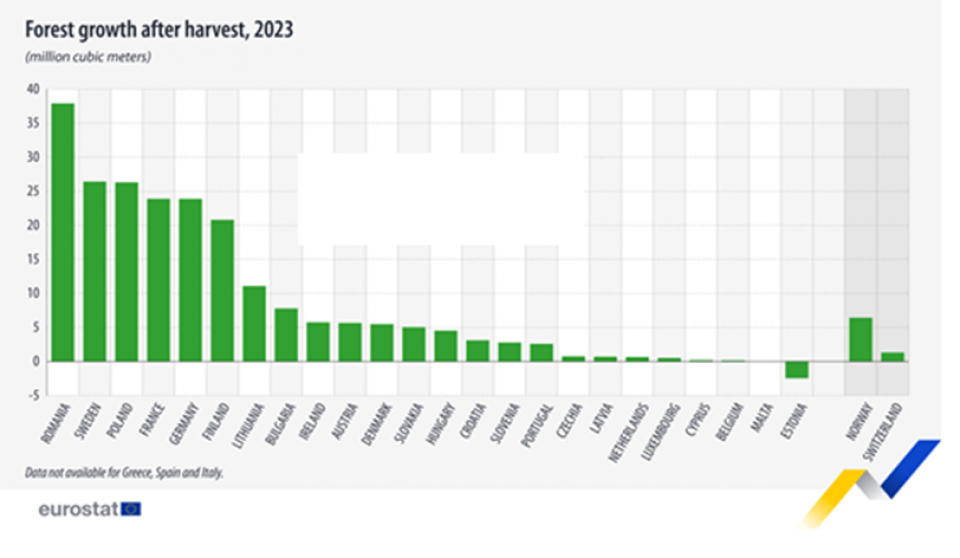
The largest annual increase in timber was recorded in Romania, where over the course of the year the growth in growing stock exceeded the volume harvested by 39.9 million cubic metres, followed by Sweden with 26.4 million m³ and Poland with 26.3 million m³. In Estonia alone, unfortunately, the situation was different. Timber extraction in Estonia reached 11.6 million cubic metres, while natural growth was only 9.1 million m³ – that is, available timber stocks fell by 2.5 million m³ over the year. Taking into account natural losses alongside timber extraction – forest fires, windthrow, pest damage – Ireland led the European Union in growing stock increase at +3.6%, followed by Denmark. It should be acknowledged that Denmark has a very small total forest area, and the country's largest stands are on the small island of Bornholm in the western Baltic Sea.
Portugal, meanwhile, showed the highest rate of forest growth in Europe – 11.1% – driven mainly by eucalyptus plantations and intensive reforestation. "Around 36% of our territory is forest. Forests and shrubland together make up 69% of Portugal's total area," said Portuguese Prime Minister Luís Montenegro, presenting the country's Forest Action Plan through to 2050. Some 6.4 billion euros have been allocated to implement it. The Prime Minister stressed: "A country that does not care for its forests does not care for itself."
The Eurostat methodology covers only deliberately harvested timber, excluding unforeseen losses caused by natural disasters. This distinction separates the impact of forest management from that of natural disasters, which they introduce into the broader timber harvesting figures. Complete data are still not available for Greece, Spain and Italy, which means that a comprehensive overall picture for the European Union is not yet possible.