




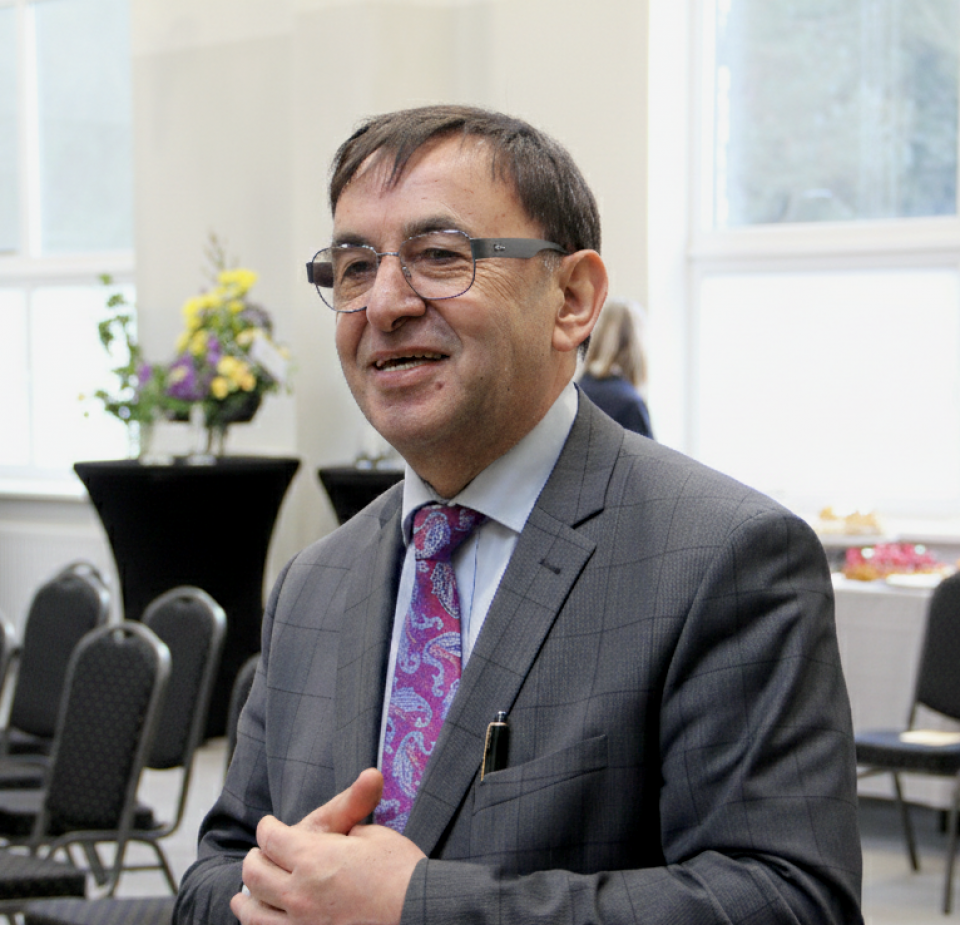
Rafaels Joffis is interviewed by Māris Liopa, director of zemeunvalsts.lv , the Latvian forestry and related-industries portal, and Pauls Rēvelis, zemeunvalsts.lv editor.
When we agreed in mid-January to meet for this conversation, you spoke with evident satisfaction about the opening of the Bulduri Arborist Centre, which took place on 11 February. What is the significance of this centre, both for the school and for the industry?
Although the arborist specialty is relatively new, we have been offering it at Bulduri Technical School for quite a while now. Since this is a specific and expensive profession – both the equipment and the gear require considerable funds –, high-quality specialist training critically needs a stable material and technical base. By combining the school's own funds with substantial support from the Ministry of Agriculture, we found a suitable building on the grounds of Bulduri Technical School and built a modern training wall, or climbing module, in it. Here it is possible to fully learn and practise everything arborists need in their everyday work, and in summer an invaluable advantage is our historic park with its ancient trees, which serves as an excellent open-air training ground.
The next step in infrastructure development, also planned with support from the Ministry of Agriculture, is insulating this building. The project has been prepared, and once it is carried out the premises will be fully in order. We have discussed the situation in the sector with colleagues in the Baltic states and Scandinavia, and we can proudly conclude – we are currently the largest and most modern centre of this kind in the entire Nordic and Baltic region.
Looking back at the history, thanks are due to Andris Spailis, former director of Ērgļi Technical School, who, so to speak, brought professional arborist training to Bulduri. Later, turning to business, he passed the baton to certified arborist and programme director Daiga Strēle, who has successfully and purposefully continued what he started. Having put both the documentation and the infrastructure in order, we successfully completed the centre's certification process. We are currently both a training centre recognised by the certification body and an official arborist certification centre.
We see a great deal of international interest. In January we were visited by representatives of two Lithuanian arborist associations, interested in training opportunities for specialists from the neighbouring country in Bulduri. We agreed that we can provide such training. There is, however, a small technical challenge related to issuing diplomas – the law requires that teaching and examinations at the school take place in the state language, and we are actively looking for a solution.
Taking a step towards closer cooperation, on the day the centre opened, 11 February, we signed a memorandum of understanding with our Lithuanian colleagues, which will allow us to join forces in carrying out joint projects, since strong internal competition is felt in the sector in both Latvia and Lithuania. The further goal is to bring in all three Baltic states, so as to jointly improve the training process and carry out international projects.
Talking about the proper care and preservation of trees, which is one of an arborist's professional duties, disputes often arise because non-specialists do not understand this work. It happens that an arborist's work gets confused with the duties of a forest worker, and so on.
Tree care often becomes a challenge on municipal properties and in public parks. In order to save money, municipalities bring in loggers, or “sawyers”, who lack the specific prior knowledge and understanding of maintaining trees in an urban environment. Such practice can cause irreversible damage to nature, so it is vitally important to entrust this work to properly trained professionals.
In landscaping, every specialist has their place: the gardener grows, the landscape construction technician installs, but the tree-care arborist looks after trees throughout their lifetime. To ensure the full and sustainable management of parks, a mid-level professional is needed – a highly qualified specialist who understands both gardening and park planning, as well as their installation and maintenance.
In response to demand from the sector, Bulduri Technical School will reinstate the “landscape gardener” specialty; the programme's content has been designed by integrating best European Union practices, in order to prepare specialists with excellent theoretical and practical skills, as well as the ability to independently lead a team's work. To ensure flexible educational options and help municipalities quickly gain high-calibre professionals, the programme is offered in two formats: for young people after 9th grade the studies will last 3.5 years, while for secondary-school graduates a focused, intensive year-and-a-half course has been created.
In practice we see that even university graduates who have gained strong academic knowledge choose to build up their skills at Bulduri, in order to learn how to apply theory in a real working environment.
The educational path does not end with graduation from the school. Thanks to successful cooperation and an agreement concluded with the Latvia University of Life Sciences and Technologies, Bulduri graduates can continue their studies in state-funded university places and become landscape architects, agronomists and foresters.
Bulduri Technical School is open to dialogue and invites municipal representatives to talk, so that together we can train the necessary specialists and create a sustainable, well-tended environment throughout Latvia.
Before we began the conversation, you mentioned that a graduate of Bulduri Technical School is continuing their studies at the Latvian Academy of Music. Gardens and music are closely related fields; a good example in Latvia is the lilac garden in Dobele and the music festival held there.
We often emphasise practical skills, but it must not be forgotten that landscaping is also an art. Gardens and music are very closely related fields – in both you must feel rhythm, harmony and composition. Our graduates are endlessly creative, and the knowledge gained at Bulduri is flexible and adaptable to any situation in life. We are truly proud that our graduates' paths are very diverse – one of them is indeed currently studying at the Academy of Music! This confirms that we prepare not only good masters of the trade, but also versatile, creative personalities ready for life.
How did you come to Bulduri Technical School? What did you do before that?
Before I began working at Bulduri, I already had considerable experience in organising and managing large systems – out of the Soviet-era laboratory system I built what is now the well-known scientific institute “BIOR”, substantially harmonising the state laboratory network. After that I worked for four years at Riga Technical University, where I was involved in technology innovation and cooperation with the relevant industry.
One day I saw an advertisement inviting applications for the position of head of what was then Bulduri Secondary School of Horticulture. I thought – that would be interesting, new opportunities! I took the useful advice to first go and see what was happening there and how. I arrived, took stock and realised: there would be a great deal of work, but the opportunities for development were huge. So I entered the competition, and I won it.
In 2017, when I first crossed the threshold of Bulduri Technical School, the picture was harsh. It was the 21st century, but the school's infrastructure was stuck deep in the grim legacy of the nineties. The school's operations rested on one “patched-together” garden tractor and ten spades, and the pipes had been brutally sawn out of the buildings... Back then, only 140 brave young people studied here.
Many thought this place was “doomed”, and there were plans to quietly privatise it. But we, in cooperation with the Ministry of Agriculture and industry enthusiasts from the Bulduri school development association “Par Bulduriem”, decided otherwise.

Today we are talking in an educational institution that has undergone a complete renaissance. From “sawn-out pipes” we have grown into an officially registered scientific institute, the “Bulduri Biotechnology Centre”. Our young people learn green skills in modern meristem and agrochemistry laboratories. We take part in numerous European fund projects, and our renovated greenhouses bloom for the whole of Jūrmala and Latvia. We give our students knowledge that makes them competitive across the whole of Europe.
Bulduri Technical School operates like a business, well aware that our success depends on our own hard work and our ability to integrate innovations and attract project funding. Although we are developing purposefully, we still face an unfair distribution of state funding and bureaucratic obstacles – we currently receive a state grant that is 10% lower than vocational education institutions under the Ministry of Education and Science (IZM). Thanks to the support and understanding of the Ministry of Agriculture, we are able to provide places for 25 more young people, but our efforts to achieve a fair allocation of budget places from the IZM side have already for ten years run into deaf ears. The freshest example of this wall of bureaucracy is Olaine College of Technology: when the scope of its study programmes was reduced there, we proactively offered our readiness to integrate part of them into our own process, so as not to lose a valuable educational offering, but we received a categorical refusal with no room for discussion. Even so, these challenges do not stop us – we keep growing, and through our work we prove that green skills are part of the foundation of business, science and our country's future.
Do you have any idea why that is?
I assume the Ministry of Education and Science is comparable to a closed circle, where budget places are primarily allocated only to schools under the ministry's authority. It must be said that this situation, where schools outside the ministry's system cannot increase the number of state-funded students, has only made us considerably stronger. It has forced us to work even more actively ourselves, write project applications and earn our living. In today's economic situation we have become an excellent and positive example of how an educational institution can operate successfully and survive, because it is vitally important for us to safeguard the values of the Bulduri school of horticulture, built up over centuries. This need to prove ourselves is a good, positive stimulus for further development.
I especially want to stress how very, very proud I am of the Bulduri Technical School team! We have an excellent microclimate, and people's sense of responsibility is remarkably high. It often happens that a colleague goes on holiday but still checks in every two or three days to find out what's happening during their absence. Such a team is fully capable of meeting the high quality standards the school has set, both in teaching and in production processes. The heads of our study programmes are highly qualified professionals who come directly from the relevant industry. So it is no surprise that our students take first places in competitions between educational institutions and also compete successfully at the European level.
A particular source of pride is our florists – they are without doubt the best in the Baltics. As is well known, the Pope has visited Latvia twice, and on both occasions it was precisely our florists' team that created the floral and plant decorations, including the splendid decoration of the Aglona Basilica. Seeing this high quality, they are also regularly invited to other large and significant events in Latvia. Overall, working at the school and our current situation give me only positive feelings. There is only one eternal question: how to develop, how to move forward, and how to reach the official level of a centre of excellence? We are working towards that.
What are the school's immediate plans, at least those you can reveal?
One of our most important directions is linked to the Lifelong Learning Centre, where, by investing serious resources, we have developed a specialty that is now very topical and in demand – the construction and restoration of log buildings. This programme is already attracting enormous international interest. People come to study with us from all over Europe, Canada and the USA.
We recently won a significant project in which we led training for representatives of nine European countries. Log-building specialists used to be trained at the now-closed Ērgļi Technical School, but today this field needs to be thought about much more broadly. Timber building construction and an ecological approach are becoming ever more popular worldwide, and demand for such craftsmen will only grow. For the training to be truly high quality, excellent equipment is needed, which, like arborist equipment, is very expensive. Here I must especially praise our project writer Aija Livmane – thanks to the work she has put in, we have been able to secure an appropriate technical base. If Latvia's large timber industry companies buy the most expensive equipment from the “top shelf”, then our equipment can steadily be rated from mid-level upward, which is entirely sufficient to train excellent log-building restorers in the Bulduri Wood Workshops. Our immediate plan is to develop the training of these unique, globally sought-after specialists even further, strengthening Bulduri Technical School's position for the future as well.
So there are plans, and the planning process doesn't stop.
It can't be otherwise, but that does require a little support. Our maintenance costs are considerable, and although the Ministry of Agriculture helps us by covering all day-to-day expenses, not much is left over for development. If we were a “normal business” able to invest freely, the picture would be different, but at the moment this financial situation drags us down a little. Even so, we don't stop. I can boast that we have created a smart flower garden – no other school in Europe has one! More than 400 flowering plants grow in it. Our landscape gardeners are actively engaged with it, designing, planning and coordinating flowering times and colours. I'll honestly add that we had enough money for half the garden, but not yet for the other half, although a smart platform is already operating there. A small robot moves around the garden, we can set a precise GPS address for every plant, the plants are scanned with cameras, and this information is then sent on to a special programme. We have renewed this system in cooperation with the University of Latvia – there is a receiver on the roof of our building, the relevant information is linked to each plant, and it is studied and evaluated by scientists in real time. Science is personally very close to my heart – figuratively speaking, it gives my life breath.

That is precisely why our scientific institute, which I mentioned earlier, was created with the aim of developing climate-controlled agriculture. A great deal is already being said about it around the world, while here in Latvia we are still looking at it cautiously for now. So what exactly is it? It is multi-storey growing, or vertical farming. In Bulduri we have an accredited agrochemistry laboratory, and we want to prove that the future belongs precisely to this kind of approach. To gain experience and an understanding of scale, we also went to China. What did we do there? In China today, very serious attention is already being paid to growing rice and grain crops in fully enclosed areas. Soon they will reach the point where such areas can yield as many as four to five harvests a year, while we will still be thinking about only one. In my view, this situation should be explained much more widely, to literally shift the minds of local farmers. I assume that recent years' geopolitical events and the growth of the world's population will only stimulate the introduction of this technology, because people will always need food.
My vision – Bulduri could create a truly serious climate-controlled agriculture centre. As is well known, the main essence of a laboratory is to develop a technology, or create a “protocol” – a clear path to reach a specific result. If we have a ready, scientifically grounded protocol, for example for efficiently growing forest trees or any other crop, all that remains is to take it and do it. Elsewhere in the world, it is being done successfully. I am completely convinced that we can do it too!