




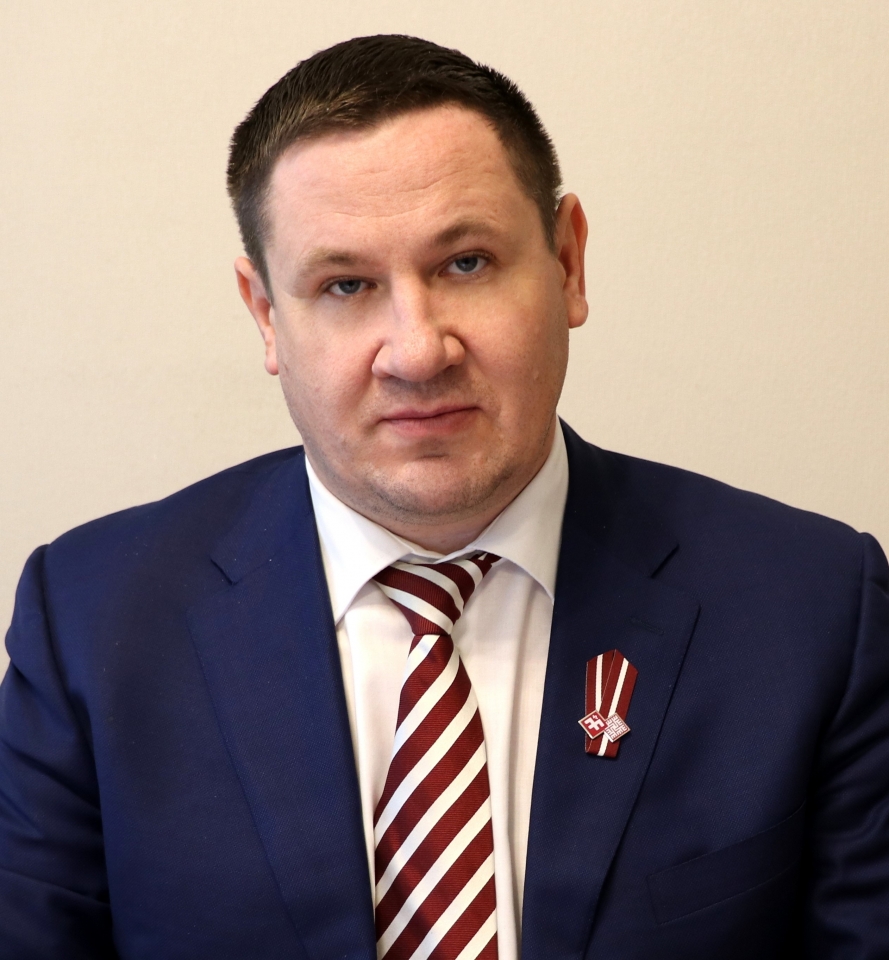
Māris Liopa, Chairman of the Forest Certification Council of Latvia, and Pauls Rēvelis, editor of zemeunvalsts.lv, speak with Egils Helmanis.
As a result of the municipal (administrative-territorial) reform, the municipality with the largest population in Latvia has emerged alongside the capital. Hearing this conclusion – the largest municipality in Latvia – how does the chairman of the municipal council feel?
It is a huge responsibility. I like the connection to historical events; for example, I drive through Latvia and see a rural school that was built by local residents with joint efforts many years ago – someone invested their labour, someone sent horses to help, someone donated timber – with the idea that the school would exist, operate, persist, and continue. That is the responsibility I mentioned – if there is no connection to what our ancestors left behind, there will be no future.
How about patriotism in Ogre Municipality?
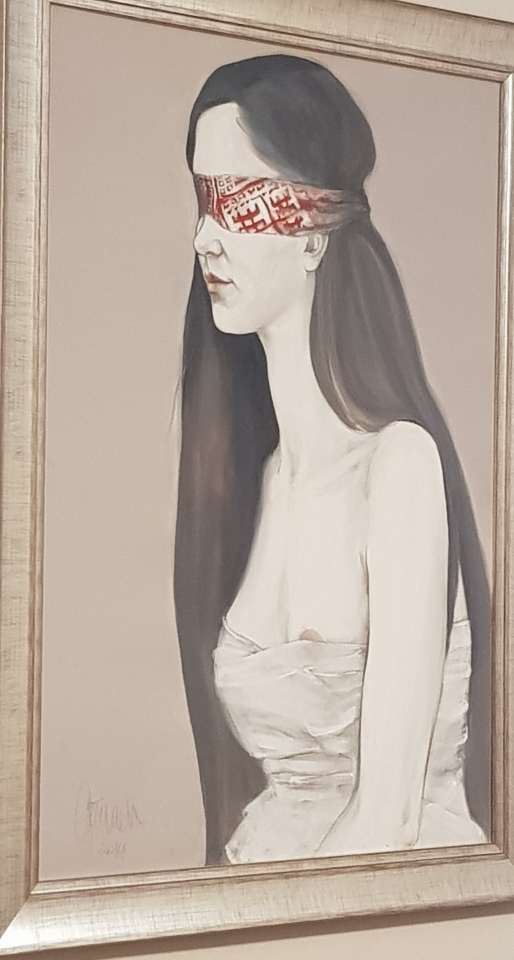
Very good! Patriotism does not start with slogans alone. On the wall in my office, there is a painting called “Blind Patriotism” (second image). Patriotism must also exist in the economy. This year, an important decision was made in the Ogre Municipality Council – to create an agency and manage the forests owned by the municipality ourselves. The municipality owns more than 1000 hectares of forest – a sufficiently large area. Until now, if necessary, some land was sold or swapped, or the forest was harvested, and the clear-felling was left to grow over naturally, remaining unmanaged. What is important: if you plant a forest, you do not plant it for yourself, but for the next generations. It is your work and contribution so that Latvia is better for our descendants than we received it.
Lately, this is even more noticeable – we often live or circulate in a specific circle of people (now referred to as a “bubble”), often assuming that “our own” understand things best. Ogre Municipality is special because of its history: the now-former Ķegums Municipality is home to the birthplace of Andrejs Pumpurs, the author of the epic “Lāčplēsis”; in Lielvārde, there is the Pumpurs Museum, and furthermore, the place where, as described in the epic, Lāčplēsis fell into the depths of the Daugava in his fight with the Black Knight is located near Lielvārde. This is our land, our past, our legacy, our pride. For instance, in the Lielvārde region, there is the well-known Edgars Kauliņš, who more than once saved local families from repressions and hired legionnaires and large landowners who had returned from exile in Siberia. The authorities could do nothing to him because he was a party member.
We would say – a national-communist.
It does not matter what party you are in (if you are in one), what matters is that you stand for your people and their interests.
Why do I mention E. Kauliņš? He is known, remembered, and recognized in Lielvārde, but elsewhere – very little. The younger generation has not even heard of this person. We want to create a museum in the municipality where the existing information is summarized logically and sequentially. Where would we start? For example, for a younger person, many things are known in fragments; they do not “fit” into one clear picture. The idea of the museum is as follows: in one room, the Latvian riflemen, then the War of Independence and Bermont, then the founding of the Latvian state, then the occupation, partisan battles, legionnaires, resistance, deportations, the Awakening, the barricades, May 4, 1990, joining NATO and the European Union. A sequence that provides historical clarity. Our history is complicated enough that, for example, foreigners would not understand it if presented in a selective way. In Latvia, the majority of society did not support Nazism, but we fought alongside such people. Why? There is a saying: “We did not have the right ally, but we had the right opponent.” The opponent was the right one – that is important!
In a historical sense, the young generation must be given a clear vision – what has been, what has happened. I will add that this is not only the work of a museum, but also management, politics, and the heritage left behind. People talk a lot about this, but one must start acting, looking, and operating in the long term. When you do something or start doing something, you must understand what this work will bring in the long run. One must think not only about what to eat today and tomorrow, or how to sell grandfather’s medals and buy a “Beemer”, but look at the immaterial value of the medal and the “Beemer”. The medal has a different, much deeper and more serious value.
Speaking of the young generation, we see that they tend to uncritically accept dangerous or strange things or criticize what they do not actually understand.
The biggest problem of our national state is the lack of state-level attention or priority for the education system. The young generation needs to be educated. There are a number of seemingly modern and popular ideas that are actually stealing our children from us. This is a problem of the education system, a problem of the lack of values. Slogans must align with real life and what is happening.
For example, the current European Green Deal, which many perceive as a solution to environmental problems, but which is based on political-economic ideas.
The Green Deal has an unadvertised name – “You will pay more for everything.”
Continuing about state matters – we must evaluate the situation solely and exclusively from the position of Latvian interests. We are self-sufficient enough. If there were as many of us as Americans – 300 million – we could definitely worry about the whole world, but there are far fewer of us, and Latvia is our only place to live. If we look at the experience of other countries, for example, how people live in Israel, which is literally surrounded by hostile Arab countries. In Israel, a lot of things, both at the state and economic and even military levels, are subject to the interests of the nation’s survival. We can learn from Israel’s experience. Where is the problem in acting like that in Latvia? Can we afford to think about everything and everyone, forgetting ourselves and our own interests?
Our nation and culture are unique enough in the world context for us to be able to afford to think about and take care of ourselves.
I like the anecdote about the Indians.
“What do you call those who conquered you several centuries ago? Occupiers?”
“No!”
“Then what?”
“Investors.”
Returning to the question of work in the municipality – one must work responsibly, remembering and knowing history, while looking into the future. We try to work so that in the future, our work does not have to be redone by someone else. If, while walking along a forest path, you occasionally take a step aside, after 10 km you will no longer find the road. There must be a link to ancestors, experience, and values. Family is of great importance; I know this well not only from personal experience but also from my work at the National Defence Academy, where I taught military close combat. At around 12-13 years of age, a young person starts looking for authorities outside the home. It is very important whether they find an athlete, a coach, a choir conductor, or a criminal authority that gives them direction in their future life path.
You have travelled a lot. How does Latvia look against the background of other world countries?
A very big misfortune in Latvia is the widely practised “wailing-ology”. When Soviet troops entered Afghanistan in 1979, there were about 15 million Afghans. Now? >30 million. So the nation has doubled in number. We restored independence in 1990, became free, and... have lost about 500 thousand people. Afghans have experienced long periods of warfare, internal unrest, but the nation has doubled. We are free, we are not persecuted in our own country, but... For example, people go to Somalia, invest, try to act so that the situation in the African country stabilizes and the country develops. Unfortunately, Somalia can be called a high-quality destroyed country. Every political force there has its own army. Imagine something similar here.
From travel experience, which is not always the best, I have learned a lot. For example, we are travelling with an interpreter in Afghanistan’s Panjshir Valley. Che Guevara was mentioned in conversation. I asked if he, as a personality, is appealing to the interpreter? The answer was: “No! We have our own heroes!” An excellent answer! We have our own!
The lack of such answers is our, Latvia’s, problem. Whether we talk about Oskars Kalpaks, or Vilis Janums, or Herberts Cukurs, or... Latvia has a tendency to follow foreign brands and celebrities, even though we have our own to be proud of. That is not right!
Some years ago, representatives of the Chinese Olympic Committee had counted and calculated the number of Olympic medals in relation to the numerical size of each nation. A question arose about us: how is that possible?
An Arab sheikh was asked: “What do you think about your and the country’s future?”
“I drive a Mercedes, my son drives a Land Rover, my father rode a camel, my grandson will also have to ride a camel.” “How so?”
“Hard times create strong men. Strong men create easy times. Easy times create weak men.”
We have very good examples: the 90s. Of course, I would not wish such a situation on my children, but if I remember what I experienced, it was a time with huge responsibility, huge changes, which hardened and gave experience.
Once, at the beginning of my time as a deputy, an event took place at the Ogre open-air stage. We decided to go, have a look, assess the situation. I walked to the stage, stood waiting for a colleague who was running late, talking on the phone. As I finished the phone call, a big guy came up to me and said: “Give me the phone!” Being big, he probably underestimated me because I’m not small either. I replied that I was ready to give it, but it was somehow awkward in front of people, inviting him to step aside. Alright! We stepped aside... It was clear that the phone stayed with me!
The question follows from what you said: Ogre and public order.
The proximity to Riga gives a certain influence, but we maintain a level of safety and order. The municipal police are working successfully. At one time, we carried out personnel changes because... As experience shows: girls tend to envy those prettier than themselves, boys – those more successful than themselves. Envy hinders any work and often leads to unnecessary consequences.
It looks like the merging of surrounding municipalities into Ogre Municipality is quite powerful.
It is good that we “got” Ikšķile Municipality. Very good! In Ikšķile Municipality, if we look at the voting by polling station, the mood was against Ogre; they voted for their own. But! If we look at the map – as a result of the previous reform (2009), Ikšķile Municipality, if one can say so, “gnawed” into the territory of the city of Ogre.
The leader of a municipality feels the merger very practically and physically: one must know the municipality, one must be in the municipality, one must travel around it. In the “old” municipal territory, I have purposefully travelled every road and track. If you see the situation or what is happening yourself, you understand the essence of things much, much better. If you are in the municipality’s leadership, you must know how people feel, how they live, and where they live, what their needs are. I cannot be told something, because I know the municipality quite well. I will add that I have not fully toured the new municipality yet – I know about our resources – there are forests, there are fields, there are bogs, there are the Daugava and Ogre rivers.
Why do I emphasize knowing the municipality well? You cannot take responsibility for a group of people if you do not know their needs. Here, my experience from Tibet is very useful, where people write their wishes or prayers on small cloths and tie them to tree or shrub branches, place them under a stone. If you see such a cloth in the mountains, you must not step over it; you must go around it or crawl under it. Why? You must not step over someone else’s wishes or prayers. That is important. My work in the council is service – I have come to serve the people. For example, if I am at a church service and someone approaches me with a request, I try to remember and fulfil it, or pass the news on. Yes, I have dozens and hundreds of important issues, but – to that person, this detail in the perception of others might be important! My duty is to take that into account. The gradation of importance is one thing, but people appreciate very concrete, even small things. Yes, you have to be able to talk to people! You cannot smirk, saying: “You are just a simple countryman...” He is no worse than a city dweller. Not at all! Latvian identity is in the countryside, and it must not be lost.
The Saeima elections are coming quite soon. Political scientists promise 2022 will be very colourful – virus, high energy prices, restless neighbours. How do you look at the upcoming early October?
The National Alliance must act so that we and our ideas are represented in the next parliament. The so-called vector system operates in politics. Namely, each issue comes from somewhere, someone directs or pushes it, and one must be able to both read and understand it. If you cannot, there is nothing for you to do in politics. For example, in Ogre, we were building a dam; entering the river about 1.5 metres, the water rippled, waves hit the opposite bank, slightly eroding it. That is how it happens in nature. Politicians' decisions erode other banks, and it happens much more seriously and severely. If a person does not understand this situation and is unable to predict where the wave created by his decision will hit and what it will erode, I repeat, there is no place for such a person in politics. The consequences of decisions must be understood. A story from what I have experienced: during the Covid situation, the decisions made caused problems in the treatment of oncological diseases. Neglected oncological conditions are also the responsibility of politicians. Changes (good or bad) cause far-reaching consequences that decision-makers must foresee. If that does not happen, the result will often be devastating.
How do you assess the decision on the link between vaccination and employment? There are quite a lot of people who are officially banned from working as of December 15.
During the pandemic, I visited Norway – a country with a high percentage of vaccinated residents. At that time, there were practically no restrictions there. Here is the answer – why is patriotism needed? (Of course, this is just one example) Lack of faith in one’s own country leads to serious consequences. 62,000 unvaccinated residents, who potentially remain without work, are the consequences of such disbelief. It is very, very sad. In principle, these people are pushed away at the state level. How does this happen? By seeing how it is decided, how decisions are made, how they are delayed. An entrepreneur would quickly go bankrupt with this style of decision-making. I will compare it with sports games, where there are season players and play-off players. The latter are ready for any complication and have a very high sense of responsibility.
Is it a recent political trend – not to decide immediately, but to postpone, consult, postpone again, etc.?
It is an inability to take responsibility. For example, the three of us may have our own solution to an issue. Moreover, each has their own, suitable, and correct one. What to do? Reach an agreement!
There are very, very many Cabinet of Ministers regulations – several thousands, their number is only growing. Parties say – administrative burden must be reduced, the bureaucracy must be smaller. The Latvian entrepreneur is already choking on all this and cannot support it. Until there is a willingness to review and simplify even these Cabinet of Ministers regulations and their volume, for example, I will not be able to tell my employees: “It is time for you to go into business, the volume of work in the council has decreased.” For example, Cabinet of Ministers regulations about dry toilets and the need to register them. Two people are dealing with this issue in the municipality. If the Cabinet of Ministers thinks of something else, it will again require work and investment. I am truly waiting for an initiative to start unravelling this knot of nonsense.
The situation in the country cannot be considered good or normal if it is possible to tell an official “Go there and there and take a look!” I will emphasize – this is not about a specific violation, but sending an official to “look at the situation”, for example, in some company or territory, or property. What does this often end with? With problems in the “object being looked at” or problems for the owner.
The question of reducing the administrative-legal burden has been current for at least 20 years. Who should start acting?
In my opinion, balance is needed in politics. As soon as that is achieved, one can start studying possible directions of action. If one list gets 50% + 1 vote in an election, only one situation can develop – there is balance, or there is not. For example, Riga remained as impassable as it was during the winter. It is visible that practical understanding is lacking. Our country is led by people with a humanities education, where I see a problem. The thoughts of these people often “circle in space”; for example, one cannot always think about benefits, support, or compensation. One generation that has become accustomed to such thinking has almost grown up. Do we need another one? One must work and let others work. We recently opened the Pārogre industrial park with 200 new jobs. What happened? At the state level, problems were created (or invented) by the Ministry of Finance, which had read (found) something else in the documents.
Control. Rarely does anything happen without this word, because – whoever works or operates must certainly be controlled.
Those who want to control should smell turpentine, and the craving to control will pass. For example, my spouse fell ill with Covid... They called her, told her not to go anywhere, not to make contact, but they were not interested in her treatment. The benchmark was to check something, forbid, and fray nerves.
The leitmotif for such a situation is the well-known story – a person is promised – you will be rich, successful, happy, but – your neighbour will get it all double. What did the person choose? This problem, which I described a little figuratively, has been “dragging on” for years. Mostly, those who want to control are those who have nothing to do and who do not know work. And that is what they consider their main task. The problem is in the fact that the controller does not understand or is not smart enough to understand that his “over-controlled” entrepreneur also earns a salary for the controller himself. I know, many working in the public sector unfortunately do not understand who earns money for them.
The most serious plans in Ogre Municipality for the near future.
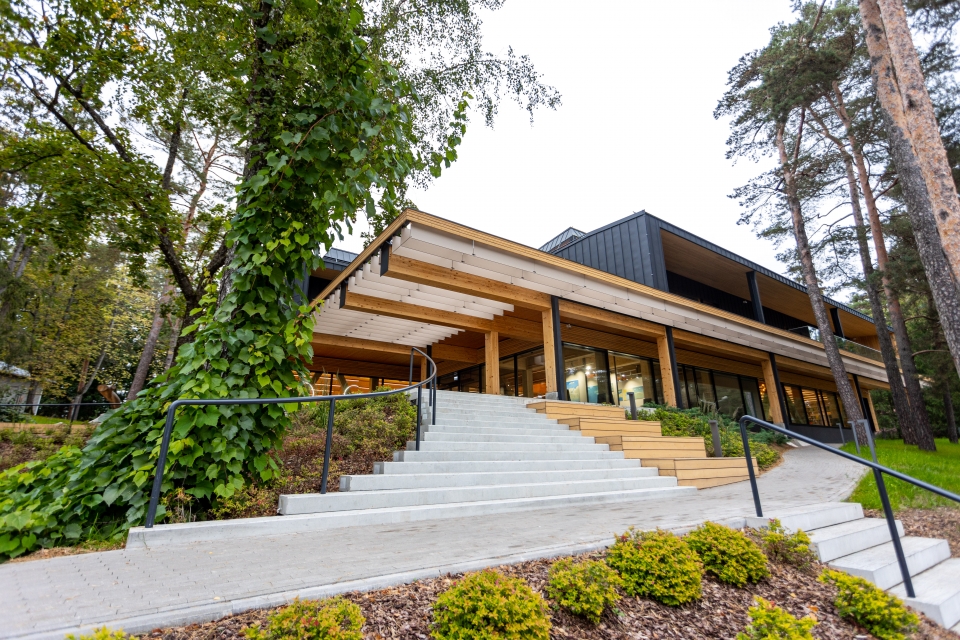
The museum, which I mentioned at the beginning of the conversation, and the musical theatre. We recently finished the Ogre Central Library. The plans are to build the Ogre River nature valley instead of the Blue Hills* with much more ambitious ideas and vision.
Speaking of plans, a good comparison from sports life is appropriate: if Riga “Dinamo” hires figure skaters, nothing good will come of the hockey game. There must be someone who fights at the board or the goal. The more fighters there are, the better... I have had experience, namely, once a very promising guy came to training, who held the puck well, saw the field, but was afraid to “go into the board”... Fighting must be mastered and taught! Fighters in society are not always respected! Why? That also means harsher and more direct language, which perhaps offends someone. There are no friends at work – you either get it done or you don't. We in Ogre Municipality have the ambition to compete with the other big cities of Latvia; I think that is the reason why we are moving forward. We are driven by the desire to be better. It must be so!
* hitherto the Ogre and Ikšķile municipal agency “Development Agency of the tourism, sports and leisure complex "Zilie kalni"”
Photographs by Andra Marta Babre, Ogre Municipality Council and zemeunvalsts.lv have been used