
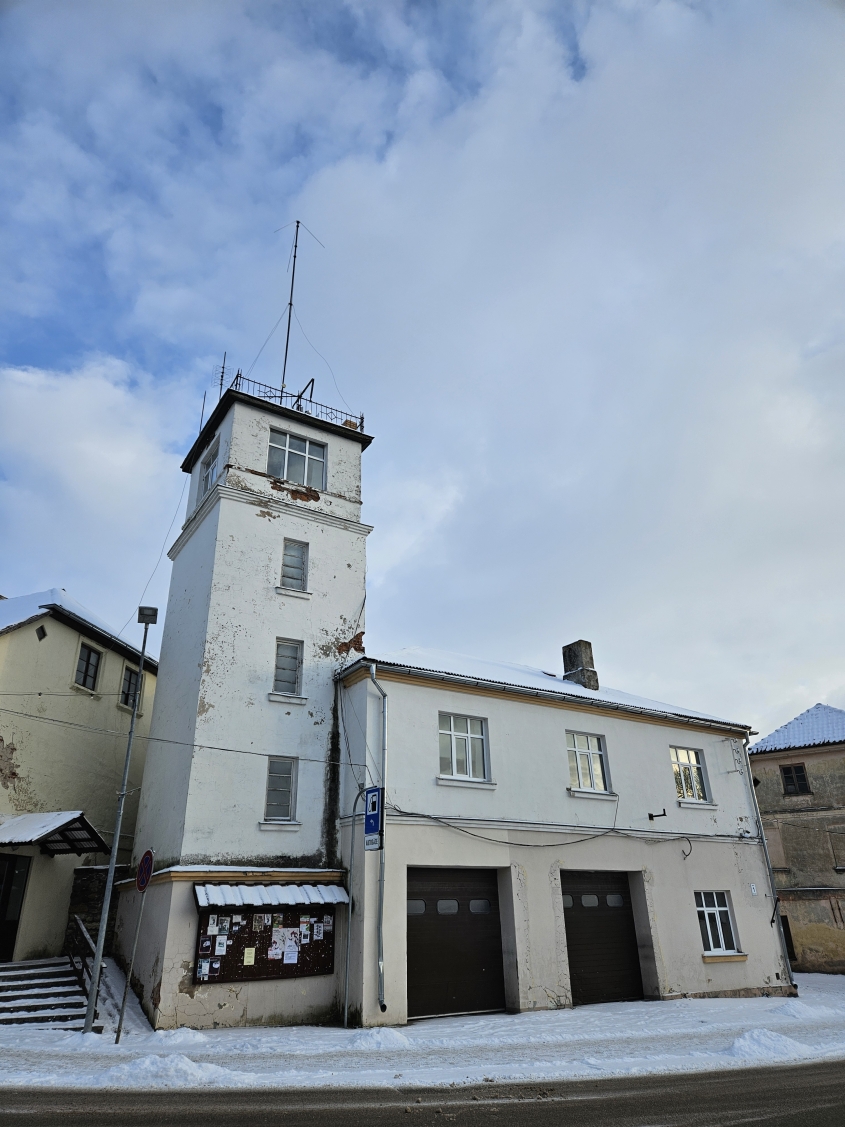
At the end of 2022, news flew around Latvia regarding the State Fire and Rescue Service's (or rather, the Ministry of the Interior's) plans to close less busy fire stations, using the classic, deceptively convenient phrase – temporarily. It seems no one has yet researched how often something announced to the public as a temporary, short-term measure turns into a long-term or permanent reality. The ministry's and the service's plans, followed by their subsequent decision, worried many residents in Latvia's districts, who concluded one very simple thing: the possibility of receiving fast and timely help is moving further away. That would be one part of the problem.
Another, or perhaps the second, issue that remains relevant is the premises left behind by firefighters and rescuers and their management. As symbols of state incompetence and lack of skill, many in Latvia are familiar with certain derelict buildings in the very centre of Riga, or some still-abandoned manor, or, for example, the harsh, oft-described tales of Kaucminde...
The third issue that came to light while unravelling the story of a building and the local residents' plans in Sabile is the relatively recent administrative-territorial reform (or regional reform) and its realisation or progress in practice. Figuratively speaking, have the fruits and benefits promised by the reform reached the districts and touched the manors and shacks, paths and highways located within them, etc.? In other words, is every parish, every village, every small town, and every remote location clearly visible from the regional centre? (It must be emphasised that the terms “small town” and “outskirts”, often used by bureaucrats in a condescending manner in Latvian, are not always used in their true sense, as small towns exist everywhere in the world, and there is no shortage of remote places; the main point is what meaning is attributed to the designation of such places and towns.)
On the situation and the problem
zemeunvalsts.lv listened to the story of Sabile residents about the events in the town with and around the building of Sabile's former fire depot. The story prompted us to investigate the situation in more detail. We intend to publish several articles, examining certain nuances month by month (step by step) and asking questions of Sabile residents, municipal council staff, and decision-makers.
A fire station, the temporary closure of which we discussed previously, is not just about personnel and equipment, but also, naturally, the building and premises. This time, we are not talking about how it has happened that for 30 years there has been no investment in the desire and conviction of people to work as firefighters, rescuers, police officers, in medicine, etc., because the closed depots are by no means in the best technical or comfortable condition. The point is that local governments do not always have a clear plan, goals, or conditions for how to deal with real estate that has been "left over after some state-level optimisation".
Sabile's fire depot was closed some time ago. The association “Sabiles attīstībai” (hereinafter – the Association) had plans for the potential future use of the depot building. When the decision to close it was made, a struggle was still ongoing, with the town and parish residents and representatives trying to change the situation – asking what would happen in terms of fire safety if the town did not have its own depot. They were neither heard nor listened to.
The State Agency for Provision (an institution supervised by the Ministry of the Interior), which held the relevant real estate, realised that it did not need the building. It was decided to transfer or sell it. Before the State Real Estate Agency decides to sell a building (or other property), this property, as stipulated by law, must be offered to the local government – to take over the building as its own property free of charge. The State Agency for Provision sent the relevant proposal to the Talsi Municipal Council, asking whether the region needed this building. At the end of March 2023, the council decided that the region did not need it.
A local government can take over state property if it plans to use it for the implementation of its autonomous functions. In the opinion of the residents of Sabile, the council made this decision in the spring without a detailed assessment of the situation and circumstances. It is possible that the deputies did not consider that the building could be used for more than just firefighters and that other activities could be organised in the building that have no connection to firefighters or rescuers. As the local government refused to take over the property, the building went to auction in the subsequent process. As far as can be understood, it was purchased by a private individual who, it seems, is trying to use a well-known, perhaps slightly forgotten style in Latvia – buy and sell, because the auctioned property can be found on the portal ss.lv at a higher price than it was obtained for at auction. If you wish, you can buy it!
What were the Sabile residents planning?
It must be emphasised that the Association had real plans for the future use of the former depot. One thing, however, must be recalled – as the VUGD has been facing a lack of funding for decades, it is clear that handing over the building to auction proves one thing – when talking about the temporary closure of the depot, local residents were plainly deceived, masking the actual liquidation of the depot with a veil of “temporariness”.
The building is located in the cultural-historical centre of Sabile; it has all the necessary infrastructure and is in a normal technical condition to be made publicly accessible by organising various events needed by local residents, which, as determined by legislators, would correspond to the functions of the local government. Speaking of costs, which are undoubtedly important, we could be talking about ~8000 euros per year.
The Association had prepared a draft project and a concrete plan for the potential location of a community centre, market, competence centre, as well as public toilets in the building; such a plan both meets the functions of the local government and is necessary for the local residents.
The dissatisfaction of Sabile residents has been earned by two important processes or events (it would be more accurate to speak of “things that did not happen”) – namely, that in the historical centre of the town, all things considered, there will now be a third building and territory that does not do the town any honour. Previously, in a similar way – via auction – the former kindergarten was legally sold, which is slowly being covered in snow during winter and overgrown with weeds during summer. Equally unpleasant is the question of the cultural centre, which is waiting and waiting to be commissioned. This is also a question of the foresight of decision-makers and processes, because, as we know from what we have read and seen, in many places properties in historical town centres are both a source of pride and joy, as well as hard work and investment, and a struggle, because maintaining buildings and property in good order requires time, finance, and coordination, with the latter often causing the most trouble. Why this is not the case in Sabile will be covered in the continuation in February.
Sources:
https://www.lsm.lv/raksts/zinas/latvija/vugd-plano-islaicigi-slegt-mazak-noslogotos-postenus-ugunsdzeseju-arodbiedriba-cel-trauksmi.a478735/
https://zinas.tv3.lv/latvija/sabiles-iedzivotajus-satrauc-pilsetas-vugd-postena-slegsana/
https://m.ss.com/msg/lv/real-estate/homes-summer-residences/talsi-and-reg/sabile/bghgmi.html