

During a visit to Helsinki, Hubert Hasenauer (Hubert Hasenauer), professor of forest ecosystem management at the University of Natural Resources and Life Sciences, Vienna (BOKU), praised the traditions of sustainable forestry both in Finland and in Europe as a whole. He believes that on forestry matters Europe should not be compared with tropical regions, and he urges the use of wood in construction.
“Our task is to combine forestry with the fight against climate change. Even in such a situation, Europe and Finland should not be compared with countries in the tropics. Our forestry is definitely sustainable. Our traditions reach back more than a century,” the professor stressed in a lecture at a seminar organised by the Finnish Forest Industries Federation (FFIF).
Hubert Hasenauer noted that since 2010 the forest area in Europe has been increasing by an average of 44,000 hectares a year. Europe is the only continent where forest area is growing. In Europe the volumes of wood used both in construction and in renewable energy production are far higher than the global average. In Finland's forests, for example, the volume of wood growing exceeds the volume harvested. Since the 1970s the volume of wood in Finland's forests has increased by 67%.
Reducing the volume of wood harvested has been proposed as a remedy for global warming. If there were more trees, forests would absorb more carbon from the atmosphere. In Professor Hasenauer's view, however, reducing harvesting would not be a sustainable solution: “The key is to understand the difference between carbon storage and carbon sequestration. As forests age, carbon storage continues to increase slowly, but carbon sequestration decreases. In older forests, trees use less carbon for growth, and a greater share of it goes into cell metabolism.”
As trees grow older and more massive, the risks also increase. Taller old trees are more easily brought down by storms. Fallen trees, in turn, attract wood pests, which cause further damage. Professor Hasenauer points out that an increase in the amount of flammable material in a forest raises the risk of forest fires. For these reasons he calls for greater focus in the climate field on storing carbon in wood products.
“Forest carbon storage does not have to take place only in the forest. It can also take place in durable wood products, such as wooden buildings. In fact these products are better than the forest: by storing wood in buildings, the forest the wood came from can regenerate and sequester carbon more efficiently than an old forest.” Professor Hasenauer stressed that not all parts of a felled tree are used in building materials – depending on the species, this is 50-60%. The rest – branches, foliage and bark – forms by-products that are used to manufacture various products and to produce energy.
“Using wood instead of concrete brings an obvious benefit for the climate, because the carbon emissions of concrete are very high. In fact the greatest climate benefit that can be gained from wood comes from using it in construction.”
Active forest management can combine timber harvesting with carbon sequestration
In Finland, home to Europe's most extensive forests, there is a lively debate about which measures in Finland's commercial forests would be most effective in curbing climate change – should the forest regeneration period be extended and harvesting reduced, or should harvesting continue at its present level?
To give this debate a firmer basis, the Finnish Forest Industries Federation (FFIF) commissioned the Natural Resources Institute Finland (Luke) to carry out a study on the question. The study assessed the growth, carbon sequestration and natural values of Finland's commercial forests using two forestry scenarios for the period from 2026 to 2055. The results of the study were presented at the FFIF seminar by Professor Jari Hynynen (Jari Hynynen).
In both scenarios FFIF set the same annual harvesting volume for Finland: 79.8 million cubic metres up to and including 2029, and 87.2 million cubic metres from 2030. The differences relate to the various management practices.
In the baseline scenario, the management of Finland's forests would continue as before, following the current forestry recommendations and the requirements of the PEFC and FSC forest certification systems.
In the second scenario, based on adaptation to climate change, forest management would be intensified in various ways. More mineral fertiliser would be used and young stands would be tended more frequently. Forest regeneration would be carried out using improved seedlings and seed. To adapt better to climate change, coniferous forest areas would be diversified, ensuring that broadleaved trees grow on one fifth of the area in sites suited to them. So-called continuous cover forestry would be increased, particularly for spruce forests growing on peatland.
Luke's study shows that intensifying management measures would bring a tangible and clear benefit. In the baseline scenario the annual increment (i.e. total forest growth) would remain slightly above 100 million cubic metres throughout the study period. In the “climate” scenario the increment would rise in each decade of the study. In the period from 2046 to 2055 it would approach 120 million cubic metres.
Without intensification measures, the planned annual felling volumes would begin to reduce the forest carbon sink after 2030. With intensified measures, carbon sequestration would continue to increase. Forest biodiversity would also improve – for example the share of broadleaved trees and the volume of deadwood, which are vital to thousands of species.
“To achieve this, the intensification measures described in the climate adaptation scenario must be implemented in full and directed towards the goal. Mineral fertiliser, for example, must be used in places where it delivers the best results,” Professor J. Hynynen stressed.
Karoliina Niemi, Forest Director at FFIF, stressed that it is precisely active forest management that makes it possible to increase forest growth while improving carbon sinks and climate sustainability. “Active forest management does not mean that forests are tended now and then, but that we know our forests and manage them throughout the rotation period,” said K. Niemi.
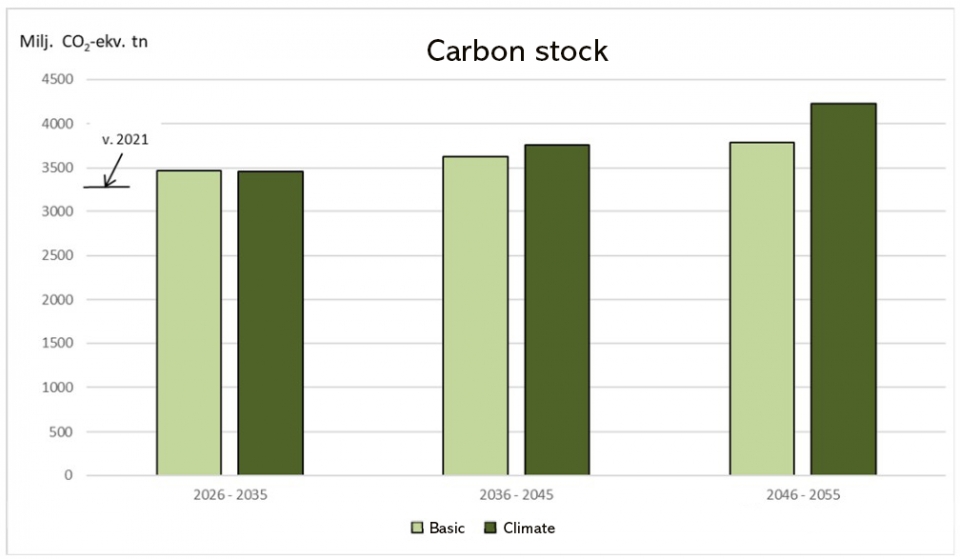
In the climate scenario, forest carbon stocks will steadily increase and in the final 10 years will be 28% higher than at the start of the assessment period. Source: Natural Resources Institute Finland (Luke)